Universe Today
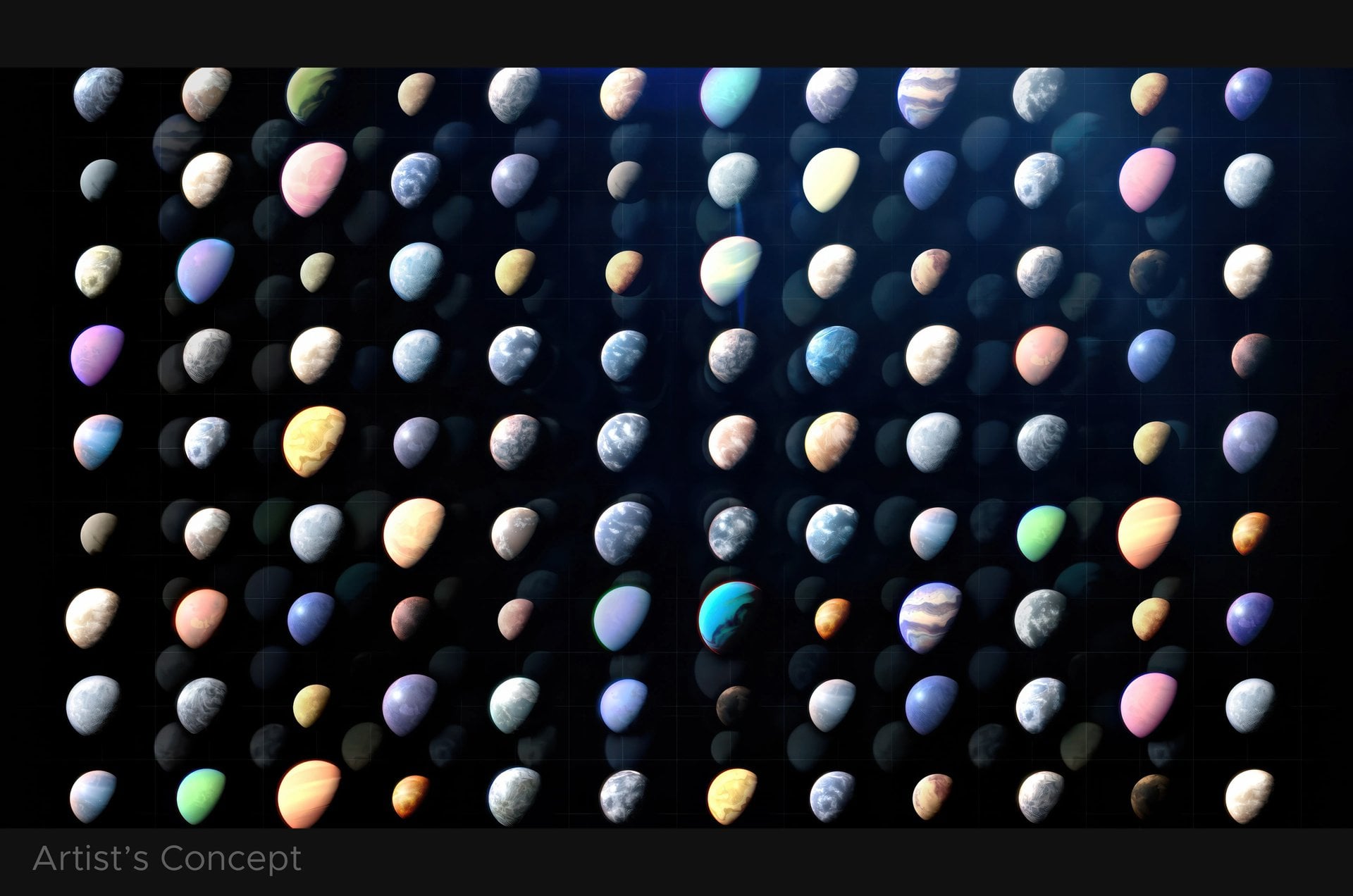
The exoplanet census continues to grow at a prodigious rate, with 6,273 confirmed planets to date and close to 20,000 candidates awaiting confirmation. What's more, the rate of discovery is accelerating, having passed 5,000 in early 2023 and 6,000 in September 2025. With such a large exoplanet census, along with improvements in instrumentation and data analysis, scientists are now focused on "exoplanet characterization" in addition to discovery. As always, the goal is to find planets that could be habitable for life as we know it (or "Earth-like").
This is challenging, since Earth-like rocky planets are small compared to other classes (gas giants and super-Earths) and orbit closer to Sun-like stars, where they are subject to considerable "signal noise." This challenge inspired an international team of astronomers to propose a dedicated facility called the Paranal solar ESPRESSO Telescope (PoET). This will collect solar light and channel it into the ESPRESSO spectrograph on the Very Large Telescope (VLT). This will aid astronomers by helping them identify the precise types of "noise" they need to comb through to find potential Earths.
The international team was led by Nuno C. Santos and his colleagues from the Institute of Astrophysics and Space Sciences (CAUP) and the University of Porto in Portugal. They were joined by researchers from similar institutes at the University of Lisbon, Coimbra, and the University of Geneva, as well as the European Southern Observatory (ESO), which operates the VLT and its Echelle SPectrograph for Rocky Exoplanets and Stable Spectroscopic Observations (ESPRESSO).
A Noise Problem
Of the more than 6,000 exoplanets confirmed to date, only 223 are terrestrial (rocky) planets. Of these, none orbit G-type main-sequence stars like our own and have mainly been found as part of systems orbiting low-mass, low-luminosity M-type stars (red dwarfs). This includes the closest exoplanet to the Solar System (Proxima b) and the seven rocky planets orbiting TRAPPIST-1. Nevertheless, scientists are confident that next-generation missions and instruments will make it easier to find Earth-like planets around G-type stars in the near future.
One of the most promising methods for detecting and characterizing exoplanets is high-resolution spectroscopy. This includes spectra obtained from an exoplanet's atmosphere as it passes in front of its star relative to the observer (the Transit Method) and Doppler spectroscopy measurements of the stars themselves (the Radial Velocity Method). When combined, these methods provide constraints on an exoplanet's size, mass, and mean density, which is vital to ascertaining its composition.
The greatest challenge to overcome is (as noted) the astrophysical ‘noise’ coming from the host stars, caused by sunspots, convective motions, oscillations, and magnetic activity. These produce variations in the observed line profiles and spectral positions, which can last for days or longer, depending on the star's rotational period and long-term magnetic cycle. The convective pattern of plasma on a star's surface (stellar granulation) is also a source of variability that can drown out signals.
To compensate for this interference, astronomers use different approaches to model the signals produced by these phenomena. But none have proven effective enough to correct RV time-series measurements required for the detection of Earth-like planets. The exoplanet science community has recognized that the processes driving stellar variability need to be identified in detail. This will allow astronomers to account for stellar noise and filter it from future signals, leaving signals generated by exoplanets intact.
Enter PoET
Since the goal is to find Earth-like planets orbiting Sun-like stars, the Sun is an ideal proxy, as it is the only one astronomers can fully resolve. Dedicated instruments with high-precision spectrographs have been developed to observe the "Sun-as-a-star," such as the High Accuracy Radial velocity Planet Searcher North (HARPS-N) solar telescope and the HARPS spectrograph (HELIOS). The main drawback is that only disc-integrated spectra are obtained, precluding a detailed analysis of individual stellar features.
According to the team, what is needed is a telescope that can offer three vital things:
- Spatially resolved spectroscopy with very high wavelength stability
- Very high spectral resolution to adequately resolve photospheric line asymmetries
- Extended wavelength coverage, for the simultaneous observation of thousands of spectral lines probing different physical conditions.
This, they claim, can be achieved by linking the ESPRESSO spectrograph to a solar telescope - in this case, PoET. The solar telescope will observe the Sun at different spatial scales, corresponding to sunspots and solar granules, and send the light it gathers to ESPRESSO via optical fibers. The overall system involves three telescopes, starting with the main telescope (MT) developed by Officina Stellare. This telescope has a Gregorian configuration, standard for solar observations, and will observe small areas of the solar disc.
Two additional telescopes, the "science" and "imaging" refractor instruments, act as the pointing telescope (PT) piggy-backed to the MT. The MT will also receive support from a custom instrument known as SHABAR (SHAdow BAnd Range), designed to measure random fluctuations in Earth's atmosphere that cause refraction. The telescope is expected to be fully autonomous, with its operations overseen by PoET's custom software.
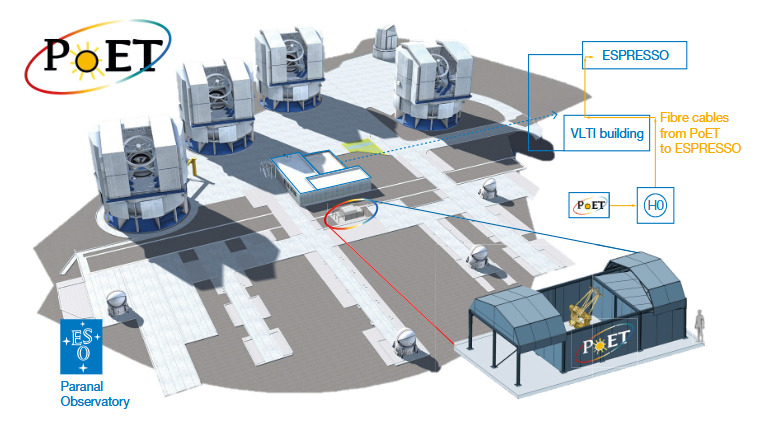 Illustration of the location of PoET in Paranal. Upper-right: Schematic of science fibers path from PoET to ESPRESSO (one floor below). Lower-Right: Dome concept with main telescope. Credit: ESO
Early in April, PoET completed its test observations and gathered its "first light." The observations showed that the system is working and can acquire spectra of the entire solar disc and specific areas of it. Over the next few weeks, the team will test and optimize the system before commencing scientific observations. Alain Smette, the VLT Operations Staff Astronomer and a co-author on the proposal paper, expressed great confidence in PoET's ability to assist exoplanet studies. As he explained in a recent ESO press release:
It is a great advantage to have ESPRESSO working in this way. By switching from the VLT at night to PoET during the day, we maximize the usage of this instrument to help us find and characterize exoplanets. Thanks to the exceptional location of the Paranal Observatory, the number of available days when weather conditions are suitable for observations of the Sun is expected to be very similar to that for nighttime observations.
Further Reading: ESO