 Universe Today
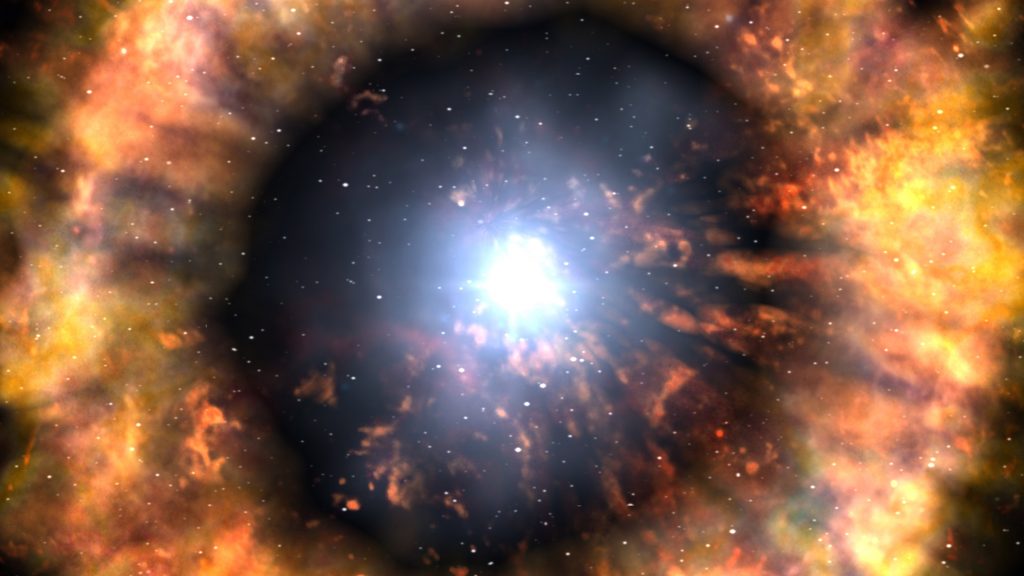
Astrophysicists have observed the x-ray breakout shock from a distant supernova for only the second time in the past couple of decades. Supernovae are known for lighting up the sky for months, and that long rise and fall of luminosity has been observed many times. But the x-ray breakout is important because it signals the very beginning of an SN explosion. It doesn't last long; only a few seconds at the shortest, and up to a few hours in some cases.
The Einstein Probe—a joint mission between the ESA, Chinese Academy of Sciences, and the Max Planck Institute for Extraterrestrial Physics—detected the soft x-rays from the explosion in March 2026. The x-ray flash, named EP260321a, came from an exploding star about 500 million light years away, and its detection triggered a barrage of follow-up observations from other observatories.
It quickly became clear that the flash was a supernova x-ray breakout, and the supernova was named SN 2026gzf. Two separate teams of researchers observed the SN's light curve over the next months and published two research letters in The Astrophysical Journal Letters.
One is titled "EP260321a/SN 2026gzf: The Faintest Shock Breakout Associated with a Broad-lined Supernova," and the lead author is Brendan O-Connor from Carnegie Mellon University. The other is "A Multiwavelength View of the First Type Ic-BL Supernova with an Einstein Probe X-Ray Shock Breakout," and the lead author is Jillian Rastinejad, a NASA Einstein Fellow at the University of Maryland.
"The earliest electromagnetic (EM) radiation from core-collapse supernova (SN) explosions is the shock breakout (SBO)," the authors of the second paper explain. "SBO occurs when the radiation-dominated SN explosion shock crosses the surface of an evolved star," they write. "This SBO releases a bright flash that shines at X-ray or UV wavelengths and persists over seconds to ∼hour timescales."
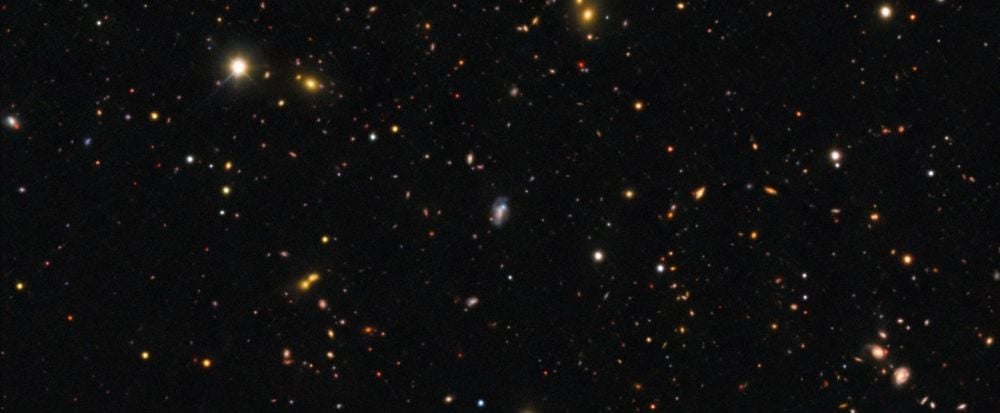 This image shows the field around supernova SN 2026gzf, detected via an X-ray flash captured by the Einstein Probe on 21 March 2026. The supernova appears as a bright blue dot within the galaxy at the center of the image. The image was captured with the 570-megapixel Dark Energy Camera (DECam), mounted on the NSF Víctor M. Blanco 4-meter Telescope at Cerro Tololo Inter-American Observatory (CTIO) in Chile. Image Credit: CTIO/NOIRLab/DOE/NSF/AURA
Observing an SN from its very first moments lets astrophysicists more thoroughly understand the SN. The flash can reveal the progenitor star's radius and structure immediately before it explodes. The breakout x-ray flash serves as an unambiguous starting point for the explosion, placing everything that happens after it in an accurate context. It also lets researchers study the physics of the shock itself, and allows deeper study of the circumstellar material (CSM) around the SN.
"As the earliest EM signatures of SN explosions, SBOs are direct probes of the very early stages of the core-collapse process, providing critical insight into the progenitor star mass and composition, explosion time, and rate of mass loss prior to explosion," Rastinejad and her co-authors explain.
SN 2026gzf isn't only noteworthy because its SBO flash was observed. It's also a broad-lined Type Ic (Ic-BL) supernova. These types of SN are known for their relativistic jets of material, and there's some evidence that a small number of them are responsible for gamma-ray bursts (GRBs). However, despite appearing similar to other Ic-BL SNe that did lead to GRBs, SN 2026gzf did not emit one. SN 2026gzf also emitted only a very weak flash, despite not being a particularly weak supernova.
“SN 2026gzf looks remarkably similar to other energetic supernovae that have been previously linked to gamma-ray bursts. Yet multi-wavelength follow-up observations using the most sensitive facilities found no evidence for a relativistic jet or an afterglow, which are typically seen in those events,” lead author O’Connor said in a press release. “One possibility is that the jet was ‘choked,’ either by the surface of the star or by circumstellar material surrounding the star.”
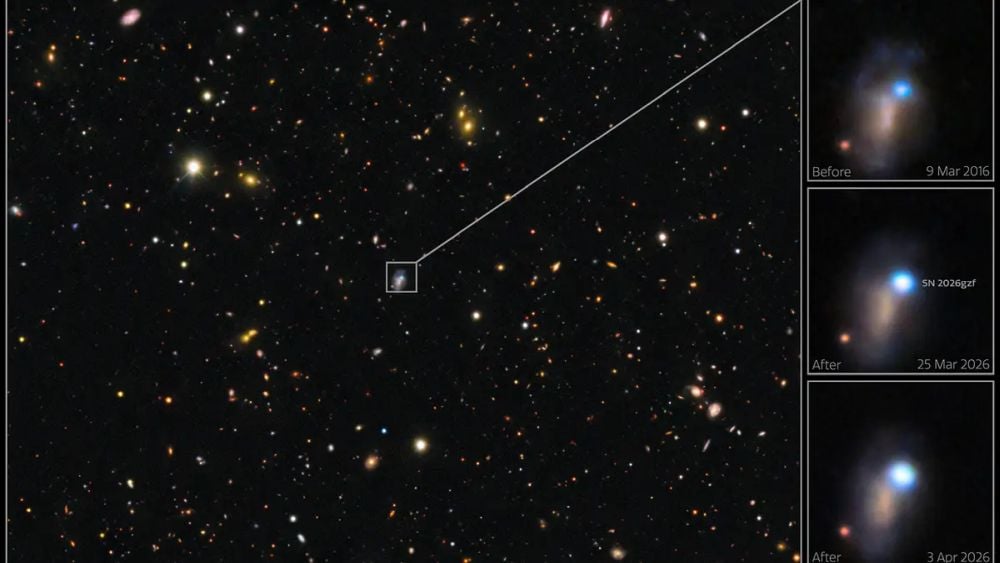 These images show how SN 2026gzf changed from early March to early April 2026. Images taken on March 25 and April 3, 2026 show the supernova brightening. An archival image of the host galaxy from March 9, 2016 reveals a bright blue source at the location of the supernova. These images were captured with the 570-megapixel DOE-fabricated Dark Energy Camera (DECam). Image Credit: CTIO/NOIRLab/DOE/NSF/AURA
Once the alert for SN 2026gzf went out, a large number of telescopes were trained on the explosion and its aftermath. The Chandra X-ray observatory, the Very Large Array, the Palomar Observatory, the Gemini North telescope, and many others took part. The Vera Rubin Observatory also took part. These combined observations revealed the progenitor star's structure right before it collapsed, and the nature of its surroundings, including the lack of jets.
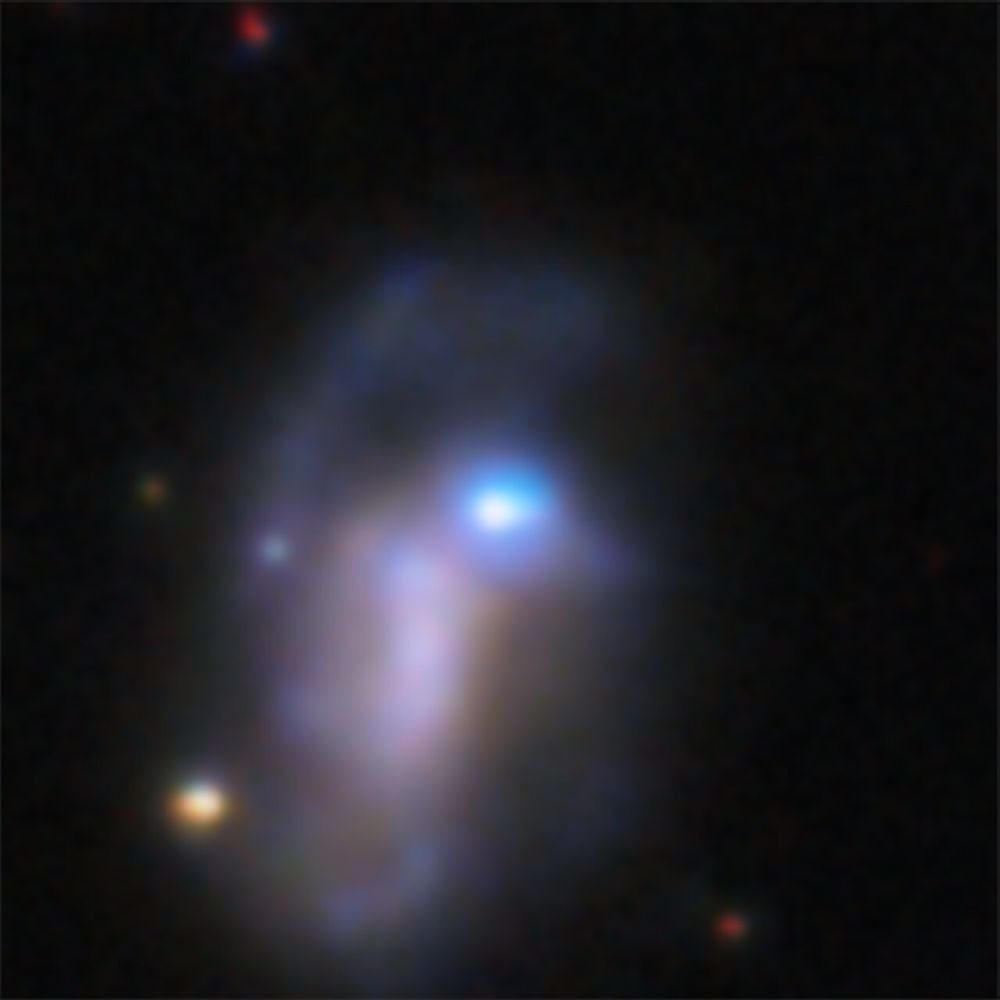 The Vera Rubin Observatory captured this image of SN 2026gzf. Image Credit: NSF–DOE Vera C. Rubin Observatory/NOIRLab/SLAC/AURA
“Our observations allowed us to study the physics of three pieces of this explosion: the X-ray shock breakout, the accompanying supernova, and the interaction of the supernova with material previously cast out by the dying star,” said lead author of the second study, Jillian Rastinejad. “With this information we were able to map out the structure of the material surrounding the star and understand the star’s violent lifestyle before it collapsed.”
“This is the first time we’ve mapped out the pre-explosion environment of a star that has been stripped of hydrogen and helium,” said Gokul Srinivasaragavan, a recent PhD graduate from the University of Maryland, and second author on Rastinejad's paper. “Going forward, I’m excited to observe more shock breakout events in similar detail to test if all stripped stars have a similar ‘lifestyle’ prior to collapse and what, if any, differences we see.”
All of the observations and analysis show that the progenitor was a Wolf-Rayet star. These stars are known to be depleted of hydrogen and helium, and are hotter than almost all other stars.
The observations also show that the progenitor star had two components to its CSM.
"Taken together, our observations and analysis favor a Wolf–Rayet progenitor star surrounded by either an inner region of dense CSM or an extended stellar envelope at ∼0.3 au," the authors of the second paper explain. "Our SN analysis also favors an additional CSM component beginning at ∼4 au, which is likely clumpy, aspherical, or otherwise porous."
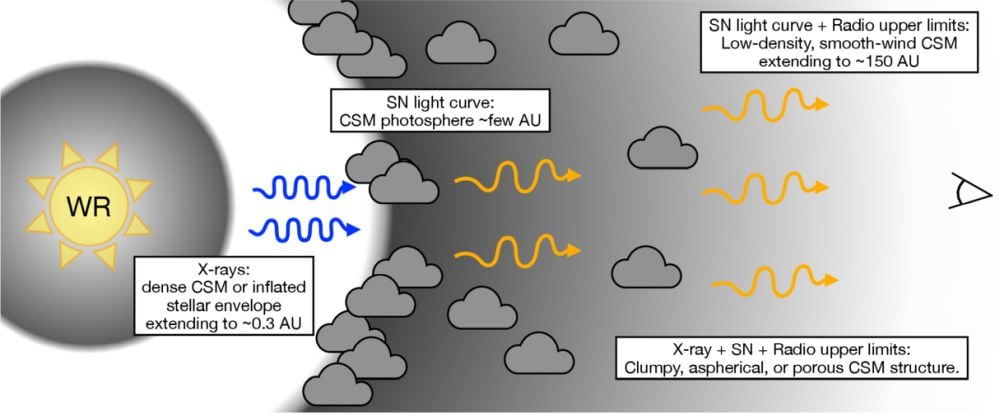 This simple drawing illustrates the WR progenitor and the two CSM shells around the supernova. "Our analysis favors two distinct regions of CSM that produce the X-ray (inner region) and SN light curve (outer region)," the authors explain. "Further, we favor an outer CSM structure that is clumpy, aspherical, porous, and/or characterized by a steep density drop outside the region probed through the SN light curve." Image Credit: Rastinejad et al. 2026. ApJL
"Our observations and analysis of EP 260321a and SN 2026gzf reveal significant insight into the circumstellar environment of a stripped-envelope, massive star just prior to collapse," Rastinejad and her co-authors write in their conclusion.
"We interpret EP260321a as a low-luminosity, thermally dominated shock breakout event associated with an otherwise typical energetic SN Ic-BL," O'Connor and his co-authors write in their conclusion. They explain that a fast ejection generated the SBO, but didn't generate bright x-rays, radio, or gamma rays along our line of sight.
These SBOs are notoriously difficult to detect, but the Einstein Probe is changing that. "While observations of shock breakout events have been limited over the last three decades due to the requirement of serendipitous timing of the explosion with observations from narrow-field instruments in 2024 January has enabled a drastic increase in their rate of discovery over the last few years," O'Connor and his colleagues write.
New missions like BlackCAT, ULTRASAT, and UVEX should allow astrophysicists to detect more SBOs. O'Connor and his co-authors say that together, these telescopes will help drive "a shock breakout revolution and expand our understanding of the deaths of massive stars and their pre-explosion mass loss and eruptions."

