 Universe Today
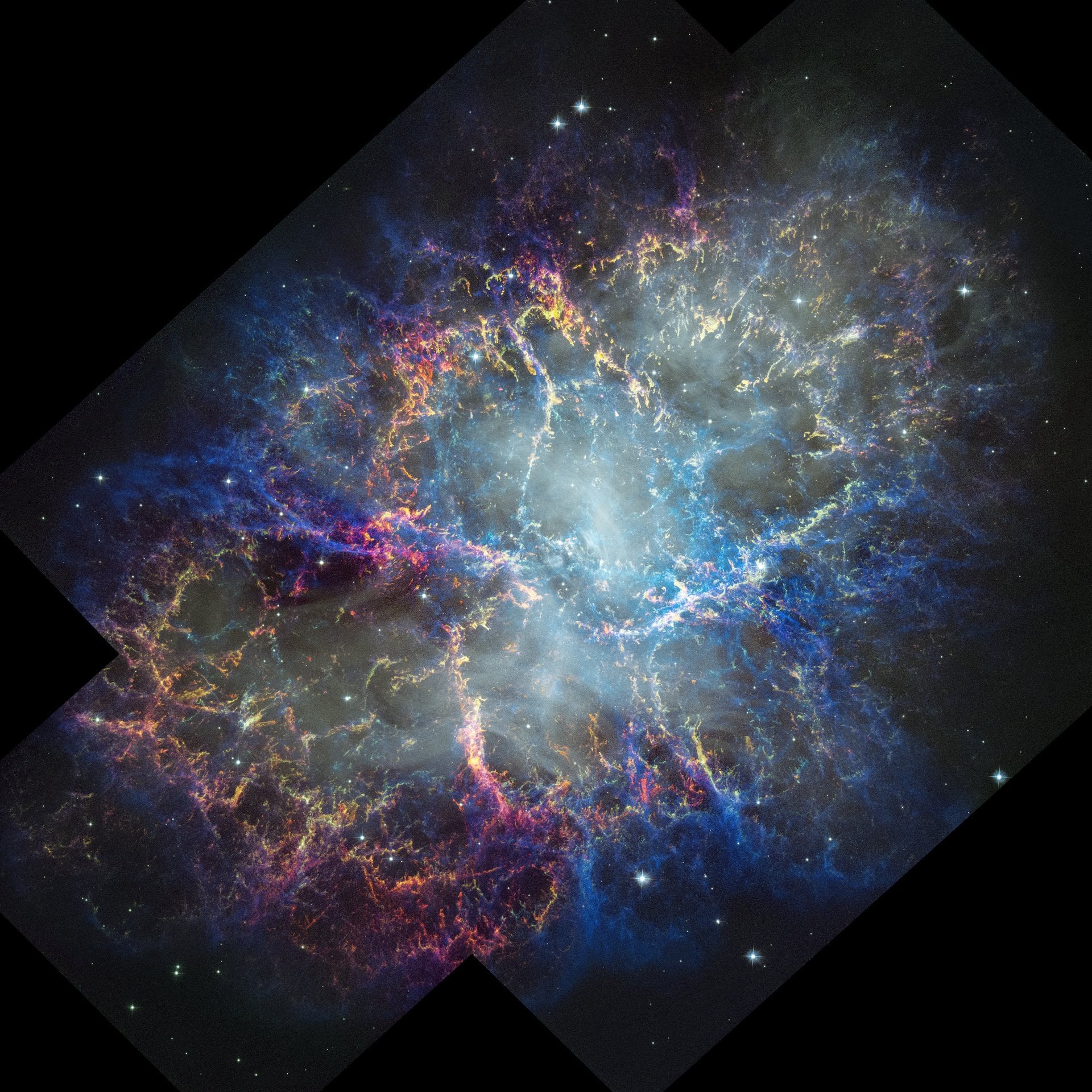
In 1054, ancient astronomers in several civilizations around the world witnessed what Chinese astronomers called a "guest star." It appeared suddenly in the sky and lasted for several months. Centuries later, in 1731, an astronomer discovered the Crab Nebula. It became apparent that the Nebula was in the same position in the sky that the guest star had appeared in.
The Crab Nebula was the first example of astronomers figuring out that a modern-day sky object corresponded with an ancient supernova explosion. That explosion left behind a special type of neutron star called a pulsar. Pulsars are highly magnetized neutron stars that spin rapidly and emit radiation from their poles.
The Crab Nebula is made of elements cast off by the exploding star and illuminated by the pulsar. The pulsar generates what's called synchrotron radiation, and that creates the multi-spectral bluish glow in the nebula's interior that's visible in radio, optical, and x-ray. The different coloured filaments beyond the interior are different chemical elements ionized by the pulsar.
Nothing in nature can resist change. As a supernova remnant, it was created when a massive exploding star blasted layers of gas into the space surrounding it. The gas is still expanding nearly a millenium later, and eventually it will disperse until there's no visible nebula at all.
The Hubble space telescope created one of the most well-known images in astronomy when it imaged the Crab Nebula in 1999. It used its Wide Field and Planetary Camera 2 to capture that iconic image. In 2009, that instrument was replaced with the much superior Wide Field Camera 3 (WFC3). Now, the Hubble has imaged the nebula again, this time with the WFC3, in an effort to track how the expanding nebula has changed.
New research in The Astrophysical Journal uses the Hubble's images to investigate how the Crab Nebula has expanded and changed over the 25 years between portraits. It's titled "The Crab Nebula Revisited Using HST/WFC3," and the lead author is William Blair. Blair is from the William H. Miller III Department of Physics and Astronomy at Johns Hopkins University.
"It has been over 24 years since the iconic Crab Nebula has been visited by the high spatial resolution eye of the Hubble Space Telescope (HST)," the authors write. "The expanding nebula is dynamic on these timescales, with many of the outer filaments of the nebula known to show proper motions of 0."3 or more per year." What this means is that astronomers can use the Hubble to watch how the nebula's outer stringy filaments expand outwards.
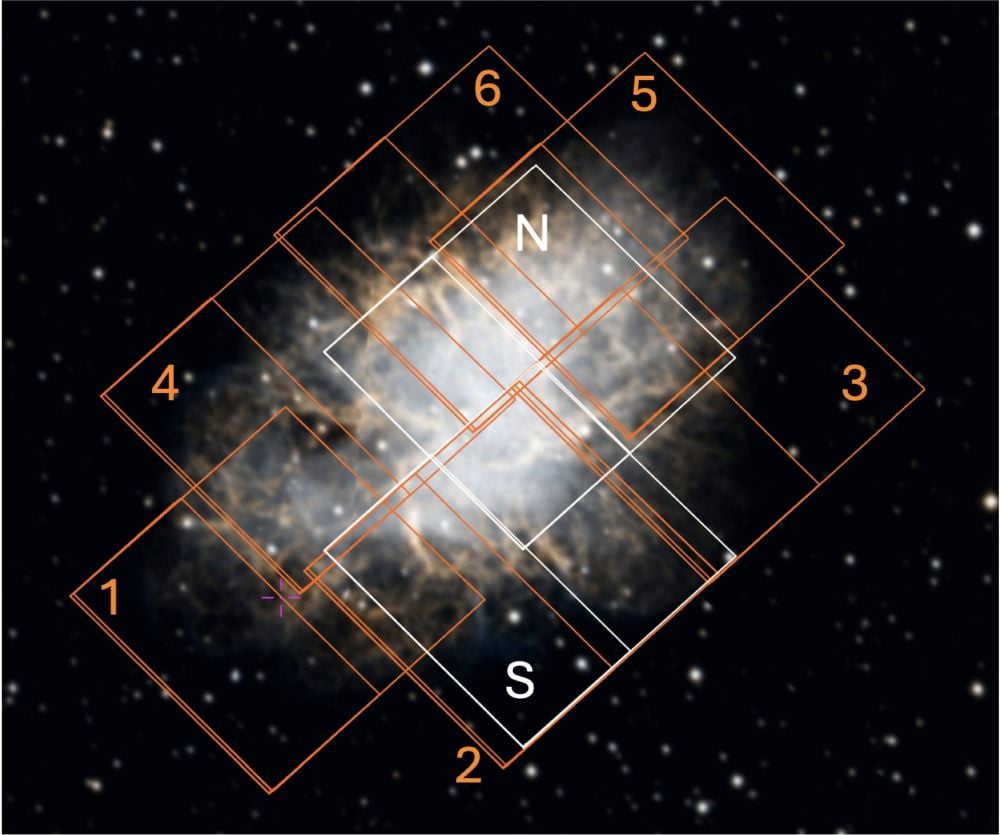 This image shows the WFC3 field locations on an image of the Crab Nebula from the Digitized Sky Survey. The two white boxes show the positions of the two Hβ (hydrogen beta) fields that cover the north/central and south portion of the nebula but do not align exactly with any of the six main mosaic component fields. Hβ is a hydrogen emission line that helps astronomers analyze the temperature of the nebula. Image Credit: Blair et al. 2026. ApJ
“We tend to think of the sky as being unchanging, immutable,” lead author Blair said in a press release. “However, with the longevity of the Hubble Space Telescope, even an object like the Crab Nebula is revealed to be in motion, still expanding from the explosion nearly a millennium ago."
The Crab Nebula's expansion speed is 3.4 million miles per hour (approx. 1500 km/second.) That's incredible compared to anything humans can do, but it makes sense since the expansion was driven by a supernova explosion.
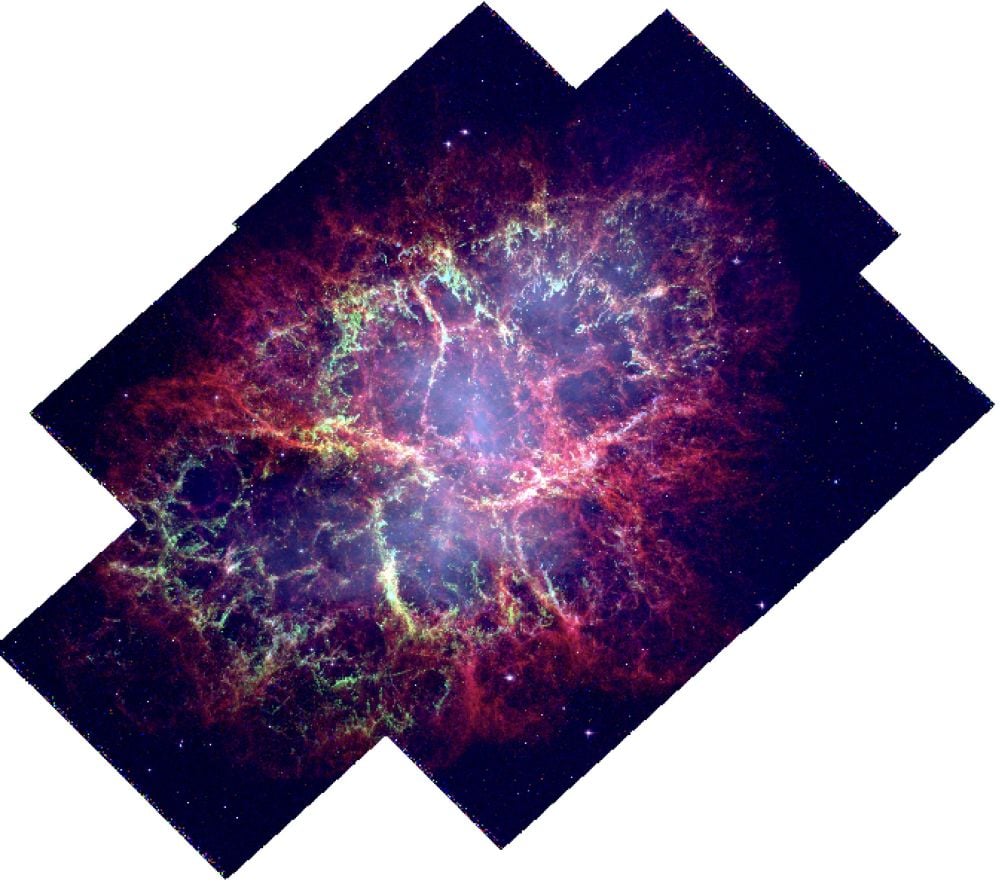 This figure shows a color mosaic of the six WFC3 fields using the three primary emission-line filters: F502N in red, which samples doubly-ionized oxygen, F673N in green, which samples ionized sulfur, and F631N in blue, which samples neutral oxygen (Oi). Image Credit: Blair et al. 2026. ApJ
The filters used in the above images have one drawback. They're broad enough that some of the synchrotron radiation continuum leaks in. The researchers processed the image to remove some of that synchrotron pollution. Two white boxes draw attention to a pair of regions that are important in comparing the new Hubble images with the 25-year-old image.
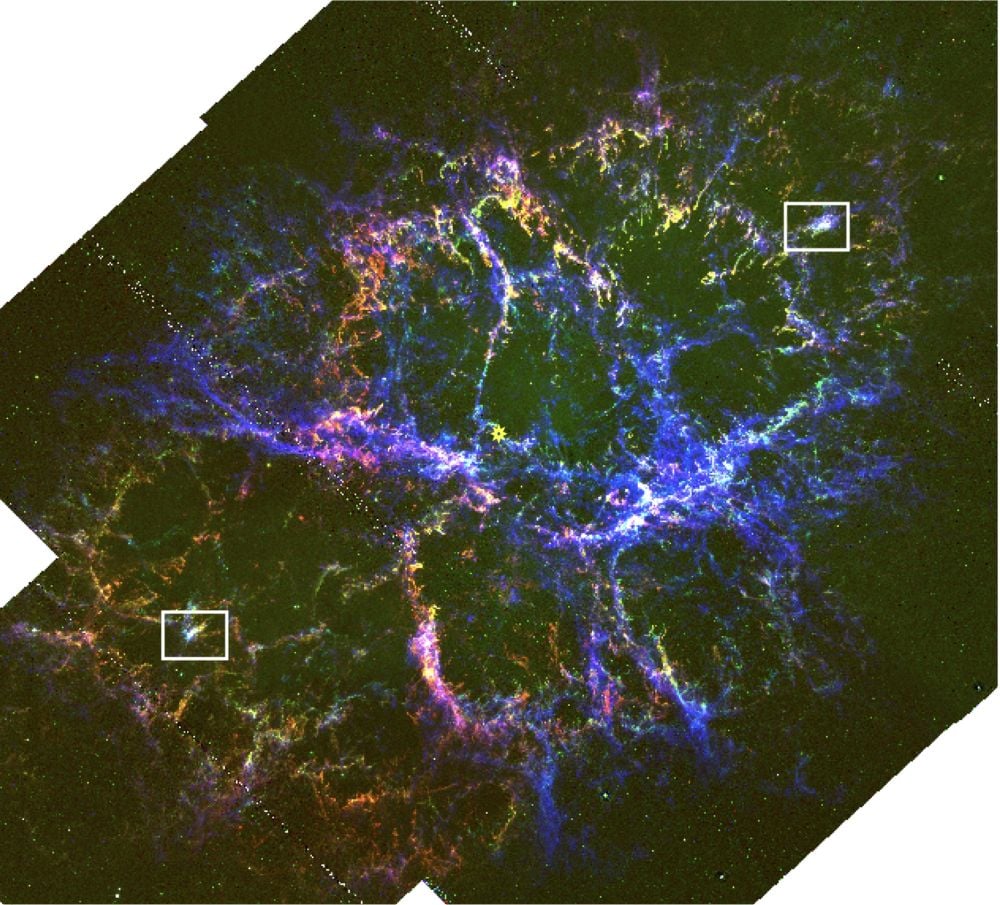 This figure shows the primary emission-line mosaic of the Crab Nebula after scaling and subtracting the underlying continuum emission.The two white boxes highlight important regions in the nebula. They're uncontaminated hydrogen bands that are helpful in comparing the nebula to the earlier Hubble image. Image Credit: Blair et al. 2026. ApJ.
“Even though I’ve worked with Hubble quite a bit, I was still struck by the amount of detailed structure we can see and the increased resolution with the Wide Field Camera 3, as compared to 25 years ago,” Blair said.
Analysis shows that the filaments on the nebula's outskirts have moved more than those nearer the center. But they haven't stretched, which may seem odd. They've simply moved outward. That's probably because the Crab Nebula is a pulsar wind nebula and its expansion is driven by synchrotron radiation rather than by shockwaves like some other nebula. In fact, the outward expansion is actually accelerating, helping make the changes visible.
The researchers noted two locations in the nebula that stand out from their surroundings. In the previous image they highlighted them with white squares. "These filament groupings are nearly diametrically opposed to the pulsar but are at large separation," the authors write.
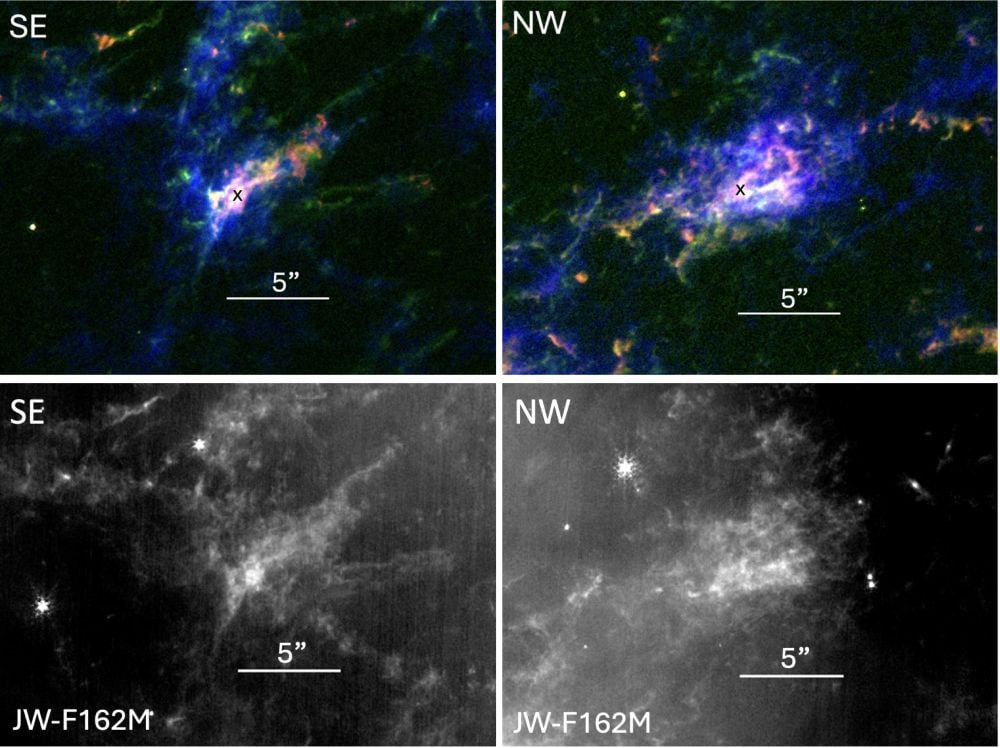 These panels show the two regions highlighted in white boxes in the previous image. The top two are from the WFC3 and the bottom two are from the JWST. Image Credit: Blair et al. 2026. ApJ.
"To our knowledge, these features have not been called out by previous investigators," the researchers explain. "Their positions nearly diametrically opposed to the pulsar suggest a possible association."
"The NW feature is brighter than the SE feature, but both stand out from surrounding emission, showing a complex morphology of clumpy knots, filaments, and more diffuse emission," the researchers explain.
These features could be caused by shock heating, but there's no certainty. "Further study of these features is needed to understand whether they are related to possible activity by the pulsar at some time in the past or some other cause," the authors write.
As one of the most fascinating objects in the sky, and one of the most observed, the Crab Nebula will continue to be studied intently, probably by generations of scientists. As observations of the nebula become more detailed, some questions are answered and new ones are asked.
The Crab Nebula will fade over the next several thousand years, and for the next tens of thousand of years it will continue expanding until it becomes unrecognizable. About 50,000 to 100,000 years from now, the nebula will melt into the background and become part of the interstellar medium.
But there's plenty of time to continue studying it, and these observations will feed into further observations.
"As such, the new data presented here become the springboard for ongoing detailed studies of this dynamic object, including comparisons with contemporaneous multiwavelength datasets," the researchers conclude.

