Universe Today
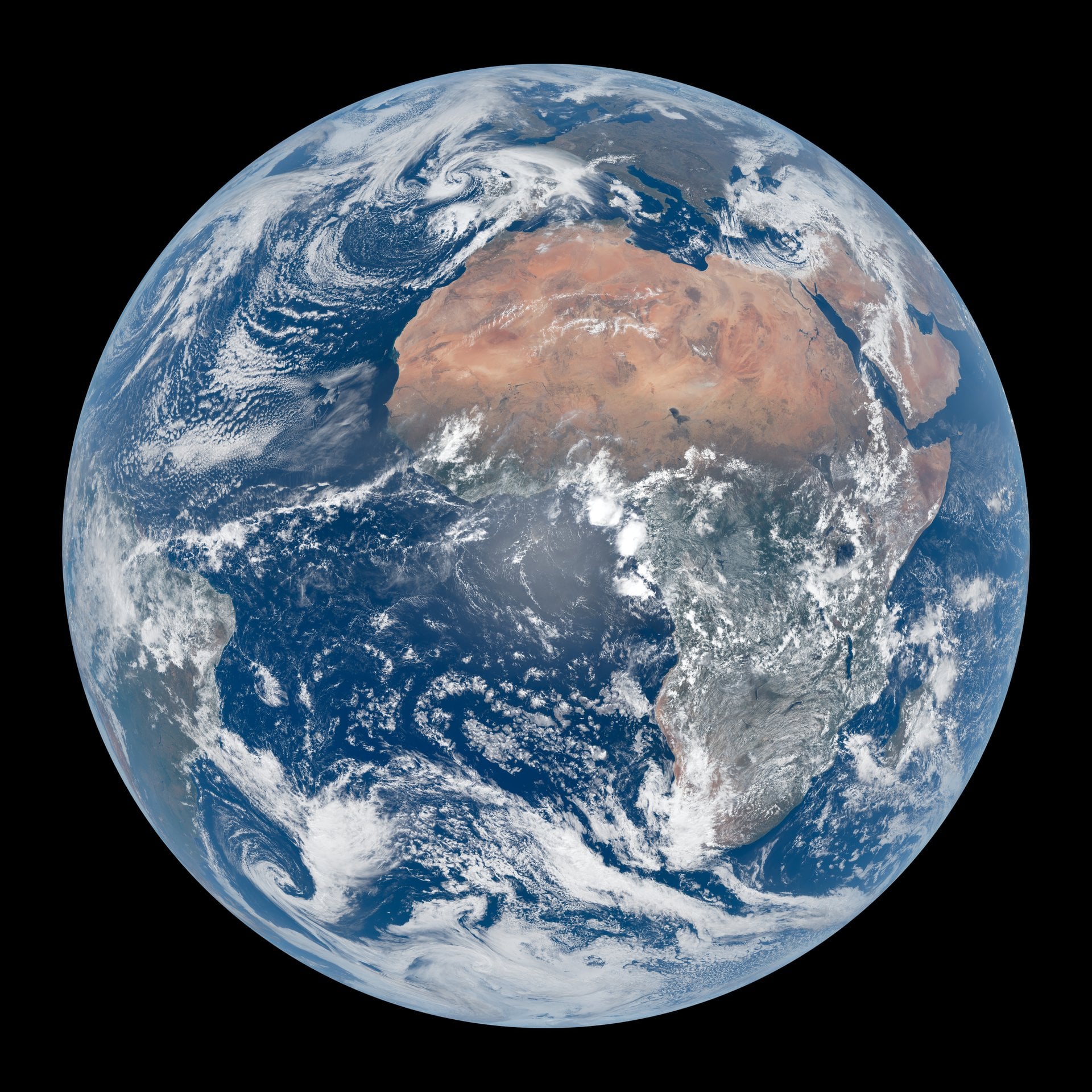
This is a cool fact to impress your friends. The length of a day on Earth changes constantly, nudged by the Moon's gravitational pull, shifting winds in the atmosphere, and slow churning movements deep within the planet. It always has. Day length is, in a sense, a living measurement and one that ebbs and flows with the rhythms of a restless, dynamic world. But something new is happening.
A study just published in the Journal of Geophysical Research: Solid Earth by researchers at the University of Vienna and ETH Zurich has found that our days are currently getting longer at a rate unprecedented in the past 3.6 million years and the primary cause seems to be human driven climate change!
 Air pollution by brick factories. The sun can be seen in the background just above the factory chimney, partially covered by the chimney's smoke (Credit : Janak Bhatta)
The mechanism proposed is simple. As global temperatures rise, polar ice sheets and mountain glaciers melt, pouring water into the oceans and raising sea levels. That water spreads outward from the poles toward the equator, redistributing mass across the planet. Think of a figure skater who pulls their arms in tight to spin faster. When they stretch their arms out, they slow down. Earth is currently stretching its arms. The result is a measurable slowing of Earth's rotation currently lengthening our day by 1.33 milliseconds per century. That sounds trivial but it isn't.
What makes this finding remarkable is not just the number, but its context. To find out whether anything similar had happened in the past, the researchers turned to an unlikely archive, the fossilised shells of tiny single celled marine organisms called benthic foraminifera, which lived on the ocean floor millions of years ago. The chemical composition of their shells encodes records of ancient sea levels. From those sea levels, the team could mathematically reconstruct how the length of the day has changed across 3.6 million years of Earth history.
The answer was unambiguous. Nothing in that entire geological record comes close to what is happening now. Only once, roughly two million years ago, did the rate of change even approach today's values and it was still slower. Every other period in that vast sweep of time saw Earth's rotation influenced by natural forces alone. What sets the present moment apart is that the dominant force is no longer natural at all.
 An iceberg in the Arctic Ocean (Credit : AWeith)
The conclusion is that the current rate of day lengthening can be attributed primarily to human activity. As lead author Mostafa Kiani Shahvandi of the University of Vienna put it, this rapid increase in day length implies that the rate of modern climate change has been unprecedented at least since the late Pliocene, 3.6 million years ago.
There are consequences however; spacecraft navigation, satellite positioning, GPS systems, and even computing infrastructure all depend on accurate knowledge of Earth's rotation rate. As that rate changes, so does the need to correct for it, creating a cascade of recalibration challenges for the systems our modern world quietly relies upon.
Looking ahead, the numbers only get larger. Under high greenhouse gas emission scenarios, the day could be lengthening by 2.62 milliseconds per century by 2080. By that point, climate change is projected to be influencing Earth's rotation more strongly than the Moon itself. The Moon has been slowing our planet for billions of years. We have apparently managed to compete with it in just a few decades.
Source : Climate change slows Earth's spin: Day lengthening unprecedented in 3.6 million years