Universe Today
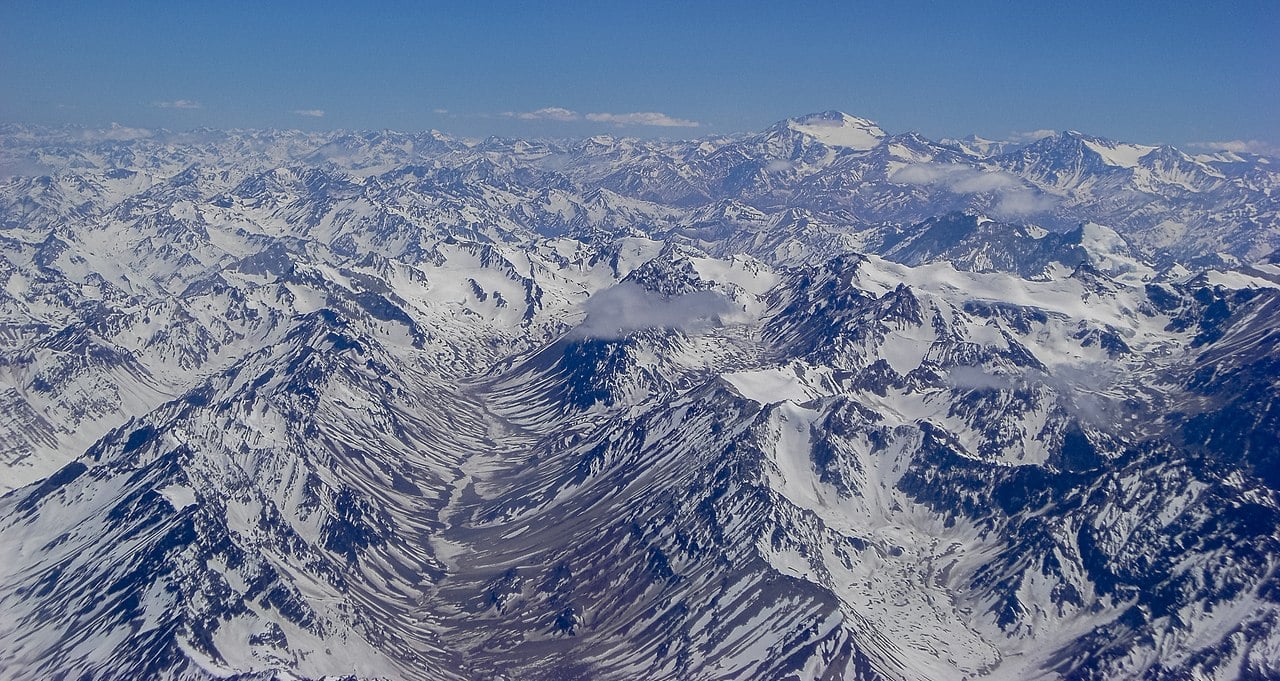
There is a place in northern Chile, 3,500 metres above sea level in the Andean Altiplano, where almost nothing survives. The Salar de Pajonales is a salt flat of savage extremes temperatures swinging from −23°C to 26°C, solar radiation among the highest measured anywhere on Earth, annual rainfall that barely registers, and winds that rip across the surface at over 100 kilometres per hour. And yet, life is there.
That life is not just surviving, but thriving and leaving a record of itself stretching back thousands of years. A new study published in Frontiers in Astronomy and Space Sciences has found that ancient stromatolites made of gypsum (the same calcium sulphate mineral found in the plaster of my nicely renovated home) at the high-altitude salt flat, contain both fossilised biosignatures from the distant past and living microbial communities in the present day. The two exist within millimetres of each other, separated by layers of crystal.
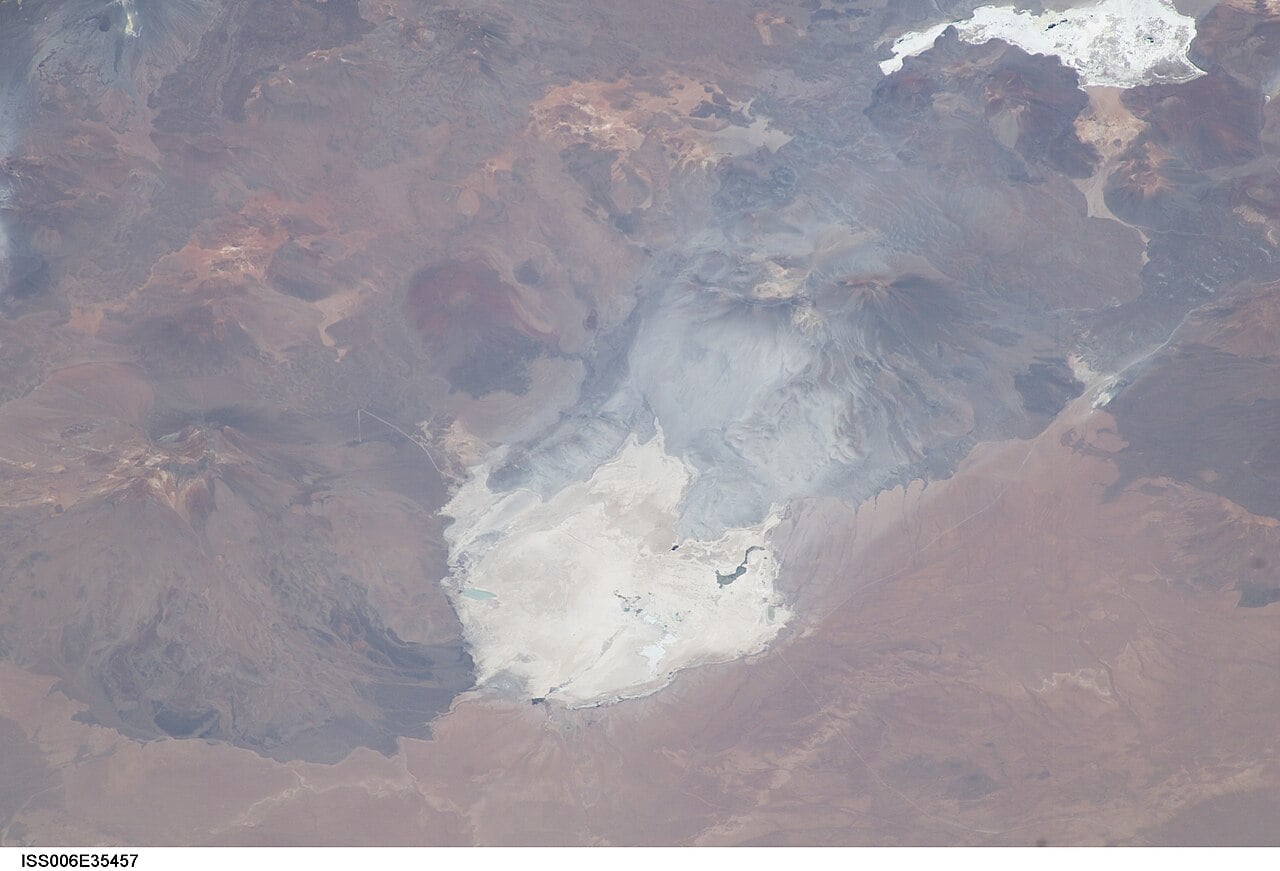 Salar de Pajonales in Chile captured from space (Credit : Earth Science and Remote Sensing Unit)
Stromatolites are layered rock structures built up over time by communities of microorganisms. They are some of the oldest evidence of life on Earth, with examples dating back 3.5 billion years. The ones found at Salar de Pajonales are far younger, probably between 4,000 and 6,400 years old but what makes them scientifically extraordinary is what they contain.
In the deeper layers of the gypsum, researchers found the glassy remains of microscopic algae along with preserved filamentous cell structures and tell tale chemical signatures of ancient photosynthesis. These are fossils, entombed in crystal during a wetter period in the salt flat’s history when a lagoon once covered the site.
Just a few millimetres higher up, in the near surface layers of the same rocks, something entirely different is happening. Active communities of some of the toughest photosynthetic organisms known are alive and carrying out photosynthesis right now, tucked beneath the gypsum surface where they are shielded from the worst of the ultraviolet radiation and desiccation above.
The gypsum itself is optically translucent, allowing just enough light through for photosynthesis while also retaining tiny amounts of water within its crystal structure, providing a lifeline for microbes even during the driest months. An interesting discovery of course but why does any of this matter beyond Chile? The answer lies up in space!
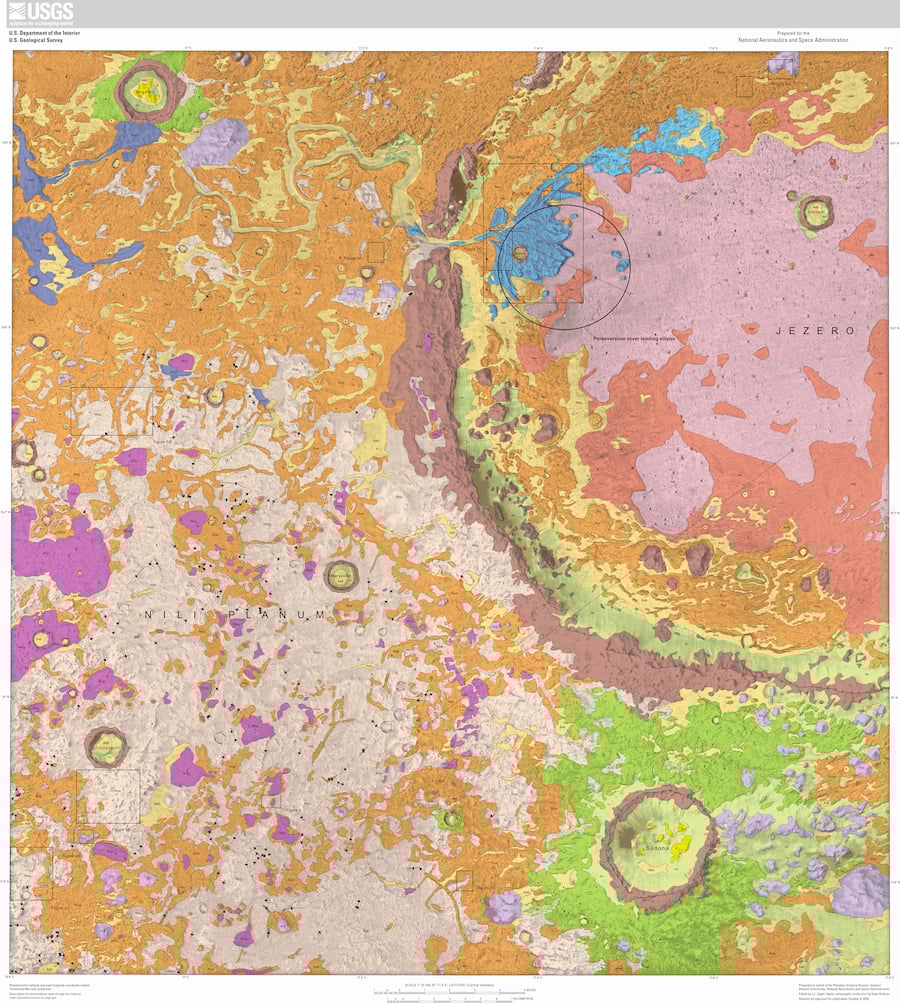 Geologic map of Jezero Crater and the Nili Planum region on Mars (Credit : NASA)
One of our nearest planetary neighbours, Mars has gypsum too. Lots of it. Orbital surveys have detected widespread sulphate deposits across the Martian surface, and NASA's Perseverance rover has been examining calcium sulphate minerals in Jezero Crater in detail. If gypsum can preserve biosignatures for thousands of years on Earth under conditions this extreme, it raises a tantalising possibility that similar deposits on Mars might be holding onto evidence of ancient life, waiting to be found.
The researchers are careful to note that finding biosignatures in Martian gypsum would not be straightforward. Preservation is not guaranteed since the chemical alteration of minerals over time can degrade organic evidence. But the Salar de Pajonales offers a working model for what to look for and where to look. In a universe that seems increasingly indifferent to life, a salt flat in the Andes is quietly making the case that biology finds a way and that the crystals that seem to entomb it might one day tell us whether it ever did the same on Mars.
Source : Gypsum sustains microbial life under extreme conditions – this could help us study Mars