 Universe Today
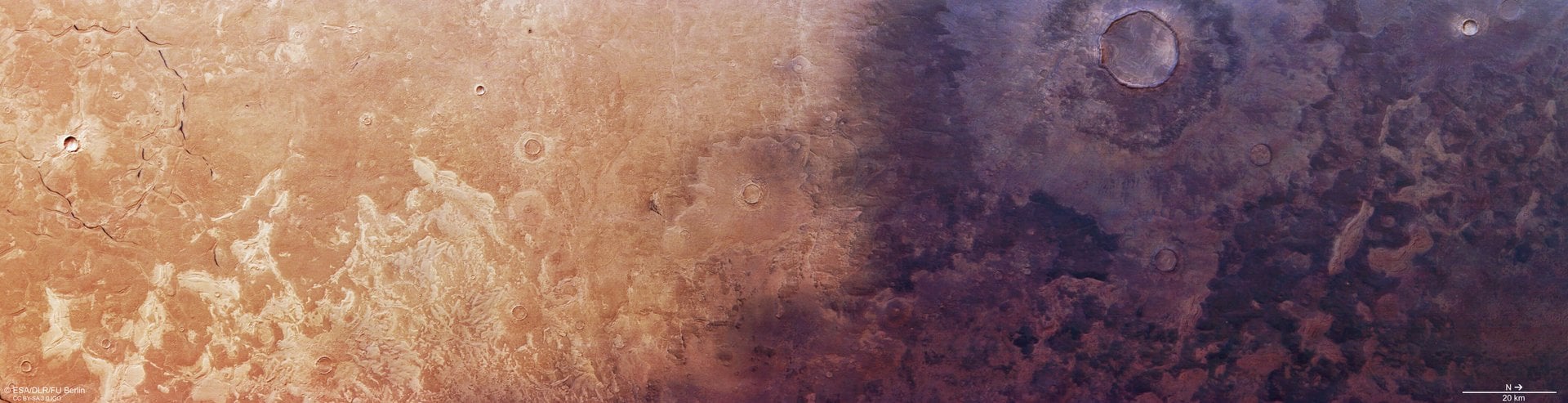
Mars is well known as a static, frozen desert. We tend to think of the only thing changing on the surface of the Red Planet is due to the occasional dust storm. But if you look closely - and are willing to wait decades - you’ll see the planet is very much alive - at least in the environmental sense. The European Space Agency just released some spectacular new images from the High Resolution Stereo Camera (HRSC) on its Mars Express Orbiter, one of which shows a surprisingly “fast” geological change happening in Utopia Planitia. A dark, ominous-looking blanket of volcanic ash is actively creeping across the bright red sands - and it's moving (relatively) fast.
Some of the earliest in-situ images of the site were taken by the Viking orbiters back in 1976. Approximately 48 years later, Mars Express took a detailed picture of the exact same area. In human terms, 50 years is a long time. In terms of planetary geology, it’s barely an eyeblink. But in those 50 years, Utopia Planitia has changed dramatically. A deposit of dark ash has noticeably spread over the area, standing in stark contrast to the ochre-colored dust that covers most of Mars.
Scientists believe the ash to be volcanic in origin, and composed of “mafic” materials like olivine and pyroxene. These iron- and magnesium-rich minerals were likely forged in the fiery insides of ancient Martian volcanoes. Most likely that happened billions of years ago when giants like Olympus Mons were actively erupting, with explosions creating plumes that shot ash high into the planet’s atmosphere. Importantly, since olivine usually degrades quickly in water, this is also a good indication that Mars has been dry since these deposits were made.
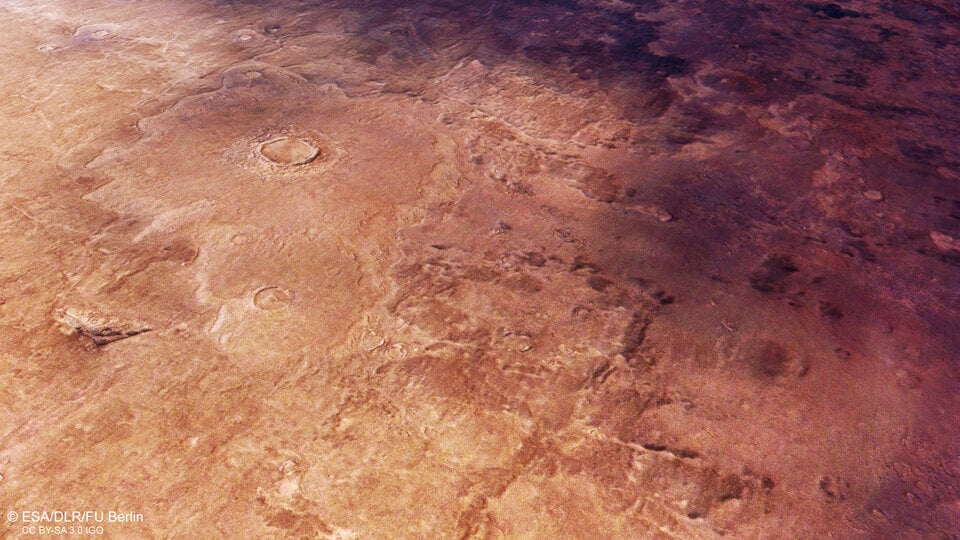 A crater at the boundary of the ash and dust. Credit - ESA/DLR/FU Berlin
So what is causing them to move? The short answer is, most likely, wind. Aeolian (i.e. wind-driven) processes are likely either blowing the dark ash across the landscape, or they are scouring away the lighter, rust-colored surface dust to expose the dark layers of ash they had hidden for hundreds of millions of years. It’s hard to tell with just a series of pictures, but either explanation seems plausible.
But the creeping ash wasn’t the only shocking feature in these new images. Scattered around the ash blanket were vaguely rounded pits with wavy edges known as “scalloped depressions.” These form when either the planet’s climate shifts or the topsoil is blown away and exposes subsurface ice, which then sublimates, causing the ground above it to become unstable and collapse. We already know that Utopia Planitia is holding about as much sub-surface water as Lake Superior, so this is more of a confirmation than a new finding, but shows how prevalent water is right under the Martian surface.
Another image from the new set highlights a 15-kilometer wide impact crater sitting in the middle of the ash blanket. This crater is also surrounded by an “ejecta blanket” of lighter material that was thrown out by a meteorite strike, while inside the crater there are squiggly lines that indicate the slow, glacial movement of ice. Located just outside the crater, a series of shadowy tectonic ditches known as “grabens” stretch up to 20 kilometers away, indicative of a part of Mars’ crust that is being pulled apart.
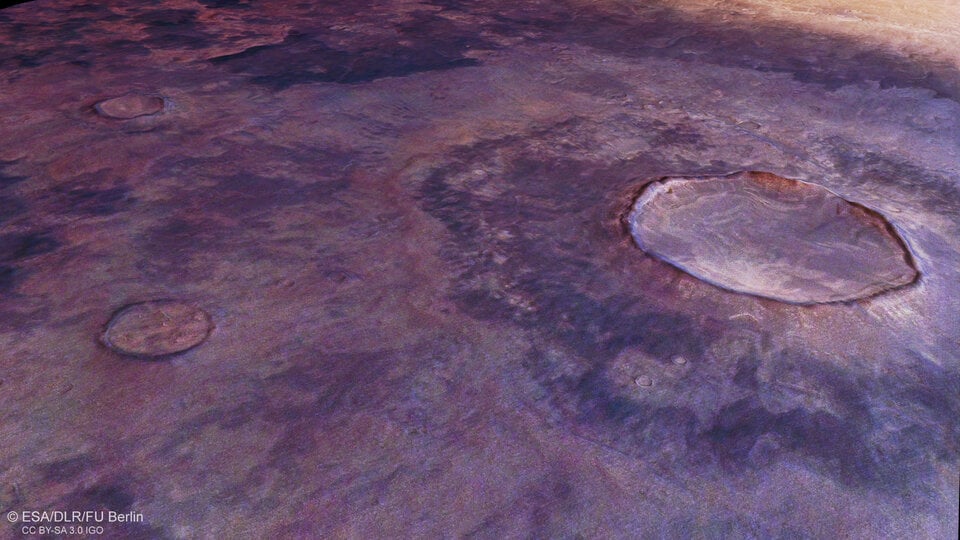 A crater within the ash blanket. Credit - ESA/DLR/FU Berlin
These new images help dispel the myth that Mars doesn’t change. It features a constant scouring of wind, former volcanic activity, subsurface ice, and crust being pulled apart. That doesn’t sound like a dead planet - or at least not much of one. As we continue to watch the Red Planet from orbit, we’ll undoubtedly find more areas undergoing these types of “rapid” geological changes. Maybe one day humanity will even be able to see them in person - just on slightly longer time scales than we’re used to.
Learn More:
ESA - Ash Creeps Across Mars
UT - Martian Volcanoes Could Be Hiding Massive Glaciers Under A Blanket of Ash
UT - Mars Was Once a World of Rain
UT - Ancient 'Supervolcanoes' Lurk On Mars And Once Showered Planet In Ash: Study

