 Universe Today
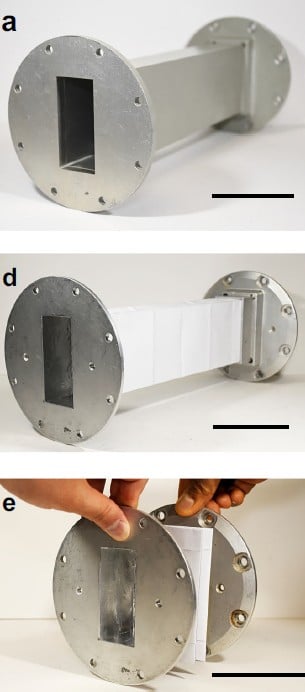
Origami and space exploration might not seem like they have much in common, but the traditional paper-folding technique solves one massive problem for space exploration missions - volume. Satellites and probes that launch in rocket housings are constrained by very restrictive requirements about their physical size, and options for assembling larger structures in orbit are limited to say the least. Anything that can fold up like an origami structure and then expand out to reach a fully functional size is welcome in the space community, and a new paper published in Communications Engineering by Xin Ning of the University of Illinois Urbana-Champaign (UIUC) and his lab describes a novel use case for the idea - electromagnetic waveguides.
Typically, when talking about origami in space, the structures under consideration are massive, such as solar panels or coronagraphs. Things where the sheer size of the design makes a huge difference to its functionality. For electromagnetic wave guides, both size and form factor matter.
Waveguides are essentially “pipes” for radio waves. While plumbing pipes guide water from a source to a destination, waveguides direct electromagnetic energy - specifically microwaves - from a transmitter to an antenna. Without a waveguide, the electromagnetic waves from a transmitter would spread out in all directions, drastically reducing their range and power capability. In technical terms, they also act as a “high-pass” filter, allowing only high frequency signals to be directed along the pass while absorbing lower frequency ones. Because they are essentially just metal tubes filled with air, they can handle massive amounts of power, ranging up into the megawatts, without melting.
Video from the UIUC lab about the foldable waveguides. Credit - Aerospace Engineering at Illinois YouTube ChannelDr. Ning mentioned in a press release from UIUC that he was originally inspired to look into the idea of how waveguides could be made flexible by a colleague at Penn State, Sven Bilén, who is an expert in electromagnetics. He pointed out that many waveguides have a rectangular shape, and Dr. Ning immediately thought of the simplest rectangular folded structure he could - a paper shopping bag.
Two of his graduate students began working on the plans for a shopping bag, and eventually came up with a folding system that allowed them to shrink the length of the original by an impressive 72%, while having a minimum amount of signal loss. They then moved on to a more complicated waveguide configuration shaped like a bellows. In this configuration, the structure can be extended or compressed to “tune” the length, and also allows it to create “elbows” in the structure without needing a separate part.
Essentially, the bellows configuration of the waveguide is adjustable, while still having an 87% smaller footprint when it’s stowed. A slight modification of it, known as a “Twist” waveguide also allowed the team to rotate the polarization of the waves coming out of the waveguide, allowing it to operate a tunable polarization modulator.
Video on how origami folding is changing the space industry. Credit - Multiscale Systems YouTube ChannelHow can all of these features come from a simple folding technique? And why hasn’t anyone done this before? A typical waveguide is simply a metal tube, though there are “flexible” kinds that use corrugated metal hoses. However, these suffer from high signal loss, aren’t able to bend at high angles, and suffer from cracking if bent too many times. Origami structures can be bent multiple times, at extreme angles, and still maintain close to the same signal integrity.
These origami tubes are actually even made out of paper, but with a 35 um laminate of aluminum foil on top of it. Such a thin layer takes advantage of aluminum's flexibility while also utilizing the “skin depth” effect. High frequency currents, such as S-band radio waves, only flow on the surface of the conductor, known as the skin depth. For example, a 2.6 GHz signal would require a skin depth of only 5.4 um - about one fifth of the depth of the foil on the flexible waveguide. So, despite being made primarily of paper with only a thin veneer of metal, it conducts high frequency electromagnetic waves as well as a solid aluminum bar.
Paper itself might not be the best material to use for space applications, though, and its still early days in terms of being able to make this system ready for flight in a vacuum. However, Dr. Ning has patented the idea and plans to further develop it as part of an effort to make usable, foldable waveguides for satellites and deep space probes. They could also be useful in naval vessels and other military applications, despite not having as many volume constraints on those systems. But someday you might see foldable metal structures on the thousands of LEO satellites that will make up future communications megaconstellations.
Learn More:
UIUC / EurekaAlert - Origami-inspired space structure is compact when launched, expanded in space
N. Ashok et al. - Shape-morphable origami electromagnetic waveguides
UT - Radio Waves
UT - Space Shapes: Watch This Origami Solar Array Prototype Unfurl

