Universe Today
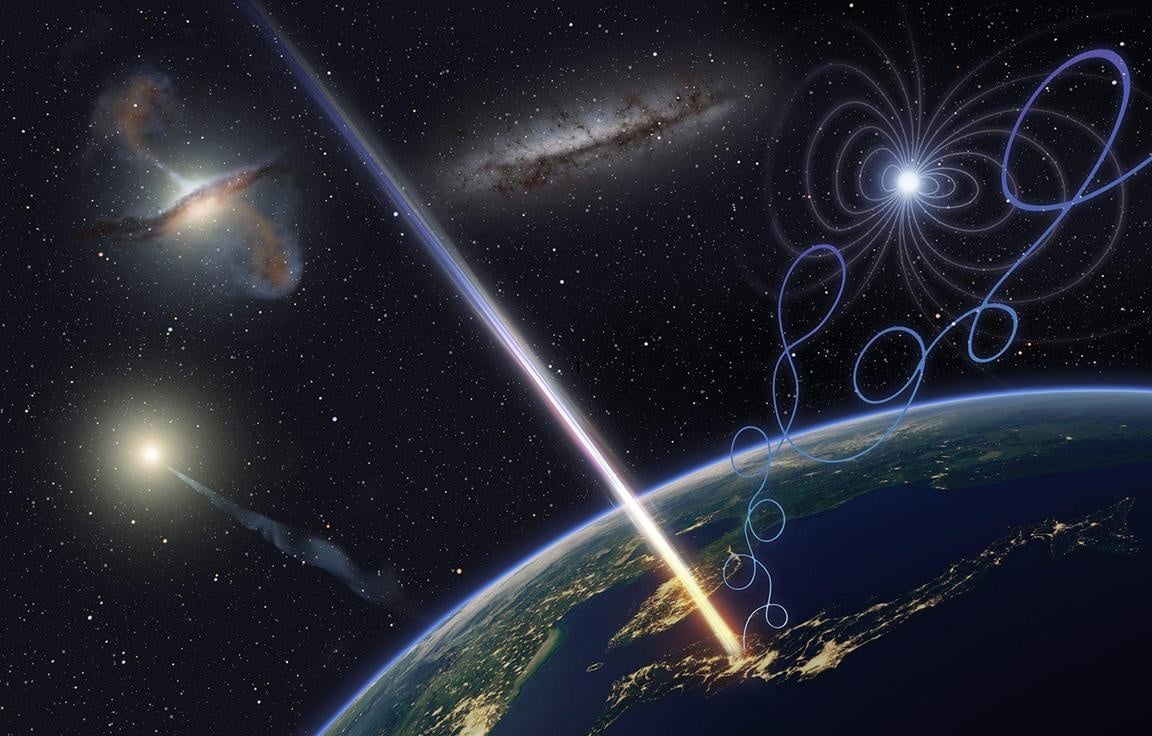
The "Amaterasu particle," named after the sun goddess in Japanese mythology, was detected by the Telescope Array Project in Utah in 2021. It remains one of the most extreme events recorded involving ultrahigh-energy cosmic rays, and an international team thinks they may have found an "ultraheavy" explanation for such particles. Cosmic rays are subatomic particles (primarily protons and atomic nuclei) that travel through space at nearly the speed of light and regularly impact Earth's magnetic field.
Ultrahigh-energy cosmic rays strike Earth with energies that are far beyond anything we can achieve with particle accelerators. The Amaterasu particle reportedly had an energy level so high that it was among the most powerful events ever observed, comparable to the "Oh-My-God particle" detected in 1991. Despite that, lingering questions remain about its origin and identity. In the new study, the team suggests that some of the highest-energy cosmic rays may consist of atomic nuclei heavier than iron.
The team was composed of members from Kyoto University's Center for Gravitational Physics and Quantum Information (CGPQI), the Penn State Institute for Gravitation and the Cosmos (IGC), the Center for Neutrino Physics at Virginia Tech, the Kavli Institute for the Physics and Mathematics of the Universe (IPMU), the CAS Institute of High Energy Physics (IHEP), and the Institute of Science Tokyo. The paper detailing their findings appeared on May 7th in the journal Physical Review Letters.
Ultrahigh-energy cosmic rays are those that have energies above 100 quintillion (1018) electron volts, seven orders of magnitude (10 million times) more energetic than particles accelerated in the CERN Large Hadron Collider. The reported energy of the Amaterasu particle was about 240 x 1018 electron volts. However, scientists are still unsure how such high-energy particles are created. Kohta Murase, a professor of astronomy and astrophysics in the Penn State Eberly College of Science and the leader of the research team, explained in a PSU news release:
Ultrahigh-energy cosmic rays can only be accelerated by some of the most powerful sources in the universe. When we detect individual cosmic-ray particles such as the Amaterasu particle here on Earth, we can often use their energies, arrival directions, and expected magnetic deflections to infer their possible cosmic sources. The origins and acceleration mechanisms of ultrahigh-energy cosmic rays have been among the biggest mysteries in the field for more than 60 years, since the first example was reported.
Astrophysicists have long held that the highest-energy cosmic rays originate from extreme events, such as the collision of two neutron stars or a massive supernova. One possibility, in keeping with Newton's First Law (F=ma2), is that the particles' mass may be partly responsible. “For many cosmic-ray events taken together, their energy distribution, arrival-direction pattern, and statistically inferred composition provide important clues about where these particles come from and how they are accelerated,” Murase added.
To learn what types of particles could reach Earth at such extreme energies, the team performed detailed computational simulations of how particles of varying sizes would change as they traveled through intergalactic space. Their calculations showed that ultraheavy nuclei can lose energy more slowly than just protons or lighter nuclei as they travel through intergalactic space, allowing them to reach Earth at extreme energies. The findings could help narrow down the cosmic sources that can accelerate these particles.
“Our research showed that at energies comparable to that of the Amaterasu particle, ultraheavy nuclei lose energy more slowly than protons or intermediate-mass nuclei, making them better able to survive cosmic distances and reach Earth at extreme energies,” Murase said. “We are not saying that all ultrahigh-energy cosmic rays are ultraheavy nuclei. But if some of the highest-energy events are ultraheavy nuclei, that would impact how we search for their sources.”
The team's calculations also placed new constraints on how ultraheavy nuclei contribute to the overall population of ultrahigh-energy cosmic rays observed by astronomers. However, there was still the question of where the Amaterasu particle came from. The inferred direction pointed to a cosmic void with no obvious source of ultrahigh-energy cosmic rays. Said Murase:
The most promising sites for producing and accelerating such ultraheavy nuclei are massive star deaths involving explosive collapse into black holes or strongly magnetized neutron stars, as well as binary neutron-star mergers known to be powerful gravitational-wave emitters. These violent cosmic phenomena can also power gamma-ray bursts that are among the most energetic explosions in the universe.
A contribution from these sources could also help explain a possible difference seen between the northern and southern skies in the ultrahigh-energy cosmic-ray spectrum. If ultraheavy nuclei contribute significantly at the highest energies, future data should indicate a composition heavier than iron.
Murase and his colleagues hope to test these findings using next-generation observatories like the proposed AugerPrime in Argentina and Global Cosmic Ray Observatory. In the meantime, they indicate that theoretical studies of cosmic explosions involving black holes and magnetars could provide additional insight into the origin of these ultrahigh-energy cosmic rays.
Further Reading: PSU