 Universe Today
When free oxygen accumulated in Earth's atmosphere during the Great Oxygenation Event (GOE), the course of life on Earth changed forever. It created a new energy pathway organisms could exploit, and exploit it they did. Complex life only appeared when oxygen was present, and complex life is one of Earth's defining features.
Cyanobacteria were the first organisms to produce oxygen, gradually creating an oxidizing atmosphere over billions of years. They formed microbial communities called stromatolites, and stromatolite fossils are a major part of the record of life on Earth. In new research, scientists from the Korea Institute of Geoscience and Mineral Resources (KIGAM) found fossilized stromatolites in the Hapcheon impact crater, the only confirmed meteorite impact site on the Korean Peninsula. While the Hapcheon crater is only about 42,000 years old, finding stromatolites there is a window into the early Earth, when stromatolite cyanobacteria slowly oxygenated Earth's atmosphere.
The research article is titled "Discovery of stromatolite formation in post-impact hydrothermal lacustrine environments and its implications for early Earth," and it's published in Nature Communications Earth and Environment. The lead author is Dr. Jaesoo Lim, Principal Investigator at Korea Institute of Geoscience and Mineral Resources.
"Understanding asteroid-collision-generated extreme environments, including hydrothermal activity, is crucial for gaining insights into biological evolution on the early Earth," the authors write. In their paper, they show that stromatolites formed on the margins of the hydrothermal lake that formed in the crater. "Considering the frequency of asteroid collisions during the early Earth, stromatolite blooms in impact craters could be one of the active oxygen oases that led to the creation of habitable environments on the early Earth," they explain.
The researchers found several stromatolites between 10 and 20 cm in the Hapcheon crater. They interpret these findings as evidence of early "oxygen oases," regions where stromatolites bloomed and generated oxygen. These types of oases were only possible in impact craters.
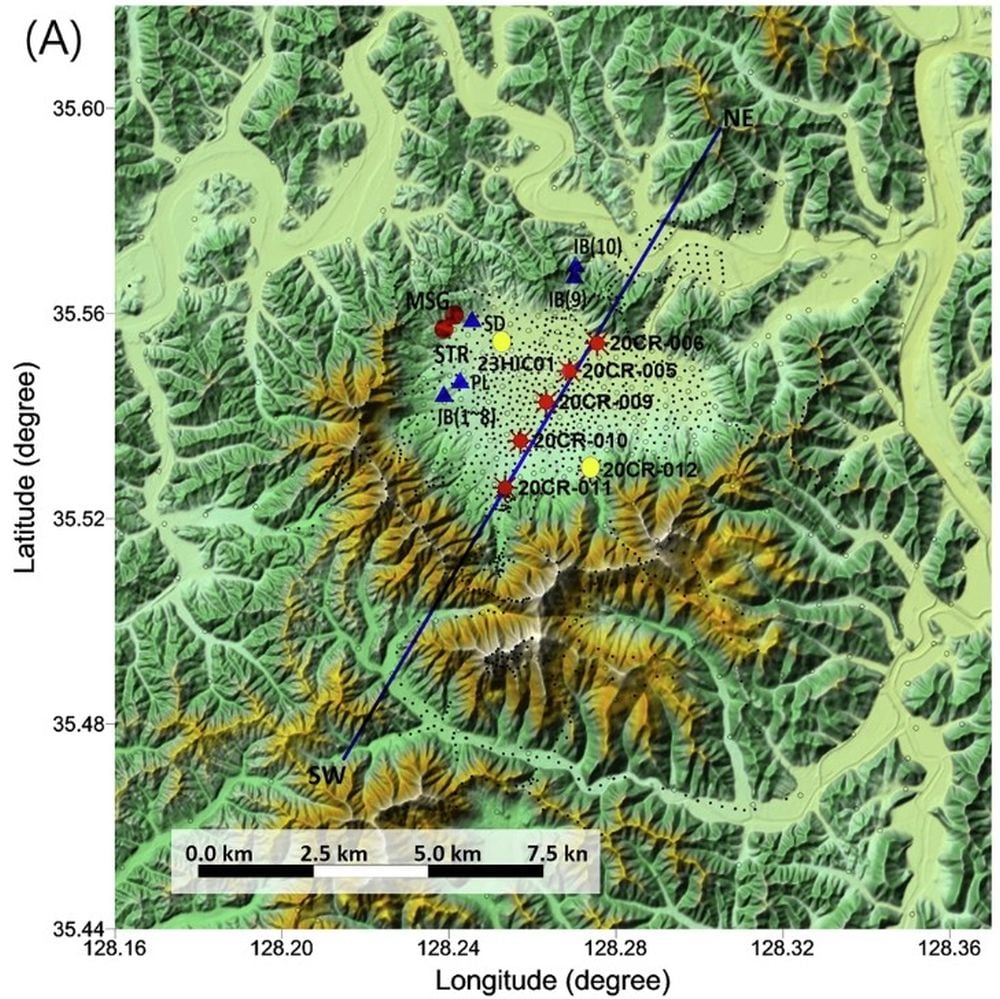 This image shows sites where the researchers drilled beneath the crater to determine that it was an impact site (marked with CR). It also shows stromatolite sampling sites (STR and MGS), slope deposit (SD) site, palaeolake (PL) boundary site, and impact breccia (IB) sites. Image Credit: Lim et al. 2026. NatCommE&E. https://doi.org/10.1038/s43247-026-03206-7
Earth suffered through a prolonged period of impactor activity during the Late Heavy Bombardment (LHB). It's hypothesized to have occurred between 4.1 to 3.8 billion years ago, and also affected Mars, Venus, and the Moon. Some research suggests the LHB extended further, until the end of the Archean Eon, about 2.5 billion years ago. Research shows that the LHB would've created tens of thousands of craters on Earth, with the largest being about 5,000 km in diameter, though evidence of these craters is long gone.
While impacts happen quickly, the effects persist. "After devastating impact events, the initial impact craters undergo several distinct stages, including the thermobaric phase, hydrothermal phase and post-impact succession phase," the authors write. The hydrothermal phase generates heat several ways, including as the shock wave deposits heat in underlying rocks. "Notably, the hydrothermal phase is thought to persist over extended periods in various impact craters," the authors explain, mentioning the Ries impact crater in Germany as an example.
Some of the evidence for these impact generated oxygen oases is in the sediments in the lake. The sediment that flowed into the lake following the impact contained a large amount of meteoric material. The researchers examined the sediments in the stromatolites using X-Ray Fluorescence (XRF). They found higher concentrations of "allochthonous](https://en.wiktionary.org/wiki/allochthonous) inputs," which is material that originated in a different location than where it formed.
The authors also point out that the Hapcheon crater and other impact craters show evidence of meteoritic material their impact breccia (IB). If meteoric material can be found in the stromatolites, that will strengthen the connection between hydrothermal impact sites and oxygen oases. "These findings warrant further investigation regarding the possible incorporation of meteoritic material into the stromatolites found in the Hapcheon crater," the authors write.
If this research is correct, these impact craters served as early oxygen oases where stromatolites bloomed, supercharged by hydrothermal activity under the craters. If it's true, then the evolution of life on Earth is linked to impacts and the hydrothermal craters they create.
“This is the first comprehensive evidence suggesting that stromatolites could form in hydrothermal lakes created by asteroid impacts,” said lead author Lim in a press release. “Such environments may have provided favorable conditions for early microbial ecosystems.”
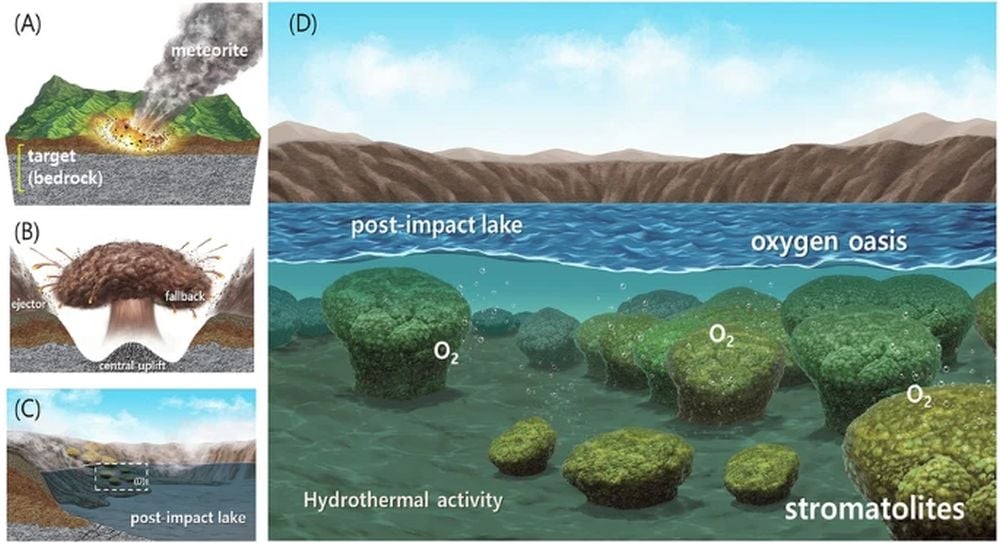 This illustration shows an impactor slamming into Earth, and a lake forming in the crater. The impact created a hydrothermal system which supercharged the growth of oxygen-producing stromatolites. If this phenomenon was widespread on the early Earth, then these impact-induced "oxygen oases" played an important role in the Great Oxygenation Event. Image Credit: Lim et al. 2026. NatCommE&E. https://doi.org/10.1038/s43247-026-03206-7
Could the same thing be true on other worlds? On Mars?
"Hydrothermal systems have been proposed as potential sites for the origin and early evolution of life on Earth and possibly Mars," the researchers write. "The results presented here support this possibility and demonstrate that impact-generated hydrothermal activity in early post-impact lake environments could have facilitated stromatolite growth within impact craters."
This study is another intriguing development in our understanding of life on Earth and elsewhere. There's ample evidence that complex organic molecules and amino acids form on asteroids and comets and travel through the Solar System. Researchers hypothesize that life on Earth may have begun when these molecules were delivered to Earth by impacts, where they created a warm, chemically-rich stew.
Though this research doesn't touch on this idea, it shows another way that impacts and life on Earth may be inextricably linked. If the Late Heavy Bombardment created tens of thousands of craters larger than 20 km, including several larger than 5,000 km, and if they served as oxygen oases, the effect on Earth's oxygen level would've been dramatic.

