Universe Today
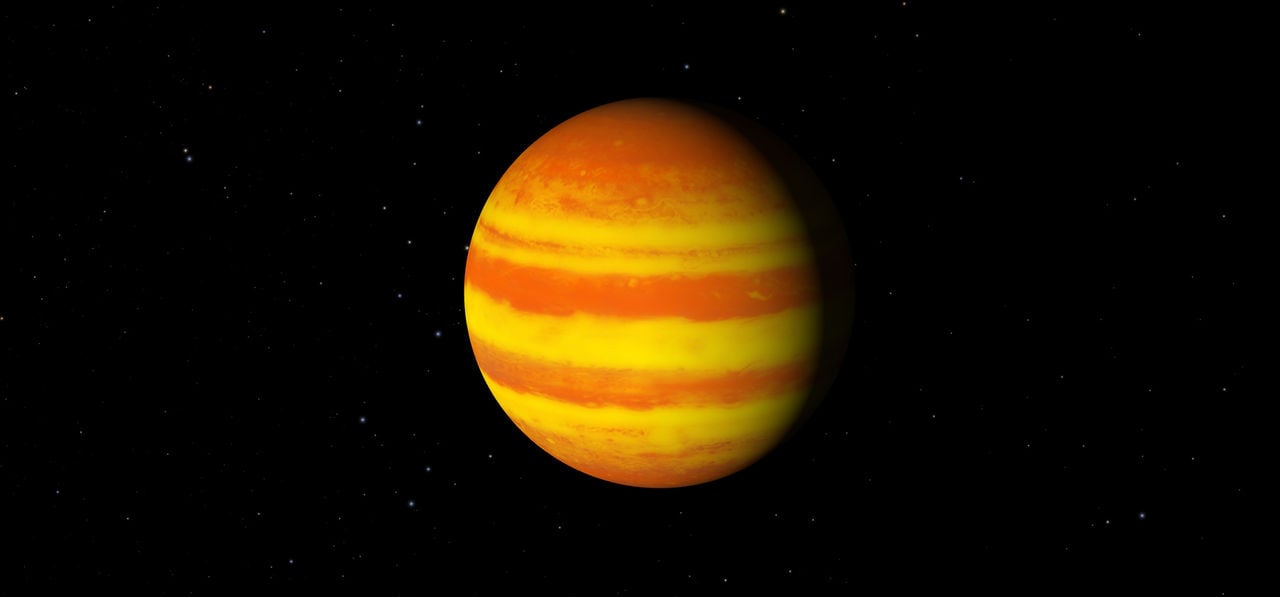
On a quiet night last year, University of Cincinnati astrophysics graduate student Paul Smith was looking over data from the James Webb Space Telescope (JWST). After being allotted observation time with Webb, he and his colleagues watched TOI-2031A (a star 901 light-years from Earth) and waited for signs of a planetary transit. According to their calculations, this star would experience a dip in brightness caused by an orbiting planet passing in front of it, relative to the JWST's line of sight.
The gas giant, designated TOI-2031A b, had been identified previously by the Transiting Exoplanet Survey Satellite (TESS) and is the only exoplanet detected around its sun so far. The planet is about 1.267 times the size of Jupiter, 80% as massive, and orbits its star at a distance of just 0.066 AU, less than 7% the distance between Earth and the Sun. This makes TOI-2031 A b a "Hot Jupiter," a subset of gas giants that orbit very close to their suns, which are surprisingly common in the exoplanet census.
Using Webb's powerful Near-Infrared Spectrograph (NIRSpec), they hoped to capture light passing through the exoplanet's atmosphere, revealing clues about its chemical composition. The observations were part of a Cycle 4 General Observation program (GO-9025) titled, "The Warm Jupiter Opportunity for Understanding Giant Exoplanet." This international collaboration of 20 institutions is studying gas giants to learn more about their atmospheres and why Hot Jupiters are so common.
Smith came to astronomy later in life, after spending 20 years in the private sector and another 10 as a writer and speaker. He earned his bachelor’s degree in physics and astrophysics at UC’s College of Arts and Sciences and is now earning a second bachelor’s degree in geosciences at UC and a master’s degree in planetary science from the University of Aberdeen. Said Smith in a UC News release:
It was a lifelong dream of mine coming true. I was up all night to get the first look at the data. What you want to see is a U-shaped curve that proves that we had the telescope pointed at the star at the moment of transit. If our calculations were wrong, we would just get a flat line, and I would have had to tell everyone we missed it. Thank God, we got a light curve. That was so exciting.
Their findings were presented at the 11th Topical Conference Series of the American Astronomical Society (AASTCS 11), titled "Exoplanet Atmospheres 2026" in Denver, Colorado, back in April. "We’re trying to figure out how these big gas giants got there. We’re studying the formation and migration pathways of big planets," Smith added. "Where do they form in their solar systems, and how do they get so close to their stars? The atmosphere is very similar to Jupiter’s — mostly hydrogen and helium, water, and carbon dioxide."
According to Cincinnati Observatory astronomer Wes Ryle, who was not part of the study, research into exoplanets ultimately lets scientists know more about how our Solar System evolved. This includes informing theories about planet formation, whether they form in their orbits (as previously thought) or migrate over time. “Exoplanets are one of the hottest topics in astrophysics right now, with the ultimate goal of learning how our solar system compares to others and the likelihood of finding other habitable worlds,” he said. “Studies like this help evaluate the role of gas giant planets and their migration in creating a planetary system.”
Further Reading: UC News