 Universe Today
We're accustomed to astronomical telescopes going over budget and taking longer than planned to complete and launch. The JWST's long struggle to completion is the most recent example of that. But NASA's next space telescope, the Nancy Grace Roman Space Telescope is bucking that trend.
The telescope is ahead of schedule and under budget, an uncommon accomplishment for advanced telescopes. It's due to launch in September, months ahead of schedule, and once it reaches its home at the Sun-Earth L2 point, it'll go through some testing and calibration, then it'll get to work.
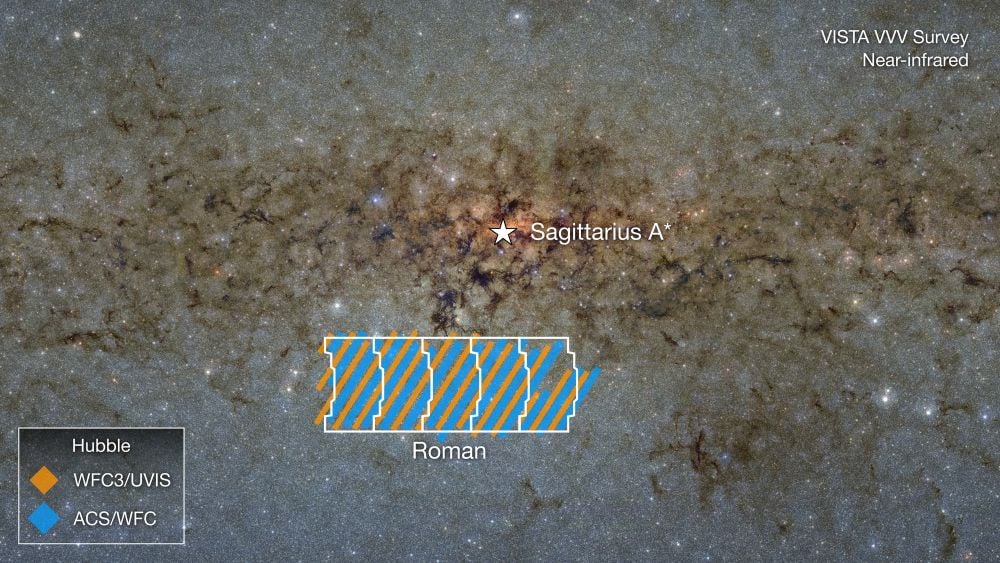
The Roman's mission is centered around surveys, and one of them is the Galactic Bulge Time Domain Survey (GBTDS), which will last 15 months. The Galactic Bulge is a bulbous region around the Milky Way's center that's tightly packed with stars and planets. It's also home to free floating objects like rogue planets, and other objects like isolated stellar-mass black holes.
The Roman will observe this region repeatedly to track changes in the brightness of stars. These variations in luminosity will reveal the presence of exoplanets, rogue planets, and other objects. The telescope won't be the first to study the bulge; other telescopes have observed it repeatedly, but none with the observational power that the Roman brings.
In advance of the Roman's survey of the galactic bulge, astronomers used the Hubble to survey overlapping parts of the bulge that the Roman will eventually survey. The Hubble's observations will help astronomers understand and interpret what the Roman's GBTDS finds.
The first results of Hubble's survey are in new research in The Astrophysical Journal Letters titled "An HST Wide-field Survey of the Galactic Bulge: Overview, Strategy, and First Results." The lead author is Sean Terry, project lead and assistant research scientist from the University of Maryland and NASA’s Goddard Space Flight Center.
"We present a Hubble Space Telescope (HST) imaging survey of a 1.1 deg2 sky area toward the Milky Way Galactic bulge," the authors write. "High angular resolution imaging of this area with HST before the start of the Roman Galactic Exoplanet Survey will greatly strengthen Roman’s ability to characterize detected exoplanet systems, as well as provide a rich and wide-field archive for use as a legacy dataset toward the Galactic bulge for the broader community."
The Roman's GBTDS is based on gravitational microlensing. In microlensing, a foreground object like a star or a planet passes in front of a more distant background object. The foreground object acts like a lens, amplifying and warping the light from the background object. The Roman's microlensing makes dim background objects more visible and will find exoplanets, rogue planets, stellar mass black holes, brown dwarfs and even neutron stars.
Since the galactic bulge is so heavily and densely populated with different types of objects, it's a rich feeding ground for microlensing events. "Among nearby resolved stellar populations, the optical depth and event rate are largest toward the Galactic bulge," the authors explain. "Owing to the competing effects of extinction and stellar surface density with galactic latitude, optical microlensing surveys find that the event rate peaks a few degrees above and below the Galactic plane."
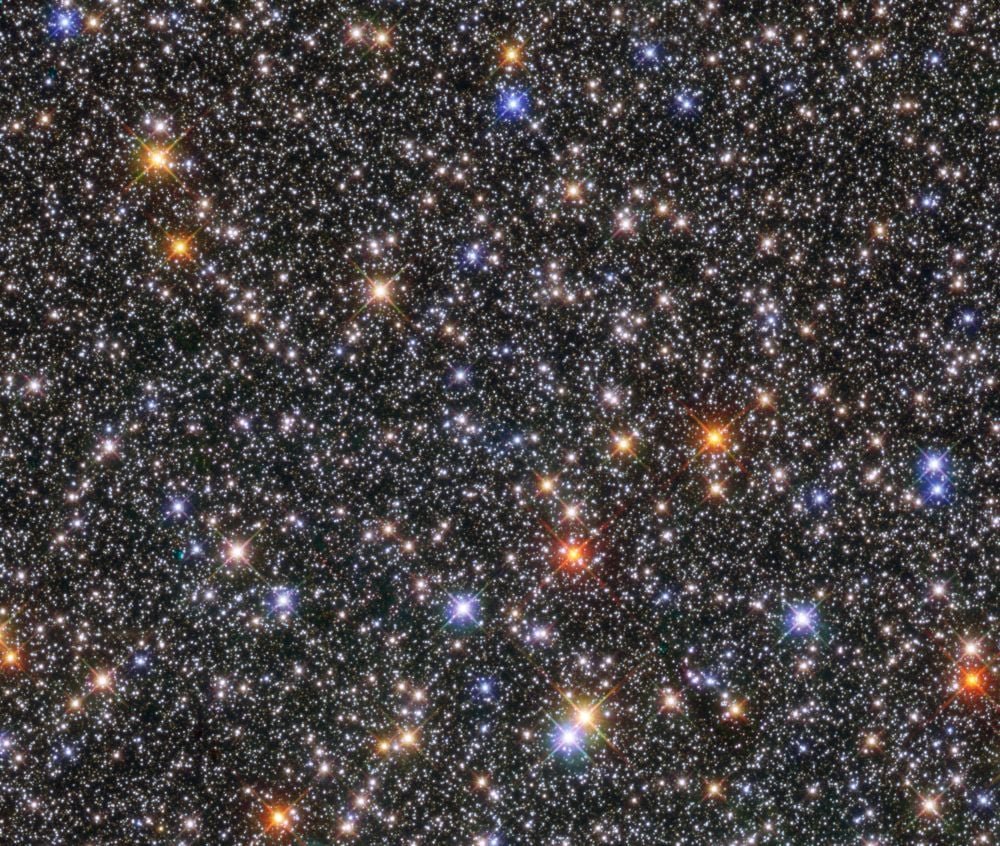 This Hubble image of the Milky Way's galactic bulge from 2018 shows how densely packed it is with glittering stars. With this many objects, it's a rich feeding ground for gravitational microlensing. Image Credit: NASA, ESA, Thomas Brown
“The great thing about microlensing is that we’ll be able to do a complete census of objects as small as Mars that are moving between us and these fields in the bulge, no matter what it is,” said co-author Jay Anderson in a press release. Anderson is from the Space Telescope Science Institute in Baltimore.
But gravitational microlensing is complex. Sometimes a foreground star will line up with a background star, and astronomers struggle to distinguish which is which. Timing is critical in microlensing, and the Hubble's preparatory observations will help astronomers discern which light is coming from which object.
"In terms of angular resolution and sensitivity, the Hubble Space Telescope (HST) is exceptionally well matched to Roman," explain the authors. The Hubble can also sense more blue light than the Roman, which complements the new telescope's observations. "HST has been widely used to image the Galactic bulge along multiple sight lines to study stellar populations, ages, kinematics, and star formation history," the authors write.
“The main goal of these observations is to be able to identify objects that participate in lensing events during the Roman survey, catching them before they undergo the lensing event,” said Anderson. “When, in a couple of years, an event happens during Roman's long stare at the field, we can go back and say, ‘This was a red star, this was a blue star, and the event happened when the red star went in front of the blue star.’”
The Hubble isn't the only telescope that has observed the Milky Way's galactic bulge. The Polish Optical Gravitational Lensing Experiment (OGLE) began in 1992 and is ongoing. The Microlensing Observations in Astrophysics (MOA) is a collaboration between Japan and New Zealand that began in 1995.
But some of these observations are too old to help the Roman's GBTDS. "One caveat that may complicate the analysis for some of the significantly older historical events is that “too much” time has passed since the microlensing event, such that the identification of the lens star is ambiguous and possibly confused with other nearby unrelated stars in the field," the authors write.
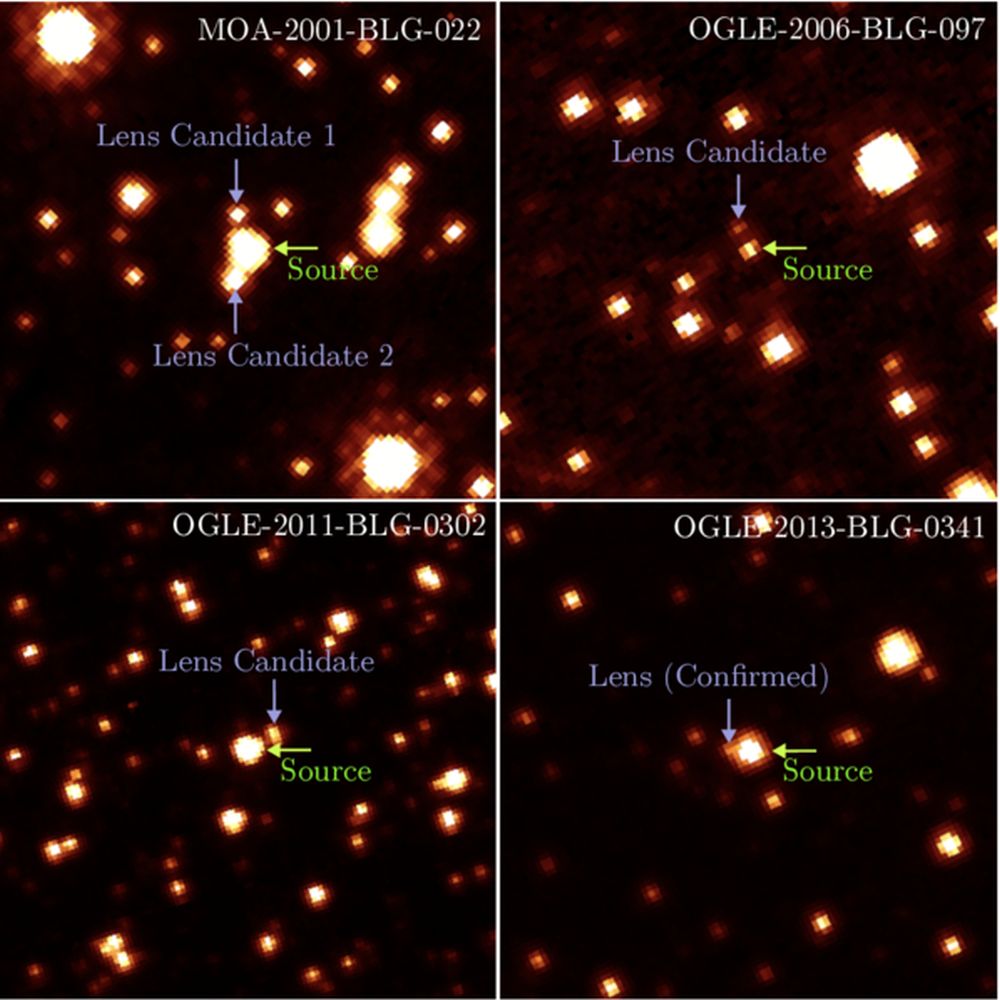 This figure illustrates how some observations of the galactic bulge are too old to be useful. The top left panel shows how confusing it can be. "The brighter source star is at center frame, indicated by the yellow arrow, with two possible nearby lens candidates indicated with blue arrows," the authors write. "The two candidates have a similar on-sky separation from the source star," they explain, which leads to uncertainty. The precursor Hubble observations can be combined with the Roman's observations to determine which candidate is the lens star. Image Credit: Terry et al. 2026. ApJL
Hubble's preparatory observations will do more than help the Roman discern which stars are lens stars in gravitational microlensing. The Hubble can also help astronomers understand the lens stars better, especially their masses. "Instead of estimating a mass ratio of a planet that's orbiting a star, we can say that we're confident it's a Saturn-mass planet orbiting a star that's 0.8 solar masses, for example,” Terry said. “So with the help of precursor imaging from Hubble you can hope to get direct measurements of the masses as opposed to indirect mass ratios.”
The Hubble's observations will also identify zones of extinction in the galactic bulge. These are regions so choked with gas and dust that we can't see the stars, and the Hubble will map them.
The Hubble's precursor work will also be the foundation for a new stellar catalog. That will also feed into the Roman's work, helping the telescope determine the characteristics of stars that host exoplanets. Once the Roman gets going, it will increase the stars in that catalog by an order of magnitude.
“This Hubble survey will build a catalog of 20 to 30 million point sources,” said Terry. “But, by the end of the Galactic Bulge Time-Domain Survey, Roman may measure about 200 to 300 million, and it will produce, essentially, some of the deepest images ever taken of any part of the sky.”
The Hubble is gradually losing its ability to point itself as its gyroscopes fail. One day, the space telescope's lengthy mission will come to an end. But it's leaving behind an admirable legacy, even though it will be superseded by more powerful technology. But the grand old Hubble will never lose its place in history. That will be cemented for all time.
It's fitting that one if its final acts, a dedicated survey, is like a passing-of-the-baton moment.
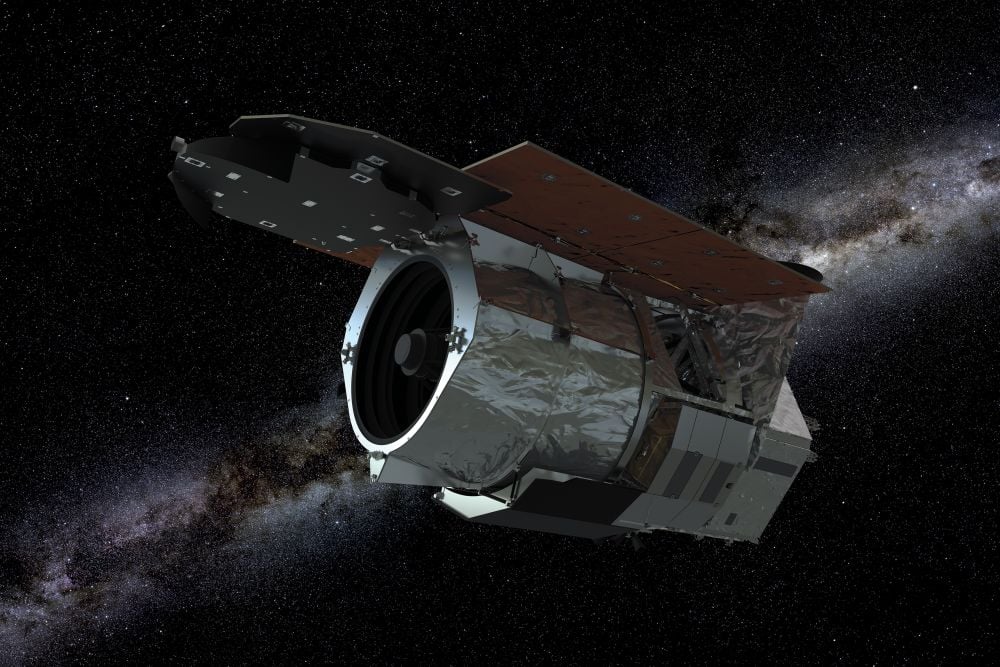 This artist's illustration shows the Nancy Grace Roman Space Telescope against a backdrop of the Milky Way. The telescope is scheduled to launch in September 2026, six months ahead of schedule. Image Credit: NASA, NASA-GSFC
"Ultimately, we aim for this HST survey to be largely supportive of, and enhance in many ways, the science output of the Roman GBTDS," the authors write in their conclusion. "The final HST catalog of ∼25 million stars will benefit future bulge population studies, dynamics, exoplanet systems, extinction, metallicities, and much more as a legacy dataset for the community as we advance toward the Roman era and beyond."
"This campaign secures HST’s lasting impact on the high-precision study of stellar populations, dynamics, exoplanet systems, interstellar extinction, metallicities, cluster associations, and more toward the center of our Galaxy," the authors write.

