 Universe Today
Was Percival Lowell kind of, sort of, almost right? In the early 20th century, Lowell speculated that Mars had canals that criss-crossed the surface and intersected with one another. Telescopes at the time could neither prove him right nor wrong, and Lowell argued that these canals were the engineering work of an advanced civilization.
That idea has passed into history, and our understanding of the Martian surface has changed from fanciful guesswork informed by hazy images to certainty generated by high-resolution cameras aboard multiple Mars orbiters.
Those images have shown that there are no canals and no technological civilization, but there are natural waterways.
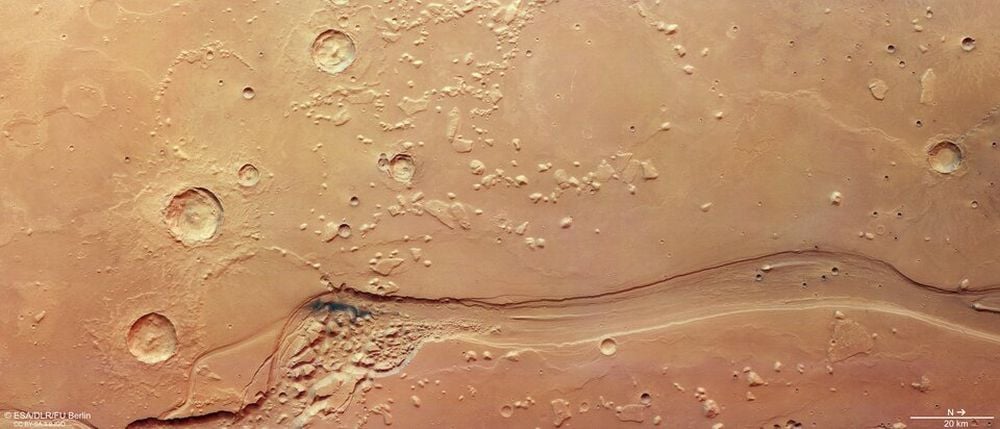
Shalbatana Vallis is an ancient water channel on Mars in the Oxia Palus quadrangle. Oxia Palus has varied terrain including ubiquitous craters, lava, chaos terrain and water channels like Shalbatan Vallis.
The European Space Agency's Mars Express Orbiter (MEO) has imaged Shalbatana Vallis with its High Resolution Stereo Camera (HRSC). Shalbatana Vallis travels for about 1300 km (800 miles) across the Martian surface. It begins near Orson Welles crater in a region of chaos terrain and ends in Chryse Planitia, a plain in Mars northern equatorial region.
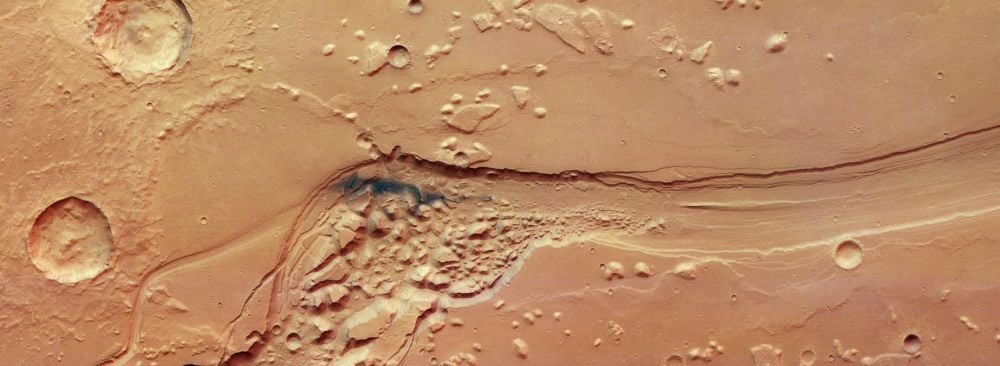 This zoomed-in image shows more of the detail in the chaos terrain at one end of Shalbatana Vallis. The dark patch is volcanic ash blown into the channel by Mars' winds. Image Credit: ESA/DLR/FU Berlin. LICENCE: CC BY-SA 3.0 IGO or ESA Standard Licence
The creation of Shalbatana Vallis wasn't a long process, like a river gradually carving out a channel over millions of years. It was created about 3.5 billions of years ago in one rapid event.
Scientists think that large amounts of water and/or ice were trapped under the Martian surface. The water was pressurized, and perhaps kept in a liquid state by geothermal heat. Something triggered a rapid release of this water, maybe a massive impact. As the water was released to the surface, the material above it collapsed, creating the jumbled chaos terrain. This would've been a catastrophic event to observe, as massive amounts of water surged across the planet's surface, rapidly carving a 1300 km channel.
Shalbatana Vallis was once deeper than it is today. Over 3.5 billion years, the Martian winds have deposited material into the channel's bottom.
The water channel is not the only one on Mars. There are many of them, and some of the largest ones terminate in Chryse Planitia. Because of this, scientists think that Chryse Planitia was once covered by an ocean in Mars warm, watery past.
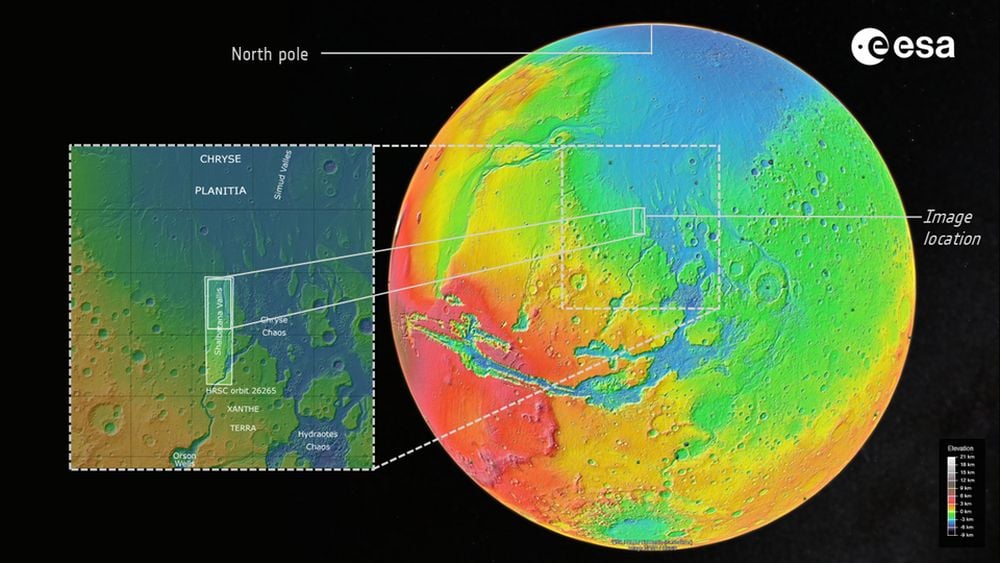 This image shows Shalbatana Vallis' location on Mars and how it terminates in Chryse Planitia. Other water channels terminate in Chryse Planitia as well, and it may have been covered by an ocean in the past. Image Credit: NASA/USGS; ESA/DLR/FU Berlin. LICENCE: ESA Standard Licence
Orbiters like Mars Express have brought the Martian surface to life. High-resolution images have replaced grainy observations, and scientific rigour has replaced whimsical interpretations.
We once wondered if Mars was warm, and if it had liquid water on its surface in its distant past. Now we can conclude, with images like this of Shalbatan Vallis, that the red planet was much different in the past. We know that water flowed across its surface in catastrophic flooding events, and that its surface held ancient palelakes and even oceans.
One day the same thing might happen with Martian habitability. We've wondered and dreamed for a long time about that. Maybe modern day rovers will replace wondering about Martian habitability with solid evidence, the same way the Mars Express and its fellow orbiters have done for Mars warm, watery past.

