Universe Today
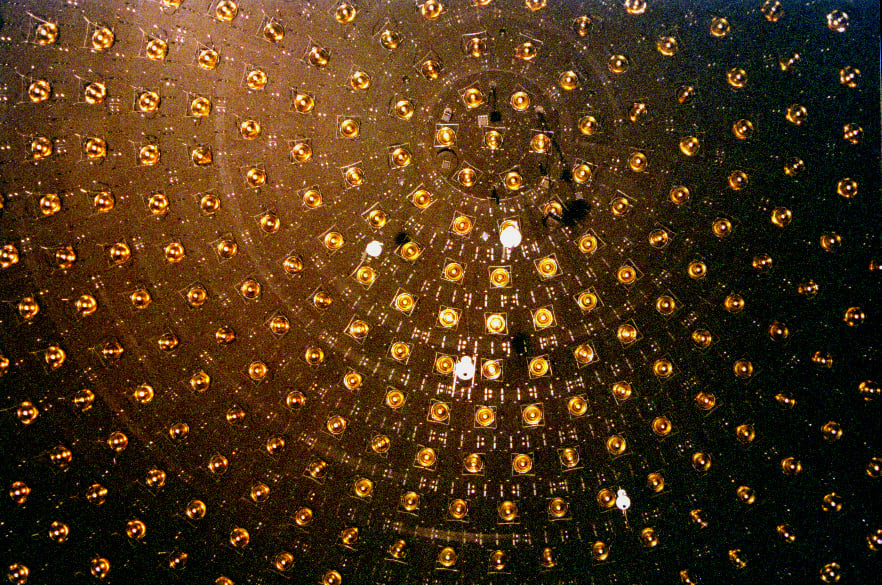
Right now, as you read this sentence, roughly a trillion neutrinos are passing straight through your body. They slip through flesh and bone and even brain without leaving a trace, streaming through the entire planet as if it weren’t there at all. These ghost particles have earned their name through spectacular elusiveness, interacting so rarely with ordinary matter that detecting even one requires enormous underground detectors and considerable patience.
Yet when scientists do manage to capture neutrinos, these invisible messengers offer a direct window into the nuclear furnaces burning at the hearts of stars. Now researchers at the University of Copenhagen have created the first complete map showing exactly how many neutrinos all the stars in our Milky Way generate and where in the Galaxy they originate.
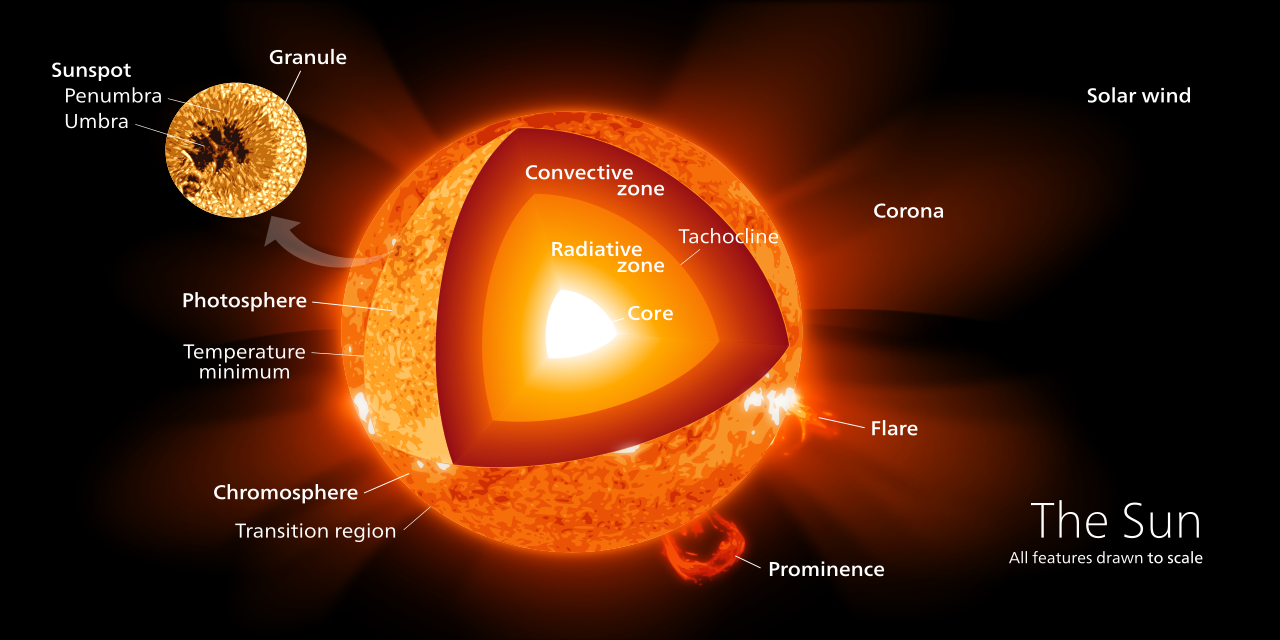 Gamma rays are thought to be generated in the core of stars. Even our local star, the Sun generates them in its core. (Credit : Kelvin Song)
The map, published in Physical Review D, combines advanced stellar models with data from ESA’s Gaia telescope to reveal which regions of our Galaxy produce the strongest neutrino signal. The results point decisively toward the galactic centre, where stars cluster most densely in regions a few thousand light years from Earth. Massive stars, comparable to our Sun or larger, contribute the vast majority of these particles.
This knowledge provides physicists with a roadmap for finding these particles. Neutrino observatories, often buried deep underground to shield their sensitive detectors from cosmic ray interference, now know more precisely where to aim their instruments. By focusing on regions where the neutrino signal should be strongest, researchers can maximise their chances of detection.
“Now we know more precisely where to look for Galactic neutrinos. The mapping reveals that younger stars heavier than the Sun produce the most neutrinos, with production varying significantly based on stellar age and mass” - lead author Pablo Martínez-Miravé, a postdoc at the Niels Bohr Institute.
Why chase these phantoms across the galaxy? Because neutrinos offer insights that light and other radiation simply cannot provide. Traditional astronomy relies on photons, electromagnetic radiation that interacts constantly with matter during its journey through space. By the time starlight reaches Earth, it carries the accumulated fingerprints of everything it encountered along the way.
Neutrinos take a different path. Born in nuclear reactions deep inside stellar cores, they escape almost immediately, barely affected by the vast amounts of matter between the star’s heart and its surface. When we detect them here on Earth, we’re receiving direct information about what happens inside stars, information that traveled to us essentially undisturbed.
Because neutrinos interact so weakly with their surroundings, even tiny unexpected deviations in their behaviour during their journey to Earth could signal new physics, fundamental laws that traditional experiments might never detect. With this new model in hand, researchers now have both map and compass to begin navigating the invisible universe these ghost particles reveal.
Source : How Many Ghost Particles All the Milky Way’s Stars Send Towards Earth