Universe Today
The universe occasionally produces flashes of light so bright and so blue that they outshine entire galaxies, then vanish within days. For years, astronomers studying these rare events, called luminous fast blue optical transients, or LFBOTs, debated their origin. Were they unusual supernovae, or something fundamentally different?
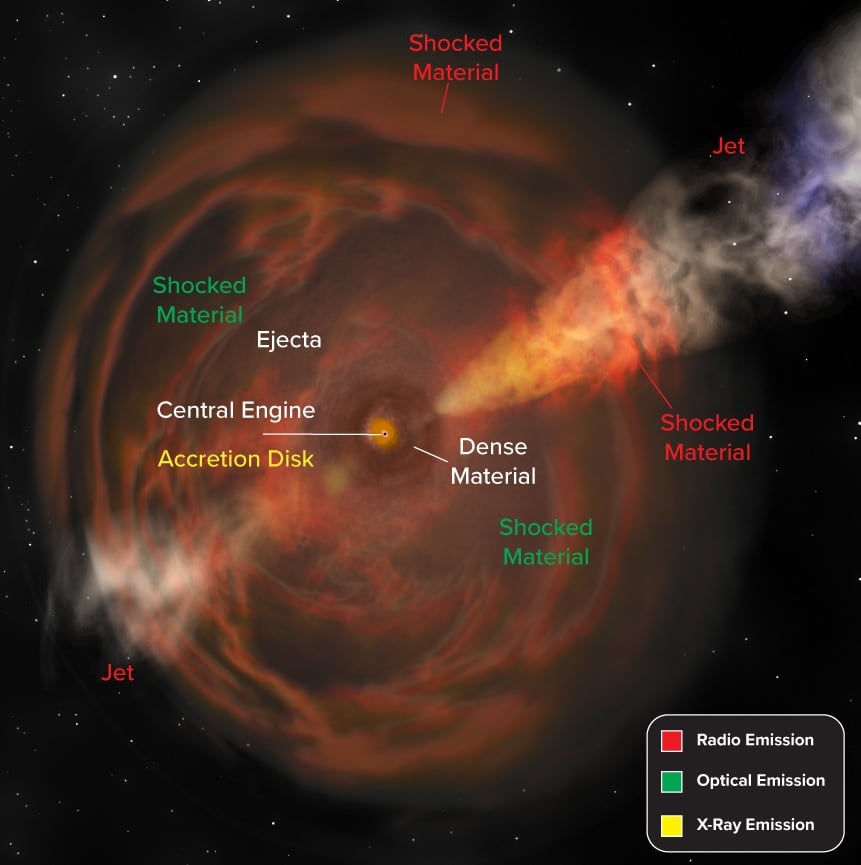
The answer arrived in dramatic fashion with AT 2024wpp, detected 1.1 billion light years from Earth. This event blazed brighter than any LFBOT previously observed, and crucially, it radiated 100 times more energy in its first 45 days than a normal supernova releases over a much longer period. That extraordinary output pointed to something beyond a stellar explosion, a powerful central engine driven by a black hole.
"For the first time we have confirmed that these transients require some sort of central energy source beyond what a supernova can produce normally on its own," - Natalie LeBaron, a graduate student at UC Berkeley.
The findings, published in The Astrophysical Journal Letters, reveal that LFBOTs occur when a black hole, potentially up to 100 times the mass of the Sun, completely shreds its massive stellar companion. These intermediate mass black holes occupy an intriguing size range between stellar mass and supermassive black holes, and their existence has been inferred from gravitational wave detections but never directly observed through electromagnetic radiation until now.
The scenario researchers have constructed is both violent and complex. The black hole and its companion star likely existed in a long lived binary system, with the black hole gradually siphoning material from its partner over an extended period. This process surrounded the black hole with a halo of gas too distant to be immediately consumed, sitting in orbit like a waiting reservoir.
When the companion star, probably more than ten times the Sun's mass, finally ventured too close, tidal forces tore it apart completely. The newly disrupted stellar material became entangled with the black hole's rotating accretion disk, slamming into the existing gas at tremendous velocities. The collisions produced powerful bursts of X-ray, ultraviolet, and blue light. Simultaneously, some material was funnelled toward the black hole's poles and expelled as jets traveling at roughly 40 percent light speed, generating radio waves when they collided with surrounding gas.
The shredded companion was likely a Wolf-Rayet star, an evolved stellar behemoth that had already shed much of its hydrogen envelope. This naturally explains the weak hydrogen signatures detected in AT 2024wpp's spectrum, a puzzle that had complicated earlier LFBOT interpretations.
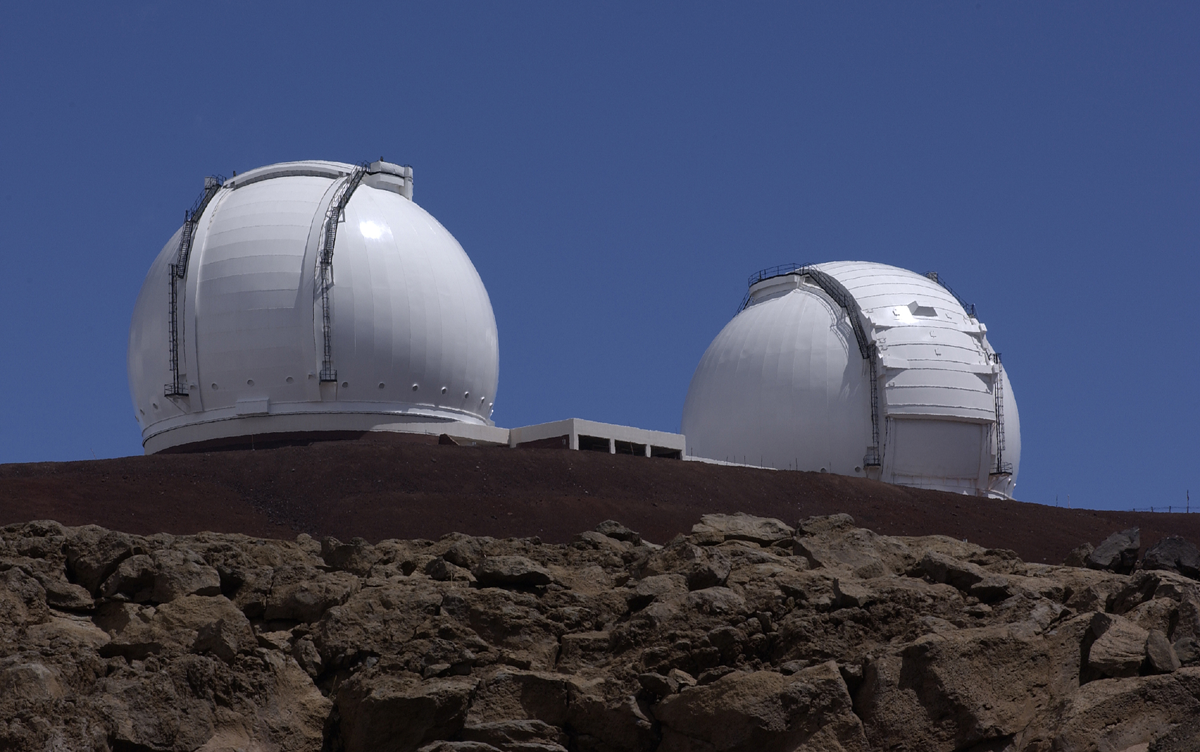 Keck Observatory (Credit : T. Wynne / JPL)
Observations from the W. M. Keck Observatory proved crucial to unraveling this mystery. Using the Low Resolution Imaging Spectrometer, astronomers detected extremely faint hydrogen and helium signatures showing an unusual double peaked pattern. This indicated the explosion wasn't spherically symmetric but instead lopsided and complex, consistent with material interaction in an accretion disk rather than a straightforward stellar explosion.
Keck's Near Infrared Echellette Spectrograph uncovered another critical piece of evidence about 24 days after the initial detection: an unusual excess of near-infrared light. This marks only the second time such a feature has been observed in LFBOTs, suggesting it may be a defining characteristic of these events. The discovery opens possibilities for future mid infrared observations that could further reveal the physical processes behind these mysterious glows.
Source : Astronomers Pinpoint Black Holes as the Power Source Behind Mysterious Cosmic Flashes