 Universe Today
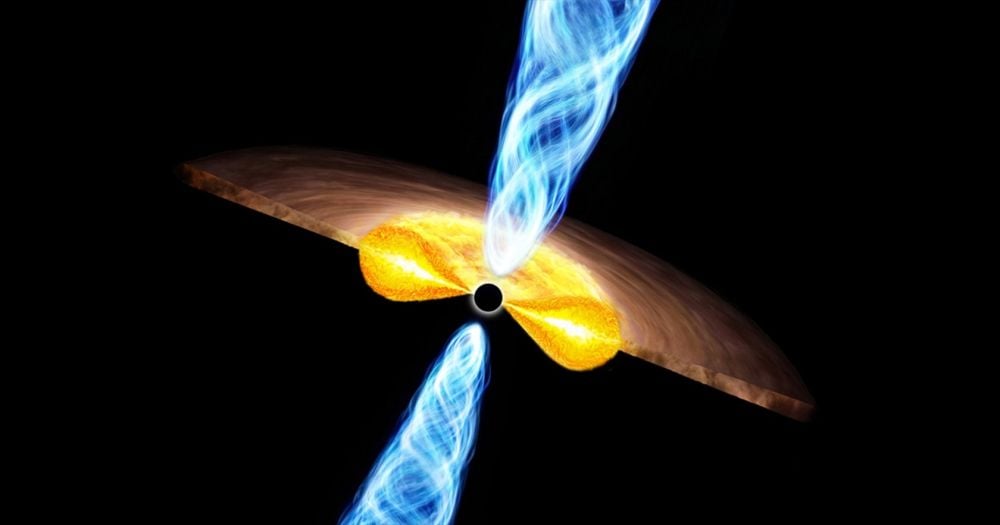
Astrophysical jets from supermassive black holes are awe-inspiring phenomena. These jets, made of ionized gas, extend for millions of parsecs, and can reach relativistic speeds. They can alter their galactic surroundings, affecting the gas inside the host galaxy, and beyond that into the host cluster, whey they can disrupt star formation.
SMBH only emit these jets when they're actively feeding. The material they feed on gathers in a super-heated accretion disk, but not all of it is consumed by the SMBH. Some of it is ejected by these jets, driven by the powerful magnetic fields in the accretion disk.
Despite understanding the overall picture, astrophysicists struggle to answer certain questions about the process. New research in The Astrophysical Journal Letters examined the link between accretion and jets. It's titled "Disk Truncation Triggers Relativistic Jet Launching of a Highly Accreting Supermassive Black Hole," and the co-lead authors are Hirofumi Noda and Kazuhiro Hada. Noda is an Associate Professor at Tohoku University, and Hada is from Nagoya City University.
"Relativistic jets are among the most energetic phenomena in the Universe and influence galaxy evolution through energetic feedback, yet the physical connection between accretion flows and jet launching remains unresolved," the authors write. "Jet production is widely attributed to the Blandford–Znajek (BZ) mechanism, which extracts black hole rotational energy via large-scale magnetic fields sustained by an accretion flow."
There are two types of accretion disks: hot, thick disks and cold, thin disks. The problem is, there seems to be an apparent contradiction between what BZ needs to launch jets and what thin accretion disks can supply. "Although this mechanism is observationally well supported for hot, geometrically thick accretion flows, highly accreting environments with strong jets present a paradox, as they are typically dominated by cold, geometrically thin disks incapable of sustaining large-scale magnetic fields," the authors explain.
So even though the BZ requires large-scale magnetic fields to launch jets, thin jets don't seem to provide that. Yet these disks still launch jets. What's going on?
To find out, the researchers used powerful x-ray and radio observations to examine 3C 120, an active galaxy about 420 million light years away. It's rapidly accreting material and is also emitting jets. They used the X-ray Imaging and Spectroscopy Mission (XRISM), the Global Millimeter Very Long Baseline Interferometry (VLBI) Array (GMVA), the Very Long Baseline Array (VLBA), and East Asian VLBI Network (EAVN).
3C 120 is an ideal subject for these observations.
"The broad-line radio galaxy 3C 120 (z = 0.033), with a black hole mass of MBH ∼ 6.3 × 10⁷ M⊙, provides an ideal laboratory for addressing this problem," the authors write. "Unlike weakly accreting AGN such as M87, 3C 120 accretes at a relatively high rate, while simultaneously launching a powerful relativistic jet."
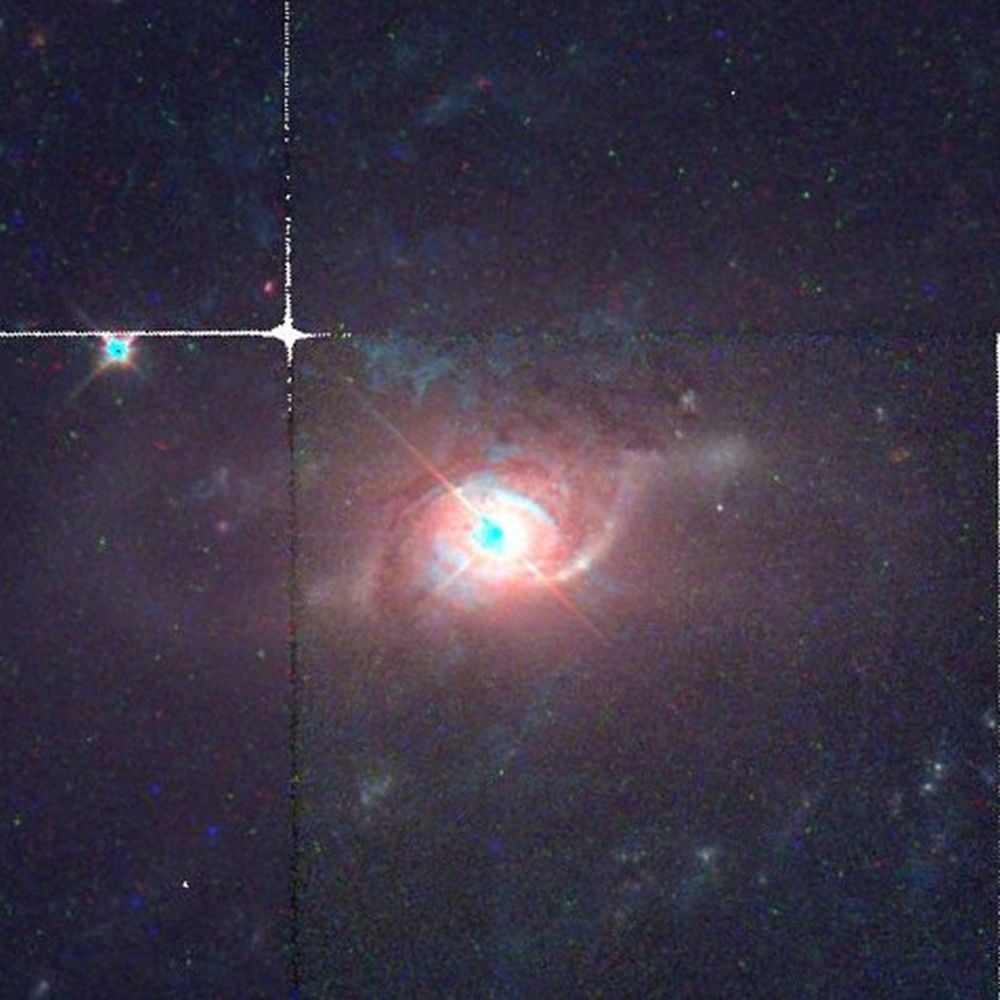 A Hubble image of 3C 120, an active galaxy with a rapidly-accreting SMBH that's launching jets. The researchers examined it with state of the art x-ray and radio observatories. Image Credit: By HST and C messier - Public Domain, https://commons.wikimedia.org/w/index.php?curid=133791754
"By looking at the same black hole with state-of-the-art X-ray and radio telescopes, we were able to see both the hot plasma surrounding the black hole and the jet emerging from it," co-lead author Noda said in a press release. "This allows us to directly connect the extreme environment near the black hole with the formation of the jet."
XRISM observations found an iron emission line in the disk around 3C 120. With some help from general relativity, and a distortion in the iron line, the researchers figured out how close to the black hole the disk reaches. This showed them that the disk is truncated.
"High-resolution X-ray spectroscopy reveals a relativistically broadened Fe Kα line, indicating that the cold, geometrically thin disk is truncated at ∼20Rg (Rg is the gravitational radius), with the inner region replaced by a hot, geometrically thick flow," the authors write. So the disk has two parts, an outer cold, thin disk, and an inner hot, thick disk.
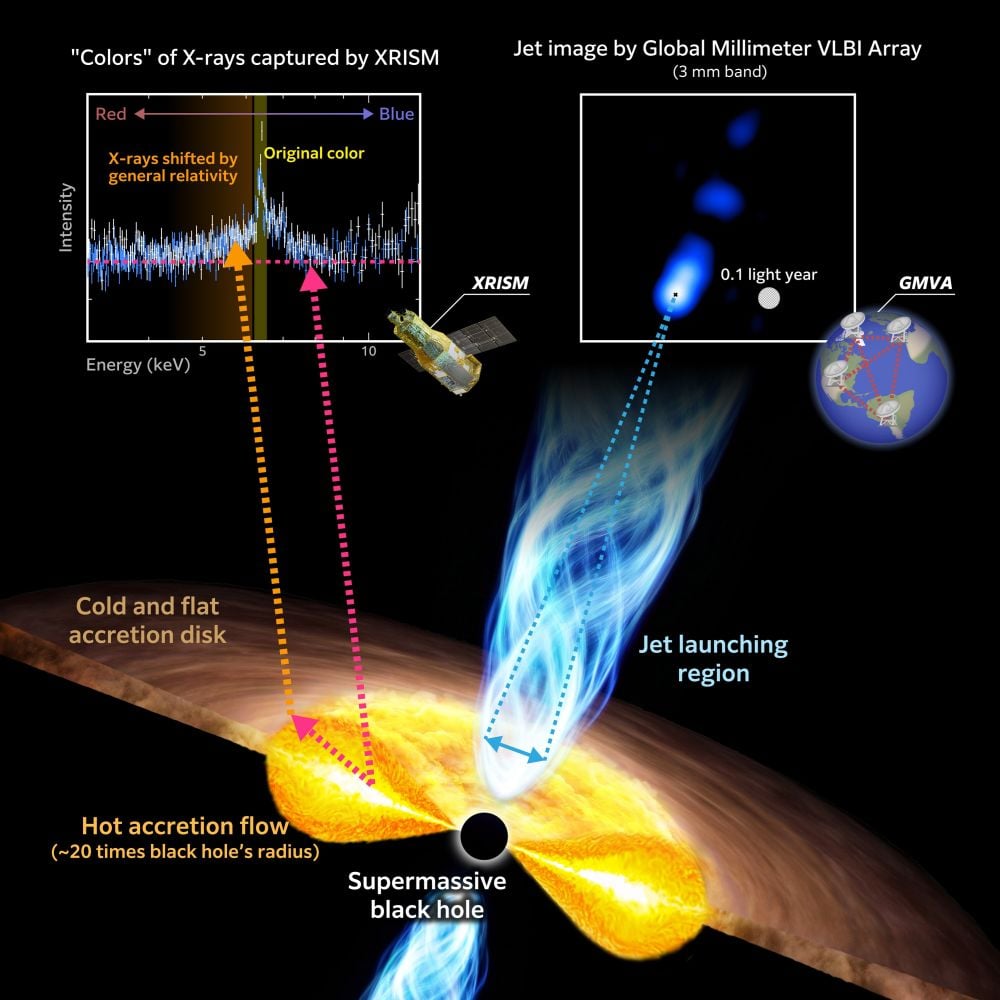 This figure illustrates the new findings. At the top left, XRISM accurately measured the "color" of X-rays from the vicinity of the black hole. The wavelengths are stretched, and general relativity changes their colors. An image of the jet obtained by the Global Millimeter VLBI Array at a wavelength of 3 mm is shown at the top right. The bottom is an artist's impression of the environment around a rapidly feeding supermassive black hole. The cold, flat accretion disk truncates at roughly 20 times the black hole's radius, transitioning into a hot accretion flow inside of which the jet is launched. Image Credit: ©Tohoku University
So even though the outer disk can't provide the magnetic fields for the SMBH to launch its jets, the inner disk can.
"These results demonstrate that, even at high accretion rates, jet launching is linked to a hot inner flow, possibly via the Blandford–Znajek process, providing evidence for a universal disk–jet connection via geometric transition," the authors write.
The idea that the Blandford–Znajek mechanism is necessary for a SMBH to launch jets is partly based on observations, but also on simulations. This work offers a new way to observe a SMBH, its disk, and its jets. The method will be applied to a larger sample to learn even more about the disk truncation phenomenon.
"These results highlight the pivotal role of coordinated high-resolution X-ray spectroscopy and VLBI imaging in unraveling black hole MHD, and demonstrate how inner structural transitions establish magnetically favorable sites for spin-powered jets," the researchers write in their conclusion.
"Our next goal is to build a more complete picture of how matter, magnetic fields and black hole rotation interact in these extreme environments," Noda said. "Understanding this process may also help us better understand how supermassive black holes influence the evolution of galaxies and the larger structures of the Universe."
