 Universe Today
Only stars have the power to forge elements heavier than hydrogen and helium. In astronomy, elements heavier than those two are called metals, and as the Universe has aged and generations of stars have lived and died, the Universe has gained higher metallicity. Stellar winds and supernovae spread these metals into space, where they're taken up in the next generation of stars that form. When astronomers examine stars, one of the most important measurements are their metallicities.
Stellar metallicity is expressed as a ratio between iron and hydrogen. It's written as [Fe/H], and it indicates the logarithmic ratio of iron to hydrogen, relative to the Sun's value. Iron is used because of the iron peak, a well-understood limit in stellar nucleosynthesis. While Fe/H doesn't always measure other metals uniformly, it comes pretty close and is a reasonable proxy for a star's overall metallicity. Iron is also easily found in stellar spectra, increasing its utility.
Astronomers and astrophysicists describe three generations of stars, and each generation is marked by different levels of metallicity. Astronomer Walter Baade created three classifications of stars by populations. Population I stars are the youngest and have the highest metallicity. Our Sun is a population I star. Population II stars are older and have lower metallicities than Population I stars. Population III stars are hypothetical. They were extremely hot, massive, and luminous stars with almost no metals. They were the first stars to form in the Universe.
No stars are identical, however, and individual stars' metallicities can vary within each population. The Populations describe ranges of metallicities.
Astrophysicists are eager to find Population II stars because they hold answers to questions about stars and the evolution of the Universe.
Now a group of researchers have found an elusive Pop II star in the ultra-faint dwarf galaxy Pictor II. Pictor II is over ten billion years old, and one star named PicII-503 is likewise ancient. The discovery is in a paper in Nature Astronomy titled "Enrichment by the first stars in a relic dwarf galaxy." The lead author is Anirudh Chiti, a postdoctoral researcher at the University of Chicago at the time of the work.
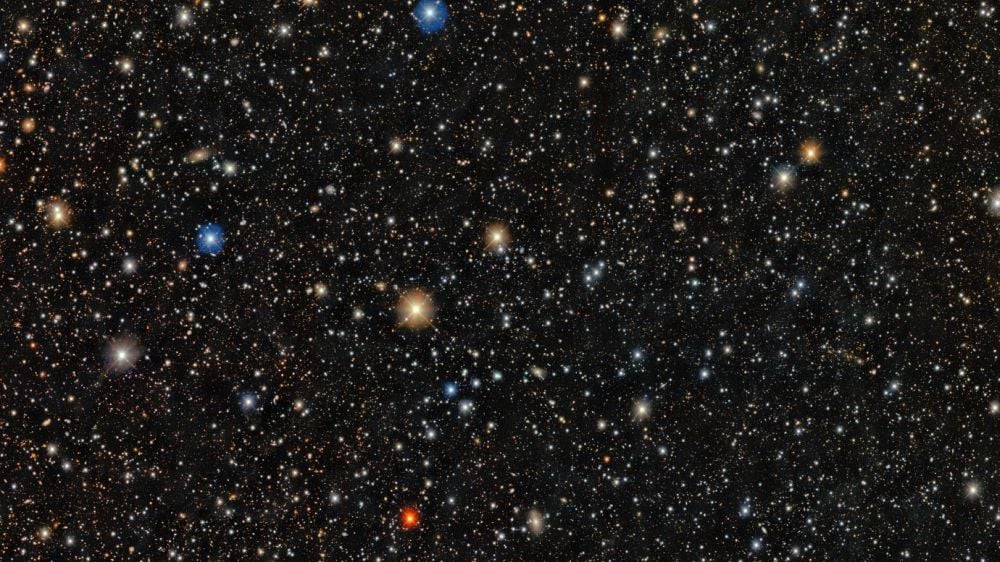
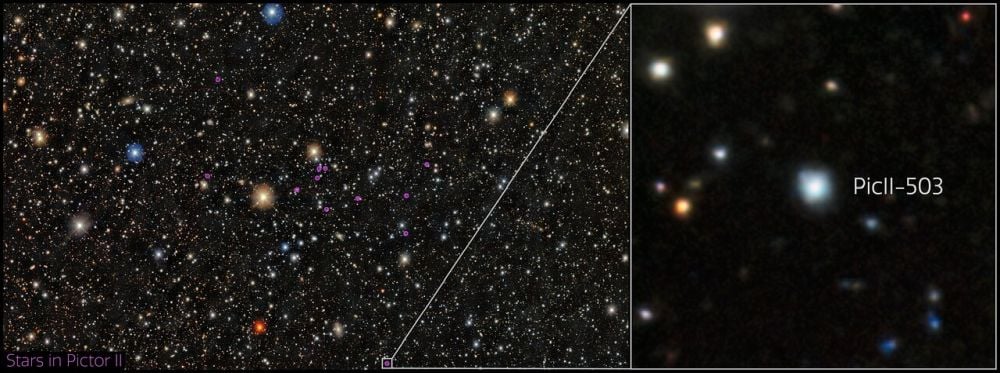 This image shows stars in the ultra-faint dwarf galaxy, Pictor II. Pictor II is a satellite galaxy of the Large Magellanic Cloud, which is a satellite galaxy of the Milky Way, and is located in the constellation Pictor. The system is made up of several thousand stars and is more than ten billion years old. Image Credit: CTIO/NOIRLab/DOE/NSF/AURA Image processing: Image Processing: T.A. Rector (University of Alaska Anchorage/NSF NOIRLab), M. Zamani & D. de Martin (NSF NOIRLab) Acknowledgment: PI: Anirudh Chiti, Alex Drlica-Wagner
Extreme examples of natural objects are important in science because they're so instructive. The Pop II star in this discovery has an extremely low [Fe/H], as well as other specific chemical fingerprints that address outstanding questions in astrophysics.
PicII-503's [Fe/H] is only −4.63, which is less than 1/43,000th of the Sun's solar iron. Even when compared to known metal-poor stars this is exceptionally low. The star's calcium is also extremely low, at about 1/160,000th of the Sun's. But it's carbon is enhanced by 3,000 times relative to iron.
Why does it matter? Almost all of the lowest-metallicity stars scientists know of in the Milky Way are also enhanced in carbon. They're found in our galaxy's halo.
Pop II stars bear the chemical fingerprints of their Pop III predecessors, so this star's chemistry shows that it had very few progenitors, possibly only one. It likely formed from a gaseous mixture expelled by a single supernovae, with no other interstellar mixing involved. So in this sense, it's like a chemical fossil from the early Universe.
“This is the first really clear detection of which elements are initially produced in primordial galaxies,” lead author Chiti said in a press release. “It’s a nice missing piece of the puzzle about how elements were formed back in those early days.”
Stars like PicII-503 exemplify what's known as the carbon-enhanced metal-poor (CEMP) phenomenon. Astrophysicists have struggled to explain whey they have so much carbon, and why no other elements are also enhanced. Finding one in a galaxy outside of the Milky Way could hold the key to understanding CEMP stars.
"The star’s exceptional paucity in iron and calcium make it clearly preserve enrichment from the first stars in a relic dwarf galaxy; Pictor II is one of the smallest, most chemically primordial systems known," the authors explain.
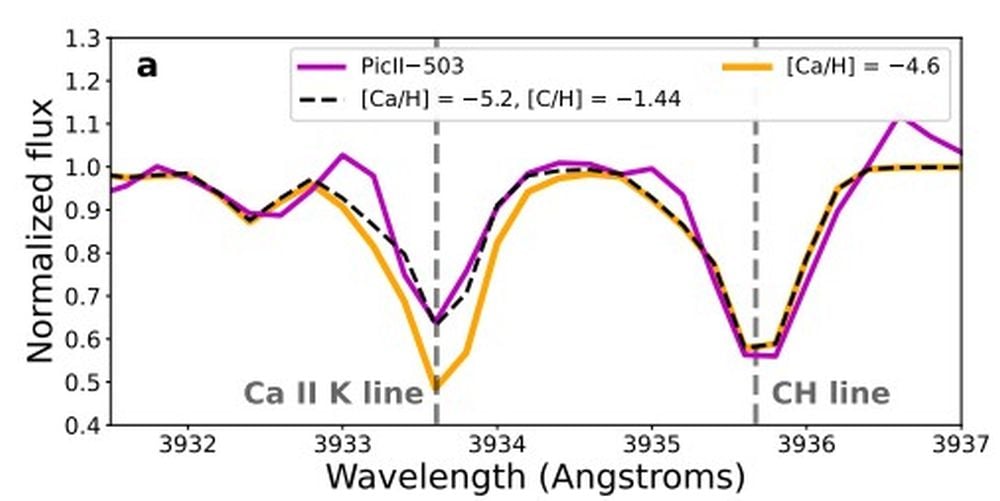 This figure illustrate's some of PicII-503's metallicity. It provides "Spectroscopic confirmation of PicII-503 as an ultra metal-poor, carbon-enhanced star," the authors write. "The Ca II K feature is typically the strongest metal line in stars, and is barely detected for PicII-503. The adjacent absorption feature is an otherwise weak carbon line that appears due to the high carbon abundance of the star." Image Credit: Chiti et al. 2026. NatAstr.
Massive stars are effective at nucleosynthesis precisely because of their great masses. They're also the progenitors to supernovae, which spread these elements out into space, to be used in the next generation of star formation. But since their masses vary, so does the energy of their explosions, and that has consequences for which elements they can eject.
Some exploding stars are low-energy supernovae. It means that their explosive power is weaker than their high-energy counterparts. The researchers say that these low-energy exploding stars created the carbon enrichment found in Pop II stars.
What happens is that even though metals are synthesized in these stars, they lack the energy to expel these heavy elements. Stars are kind of like onions, with lighter elements nearer the surface and heavier elements under them. Heavier elements like iron and calcium fell back into the core during the low-energy supernova explosion, while lighter elements like carbon were ejected. So when the Pop II star PicII-503 formed from this progenitor, it acquired less iron and calcium and more carbon.
The fact that they found this Pop II star in a dwarf galaxy is significant. Since the ultra-faint dwarf galaxy Pictor II is so small, it has less gravitational power. It contains only a few thousand stars. A high-energy supernovae would've blown much more of its contents outside of the small galaxy, while a lower-energy one wouldn't. So finding PicII-503 in this lower-gravity galaxy helps confirm its ancient chemical fingerprints and that low-energy supernovae are responsible for CEMP stars.
"This star supports the hypothesis that extreme carbon enhancement results from low-energy supernovae from the first stars, as the yields of energetic supernovae are harder to retain in small-scale environments," the authors write.
It also helps confirm that CEMP stars in the Milky Way's halo have a similar background. "PicII-503 demonstrates that second-generation CEMP stars in the Milky Way halo can originate from accreted relic galaxies, and supports a low-energy-supernova origin of their enrichment," the authors explain.
“It’s a really nice finding because we have seen a lot of these carbon-rich stars in our own Milky Way galaxy, and now we can see how these stars likely originated,” said Chiti.

