Universe Today
General relativity stands as one of the bedrock theories in modern physics. Its strange view of relative time and space has been confirmed by countless experimental and observational tests, from rotational frame dragging to the radiation of gravitational waves. But there is reason to believe that it is not the final say on the nature of space and time.
One of the big reasons for this is that general relativity breaks down on the scale of the very tiny. The world of atoms and molecules is a quantum one, but general relativity is a classical theory. What we need is a quantum theory of gravity. There are plenty of proposed models for quantum gravity, but they often assume alternative models of gravity. Theories that give the same results as GR for weak gravitational interactions but that deviate from GR in strong gravitational fields. The predictions of these alternative models have been untestable with current observations. But that's starting to change, as a recent set of papers shows.
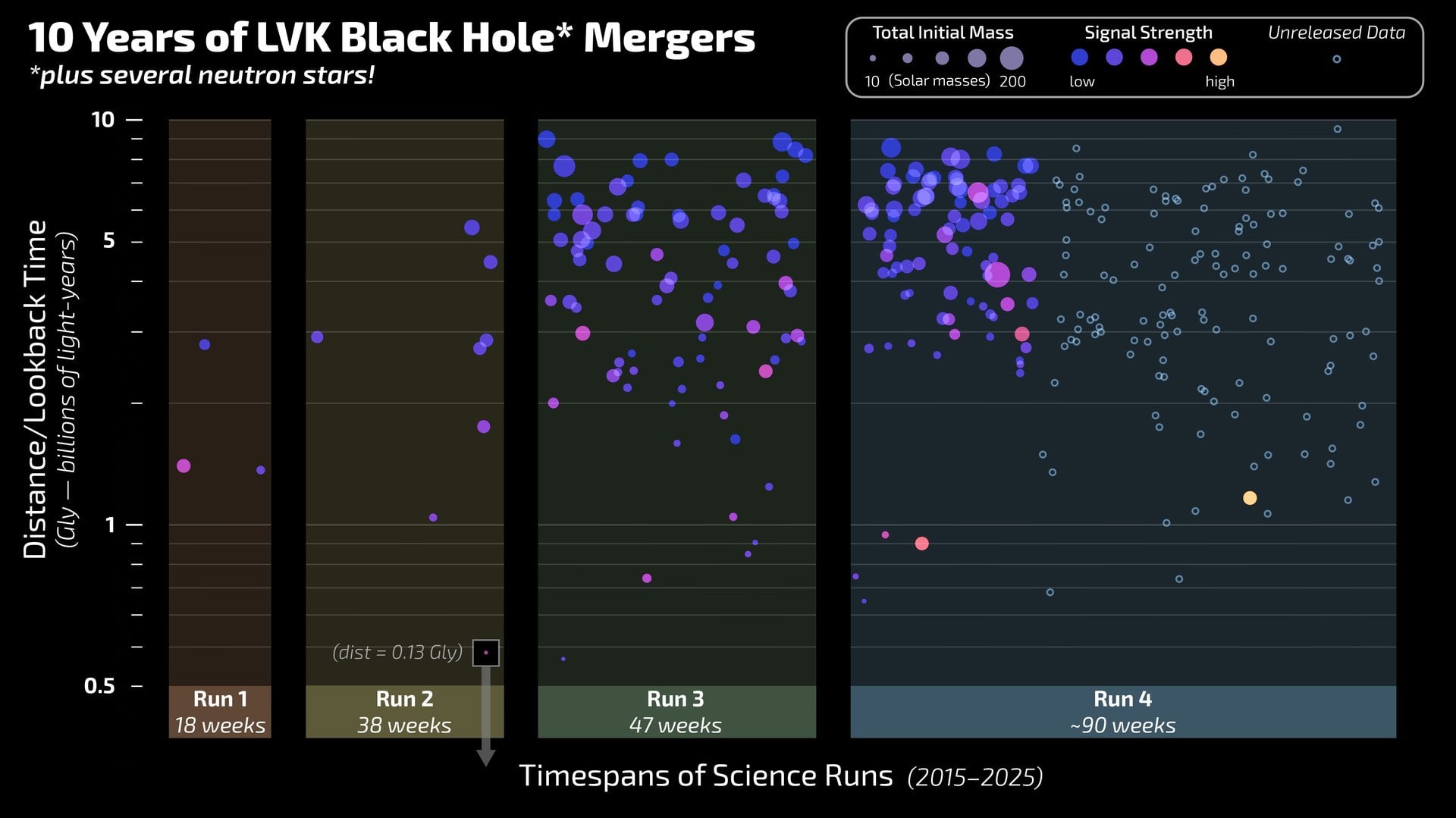
The three papers look at data from the 4th run of the LIGO–Virgo–KAGRA detections of black hole mergers, which is the latest and most advanced set of observations. The first paper looks at the overall comparison of the data with general relativity to see if GR is consistent with the data. The second looks at what are known as post-Newtonian parameters, which is a way to look for deviations from GR. The third paper looks specifically at the "ringdown" data as the newly merged black hole settles down into its new stable state.
As you might expect, all the results support general relativity. The first work found that within the limits of observation, GR is a solid fit. There is no need for an alternative model. There are alternative gravitational models that also fit the data, but we have no reason to assume they are correct.
The second paper further constrained alternative models. In the post-Newtonian approach, you look at how observations deviate from Newtonian gravity by tweaking a set of parameters. The more parameters you can fit to the data, the more precise your model is. The merger data is precise enough to look at the dipole and quadrupole parameters and found no deviation from GR. This means that any alternative model that predicts, for example, a quadrupole deviation is ruled out.
Interestingly, since post-Newtonian approximations of gravity can be quantized, this second paper also gives a new experimental bound on the mass of gravitons. Based on GR and basic quantum theory, gravitons should be massless, just like photons. This new work proves the mass of the gravition must be less than 2 x 10-23 eV/c2. In comparison, in particle physics, the upper bound of photon mass is 10-18 eV/c2.
The third paper focused on the prediction of some alternative theories that merging black holes could create gravitational echoes. That is, after gravitational waves of the merger settle down, there should be a second burst of gravitational waves. These echoes are impossible under general relativity, so detecting them would prove GR is incomplete. The authors found no evidence for gravitational echoes and thus no evidence for alternative gravitational models.
These results are not surprising given how strongly GR has been supported by previous experiments. But the big news here isn't that we've proven Einstein right once again. What is key with these papers is that we now have gravitational wave data good enough to test GR. We can now test how space and time behave in the regions of black holes. All with only a decade of observations. The next few decades of gravitational wave astronomy will finally give us the kind of data we need to truly explore the limits of gravity.
Reference: Abac, A. G., et al. "GWTC-4.0: Tests of General Relativity. I. Overview and General Tests." arXiv preprint arXiv:2603.19019 (2026).
Reference: Abac, A. G., et al. "GWTC-4.0: Tests of General Relativity. II. Parameterized Tests." arXiv preprint arXiv:2603.19020 (2026).
Reference: Abac, A. G., et al. "GWTC-4.0: Tests of General Relativity. III. Tests of the Remnants." arXiv preprint arXiv:2603.19021 (2026).