Universe Today
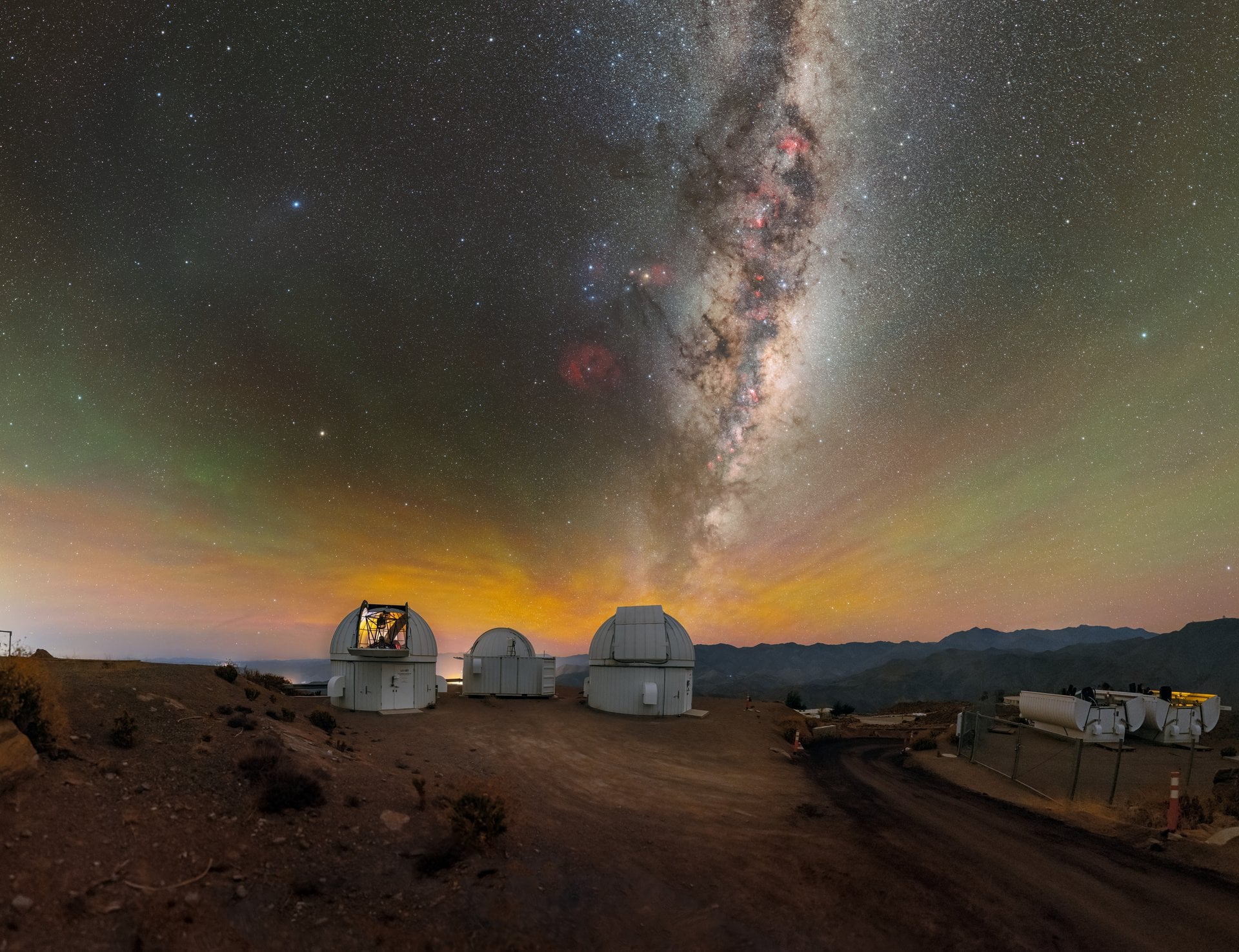
The Vera C. Rubin Observatory commenced operations last summer with the release of its "first light" images. During its ten-year Legacy Survey of Space and Time (LSST), the observatory will study the Universe for indications of Dark Matter and Dark Energy. It will also create an inventory of objects within the Solar System, and explore the sky for "transient" objects - i.e., those that move or change in brightness. These include asteroids, comets, interstellar objects (ISOs), transient stars, and supernovae.
To ensure follow-up observations of these objects, the National Science Foundation (NSF) has developed a system to enable rapid responses to Rubin-generated alerts. This allows observatories around the world to aim their telescopes at fleeting objects in the night sky and conduct rapid follow-up observations before they disappear. The system was recently validated when Rubin issued a series of alerts that led to the classification of four supernovae, which are a vital tool for measuring the expansion rate of the Universe.
The system incorporates a series of tools developed by NSF's National Science Foundation National Optical-Infrared Astronomy Research Laboratory (NOIRLab), including an alert-filtering system, an automatic observation request manager, a network of telescopes - the Astronomical Observatory Event Network (AEON) - to conduct observations, and automatic data reduction software. This system helps to process the millions of alerts Rubin is expected to generate every night once the LSST begins.
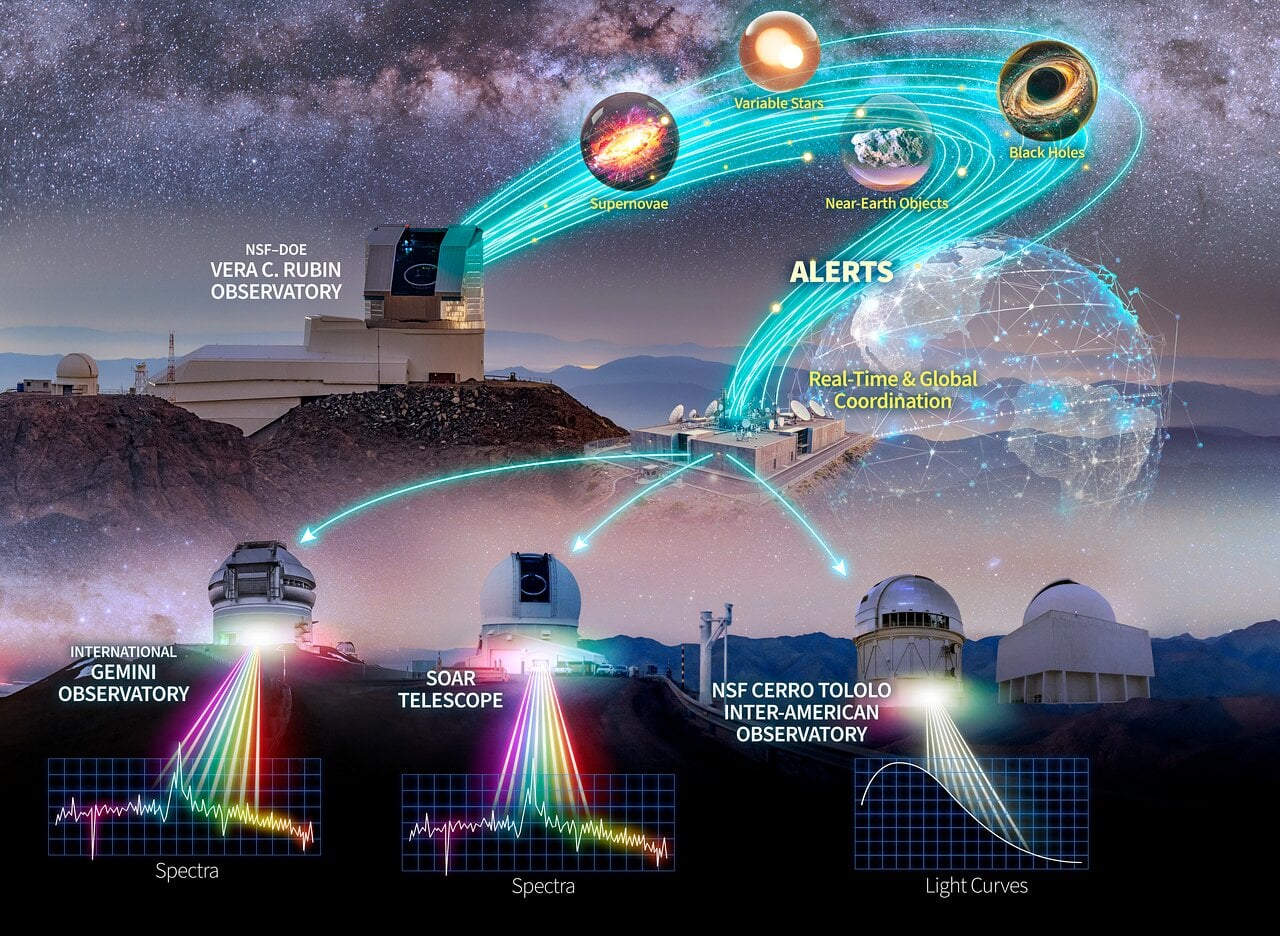 This graphic represents the full NOIRLab ecosystem designed to follow-up on alerts generated by NSF–DOE Vera C. Rubin Observatory. Credit: NOIRLab/NSF/AURA/P. Marenfeld
To interpret the estimated 30 petabytes of data Rubin will obtain during the survey, NOIRLab has also developed a network of "brokers." These consist of software platforms with machine-learning algorithms that filter, sort, and classify alerts before they are released to the scientific community. One such broker, operated by NOIRLab, is the Arizona–NOIRLab Temporal Analysis and Response to Events System (ANTARES).
Once filtered, the alerts are sent to the Gemini Observation and Analysis of Targets System (GOATS), a software tool developed by the Science User Support Department (SUSD) at the Gemini Observatory. GOATS selects objects for follow-up study and automatically submits the observation requests to AEON. This international collaboration includes the NSF Cerro Tololo Inter-American Observatory (CTIO), the Southern Astrophysical Research Telescope (SOAR), the Gemini South and Gemini North telescopes, and the Las Cumbres Observatory global network.
During their follow-up observations, the team responded to a total of 18 alerts from Rubin using the Dark Energy Camera (DECam), the Goodman spectrograph mounted on the SOAR telescope, and the Gemini Multi-Object Spectrographs (GMOS) mounted on both the Gemini North and Gemini South telescopes. ANTARES flagged these alerts as likely being supernovae, which the NOIRLab team confirmed using additional images obtained with Las Cumbres Observatory’s 1-meter and 2-meter telescopes.
This first run of end-to-end Rubin alert observations led to the classification of four supernovae: one Type II, one candidate Type Ic, and two Type Ia. A Type II supernova consists of a massive star exploding and retaining a hydrogen-rich envelope. Type Ic supernovae also involve massive stars exploding, but only after they have lost their outer layers. Type Ia are exploding white dwarf stars, which are the supernovae used to measure the Hubble-Lemaitre Constant, the rate at which the Universe is expanding.
Said Bryan Miller, lead for science operations development at Gemini Observatory, in a NOIRLab press release:
The time-domain community, including NOIRLab, has been building the infrastructure needed to do efficient follow-up from Rubin alerts for over ten years, and it is very rewarding to see the entire ecosystem working as we had envisioned. Lessons learned from the demonstration will be used to improve the systems that we will provide to the community.
The successful end-to-end run has demonstrated the effectiveness of the follow-up ecosystem developed by the NSF and NOIRLab. It offers a preview of how astronomers will use Rubin data to study the Universe in far greater detail. Throughout the LSST's 10-year run, scientists will be alerted to billions of transient objects in the Solar System and beyond and will be able to make rapid follow-up observations before they disappear.
Further Reading: NSF NOIRLab