 Universe Today
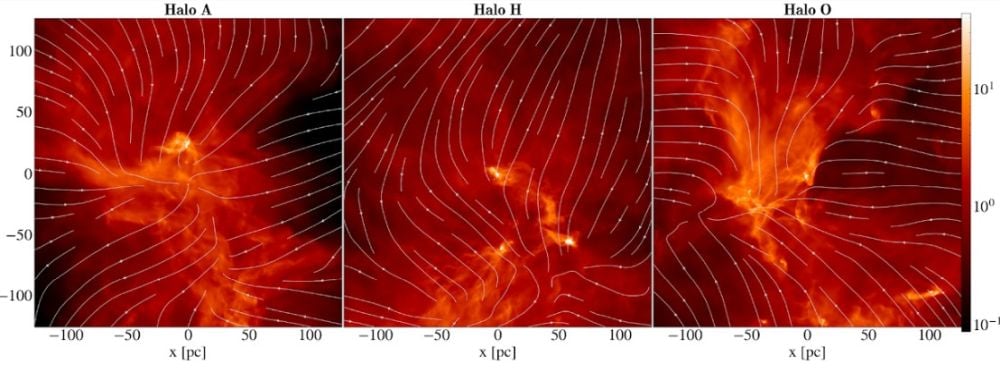
In the beginning, after the Big Bang, the Universe was a cold, dark, desolate place where hydrogen and a little helium drifted aimlessly. Only when the first stars formed in dark matter halos did things get going. Those first stars are called Population III stars, and astrophysicists think they tended to be massive, low-metallicity stars that were extremely hot and luminous and formed in calm environments.
But new research questions this image. Instead of a calm environment that favoured massive stars, the early star-formation environment may have been turbulent. And that means the Population III stars may not have been as massive.
The research is titled "Turbulence in Primordial Dark Matter Halos and Its Impact on the First Star Formation," and it's published in The Astrophysical Journal. The lead author is Meng-Yuan Ho from the Institute of Astronomy and Astrophysics, Academia Sinica, Taipei, Taiwan.
"The first generation of stars, known as Population III (Pop III) stars, formed from pristine primordial gas composed primarily of hydrogen and helium," the authors write. Since they were the first stars, there were no metals in the gas yet, and metals help cool gas down so stars can form. Molecular hydrogen can cool the gas, but not as effectively. This affects what's called the Jeans mass. It's a mass threshold inside a cloud of gas. The gas must reach a certain mass before the cloud can collapse and form a star despite the gas' radiative pressure. The lack of metals in the primordial gas changed the threshold and allowed more massive stars to form.
"Unlike present-day star formation, the lack of metal-line cooling in primordial environments results in significantly higher Jeans masses, leading to the formation of more massive stars," the authors explain. "Early theoretical studies suggest that Pop III stars formed with masses ranging from 40 to 500 M⊙, far exceeding the typical stellar masses observed in the local Universe."
In more recent years, other researchers have used simulations to explore the masses of Pop III stars. They've found that there were more lower mass Pop III stars than thought. "Overall, these studies indicate that the mass distribution of Pop III protostars in the early Universe spans approximately 10−3–102 M⊙," the authors write, adding that factors like turbulence and feedback change the results.
To test this understanding of Pop III stars, the team turned to Illustris TNG, an ongoing series of hydrodynamical simulations of galaxy formation that runs on a supercomputer. In this work, the researchers modified the simulations to reach smaller particle sizes. "This enables us to resolve gas accretion during the early assembly of minihalos and to capture the emergence of strong turbulent flows," the researchers explain.
The researchers simulated 15 different primordial minihalos, the ultra-dense pockets of dark matter in the early Universe where the first stars formed. The simulations began when the Universe was only 300 million years old. Since they had increased the resolution of Illustris TNG by a factor of 100,000, they could track the movement of gas on a scale smaller than one light year. "This procedure significantly refines the mass resolution of gas particles, enabling us to resolve the turbulent gas accretion and fragmentation processes that occur during the minihalo assembly," the authors write.
They found that turbulence played a larger role in the formation of Pop III stars than thought.
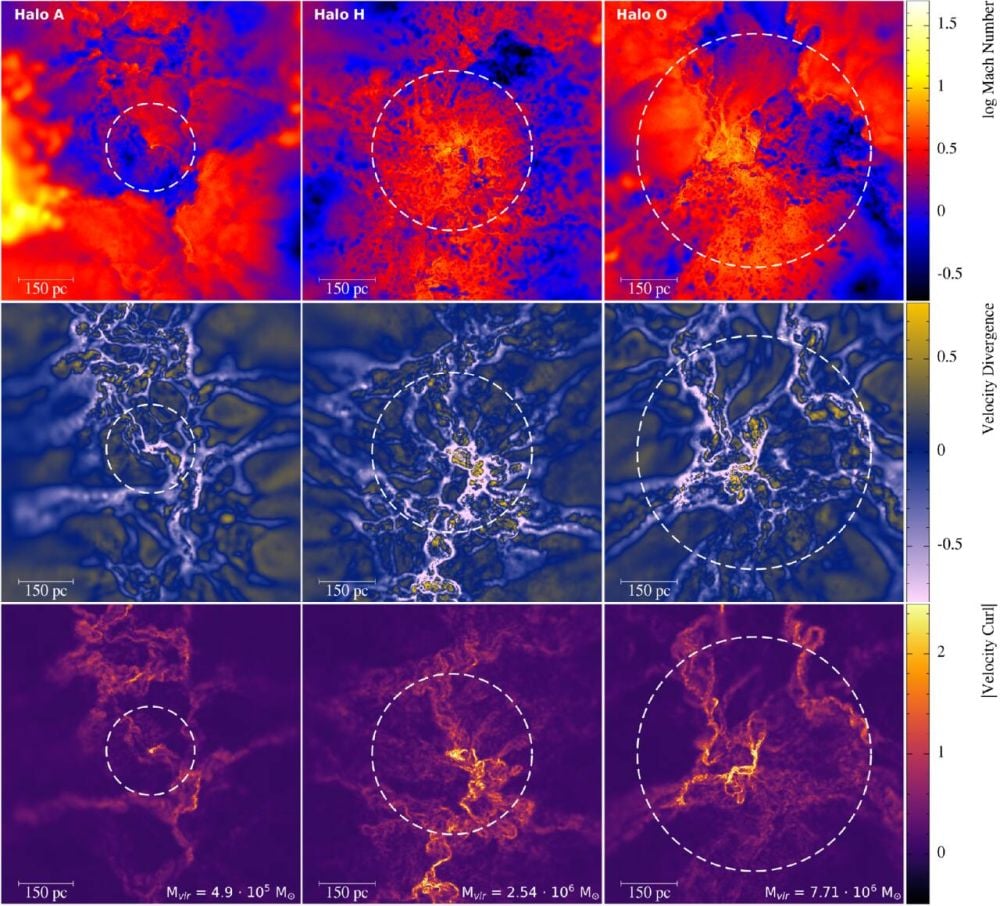 This figure shows some of the results of the simulations for three of the primordial mini halos. The top row shows mach number, the middle row shows velocity divergence, and the bottom row shows curl. "Areas where divergence and curl overlap indicate highly turbulent gas motions," the authors write. Image Credit: Meng-Yuan Ho et al 2026 ApJ
The turbulence is created naturally as the gas flows into the minihalo. Gas flows in through multiple streams, and when they collide in the center of the minihao, it generates turbulence. The gas velocity spans from 1.8 to 4.2 times the speed of sound as it swirls chaotically into the minihalo, with larger halos having higher speeds.
Instead of smoothly collapsing into one massive star, the turbulence fragments the gas into multiple clumps inside the minihalo. In the simulations, some of these clumps had tens of solar masses and some had only a few. So instead of the first Pop III stars being a monolith of massive stars, there was far more variety in their masses. "Some dense clump masses range from 2.6 M⊙ to 66.5 M⊙ exceeding their corresponding Jeans masses and soon collapsing to form the first stars," the authors write.
"Our results suggest that supersonic turbulence is a common feature of minihalos and plays a key role in producing clumpy star-forming clouds, with important implications for the initial mass function of the first stars," the researchers explain.
These results can explain a puzzle in astronomy regarding the first stars. If they were as uniformly massive as was previously thought, then many of them must have exploded as supernovae and spread metals into the interstellar medium, to be taken up in the next generation of star formation. But many stars in the Milky Way that formed after Pop III stars preserve the chemical fingerprint of their Pop III ancestors, and their low metallicity suggests that Pop III stars weren't as massive as thought.
The turbulence in these simulations can explain that discrepancy. Instead of gas in the minihalos collapsing into one spherical clump and one massive star, the gas forms smaller filaments that collapse into less massive stars. If not as many Pop III stars were massive because of this turbulence, then their descendants will have lower metallicity than thought.
The mass of the first stars affects what forms after them, too. Larger stars have more powerful stellar feedback, heating the surrounding gas and inhibiting further star formation. In this way, the Pop III stars helped shape the galaxies they formed in.
"The physical properties of primordial turbulence revealed by our simulations offer critical insights into the long-standing problem of Pop III star formation," the authors write in their conclusion. "Our findings show that the clump masses produced by supersonic turbulence significantly influence the characteristic mass scale of the first stars and their associated stellar feedback, which critically shape the physical properties of the first galaxies."

