 Universe Today
Humanity is in a precarious position. Cosmic forces beyond our power to alter buffet us about like playthings. We can soothe ourselves with hubrisitc talk of colonizing Mars or other star systems, as a bulwark against cosmic annihilation, but the reality is that we're bound to Earth and all that happens to it. This includes passing stars and the gravitational havoc they can wreak on our little Solar System.
Our Solar System has experienced thousands of stellar flybys in its long history. There's no agreement on which exact distance constitutes a stellar flyby; some say one light year, some say one parsec, some use other definitions. The most recent stellar flyby was likely Scholz's Star, which may have come as close as 0.25 parsecs or 0.82 light-years of the Sun about 70,000 years ago.
At that distance, it passed directly through the Oort Cloud, and likely perturbed many comets. Some were nudged outward into deeper space, and some inward towards the Sun. The inward comets won't reach the inner Solar System for about 2 million years, according to researchers. There's ongoing debate about how many comets it perturbed, with some researchers expressing concern that collectively, they pose the threat of an impact. There's no certainty but lots of possibilities.
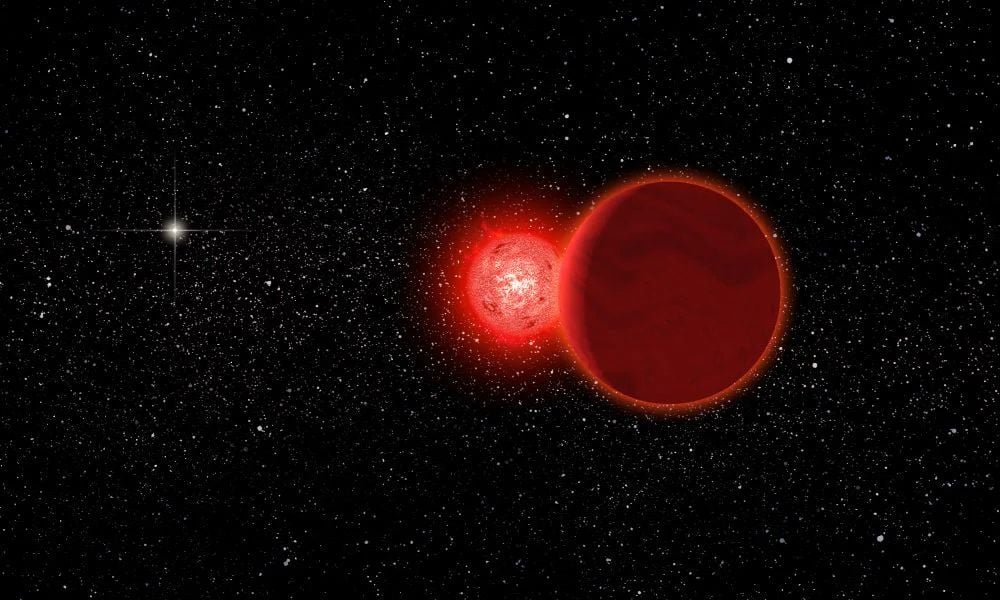 This illustrations shows Scholz's star, a binary star that performed a stellar flyby of our Solar System about 70,000 years ago. The Sun is the small star in the upper left. Image Credit: Michael Osadciw/University of Rochester.
New research to be published in Astronomy and Astrophysics takes a closer look at stellar flybys, with special consideration given to an upcoming one. The research is titled "Stellar encounters in the solar neighbourhood and the special case of GJ 710." The lead author is Eloi Fernandez-Puig from the Institut de Ciències de l’Espai and the Institut d’Estudis Espacials de Catalunya in Spain.
Our understanding of stellar flybys changed with the ESA's Gaia mission and its first data release. By cataloguing around 2 billion stars and their motions, it opened astronomers' eyes on the nature of our stellar neighbourhood and stellar flybys.
"The first data release from Gaia revolutionised this field as the mission was able to detect and measure nearly all of the local stellar systems within 50 pc of the Sun," the authors write. This led to an earnest recalculation of the rate of stellar flybys.
With Gaia's third data release (DR3) in 2022, astronomers received even more thorough information. Researchers were able to identify multiple stellar flybys within 1 parsec of the Sun for the first time. They were also able to refine more precisely their understanding of known future encounters. One particular star jumped out of the data: Gliese 710 (GJ 710).
"One such Solar System close encounter is the remarkable case of GJ 710," the authors explain. "Several works have reported on it in the past, noting that the star was predicted pass by at only ∼0.06 pc (just over 2 light-months) of the Solar System in approximately 1.3 million years." By any definition of a stellar flyby, 2 light months is awfully close.
The authors reiterate the potential damage this flyby could cause. Planetary orbits could be disturbed, and a shower of comets could be unleashed into the inner Solar System. "Several studies have addressed how close stellar fly-bys affect the long-term stability of the Solar System or drive episodes of increased bombardment on Earth," the researchers explain.
But they also point out that the link between stellar flybys and comet showers is tenuous. They used Gaia DR3 to dig more deeply into the issue, and worked with a sample of stars within 25 parsecs of the Sun. They also used data from CARMENES. Their goal was to characterize the risks, probabilities, and results of stellar flybys.
"We have identified a total of six close encounters (< 1 pc) with the Sun of stars closer than 25 pc within a time window of ∼1 Myr," the researchers write. "We also computed the rate of encounters within 0.5 pc (Oort cloud limit) to be 2.6 ± 1.1 encounters per Myr, meaning that the Solar System has experienced ∼ 12 000 ± 5000 such fly-bys over its 4.56 Gyr lifetime." They also explain that these close encounters will perturb comets, with some driven into interstellar space and some driven into the inner Solar System.
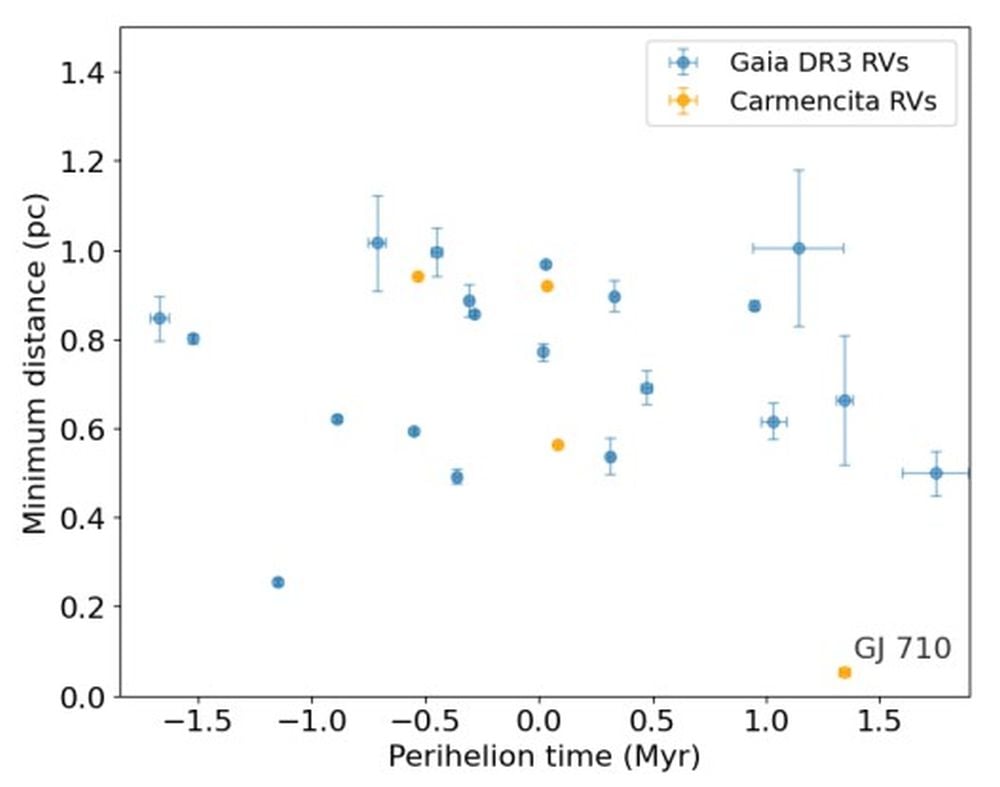 This figure shows close encounters with the Sun for stars within 100 parsecs. Blue is from Gaia data, orange is from CARMENES data. Image Credit: Fernandez-Puig et al. 2026. A&A
Then the researchers focused on GJ 710, examining the statistical frequency of its upcoming close encounter with the Sun. "Based on the resulting statistics, we find that an approach closer than the expected GJ 710 fly-by is quite rare, with an average frequency of one such event per star every approximately 50 Myr," they write.
But they also point out another way of looking at the issue. They explain that every billion years, 20 of the stars in our solar neighbourhood come within about 104 AU of the Sun, about ~0.0485 parsecs or 0.158 ly. "The cumulative effect of the dynamical perturbations is potentially large," they write.
There's a scale of potential outcomes from stellar flybys. Maybe nothing would happen except we'd get to see more comets in our telescopes. On the apocalyptic end of the scale, a swarm of comets sweeps into the inner Solar System, and we have advance knowledge of their arrival. It's easy to imagine sci-fi levels of panic and conflict about how to prepare.
Could we mount some kind of defence against comets on impact trajectories with Earth? What if multiple comets threatened Earth? We're in the early stages of protecting ourselves against incoming asteroids, even though geopolitical hostilities are a barrier to the kind of coordination required. Panicking over things like this is never helpful, but we are at the mercy of Nature's whims.
One pallliative for this whole scenario concerns the Oort Cloud itself. At this point, it's only hypothetical. It's been proposed as the home turf for long period comets, but questions abound. If it's not real, or it's much smaller with a smaller population of comets, the risk shrinks.
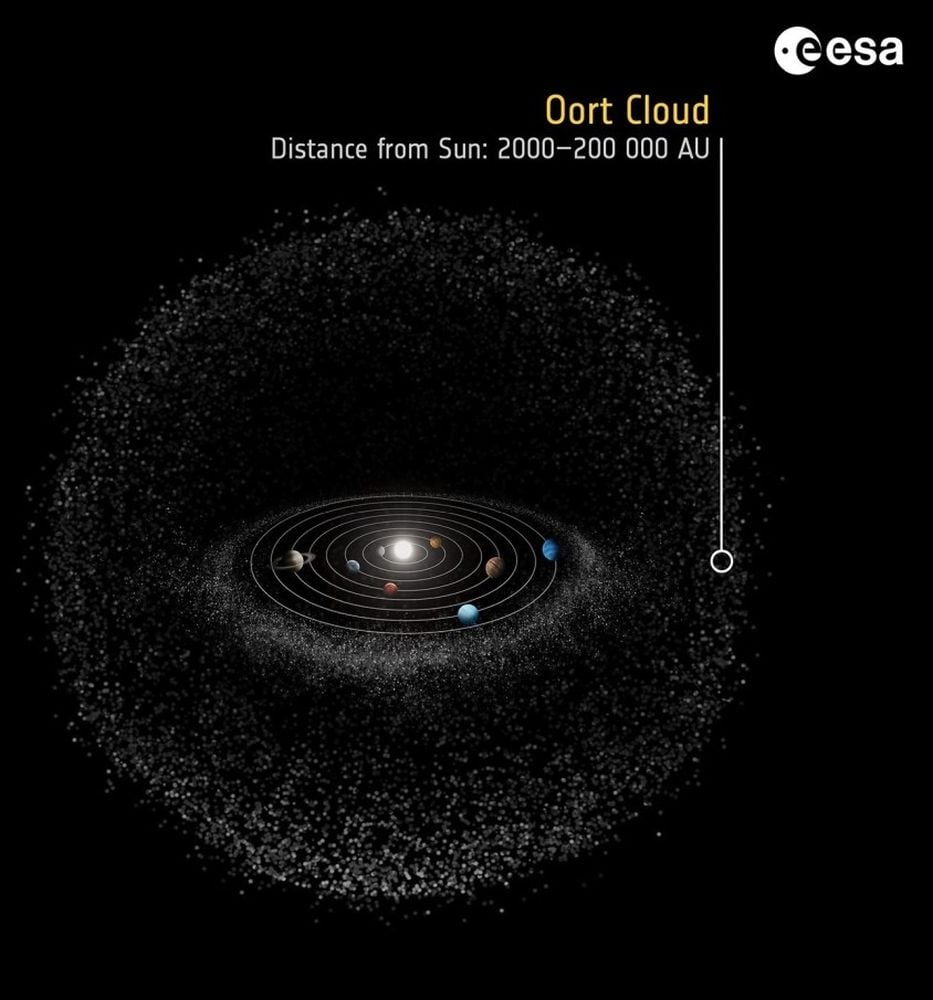 The mysterious and hypothetical Oort Cloud is thought to be the home of long-period comets that visit the inner Solar System. Image Credit: ESA. LICENCE: ESA Standard Licence
But since this is the realm of speculation, the authors offer their own.
"From an entirely different perspective, we might go on to speculate that such close encounters could be potentially used as an energy-efficient means for a civilisation to extend itself across the Galaxy," the authors write. "This could be dubbed a ‘star-hopping’ strategy."
From this perspective, stellar flybys are beneficial rather than threatening. "With this approach, a civilisation could wait for the close passage of a star and settle on a hypothetical planet (or moon) to continue its galactic journey."
Rather than doom, salvation.
"This could allow for a slow, but exponential spread of a civilisation across the Galaxy by utilising minimal energy resources," they conclude.

