 Universe Today
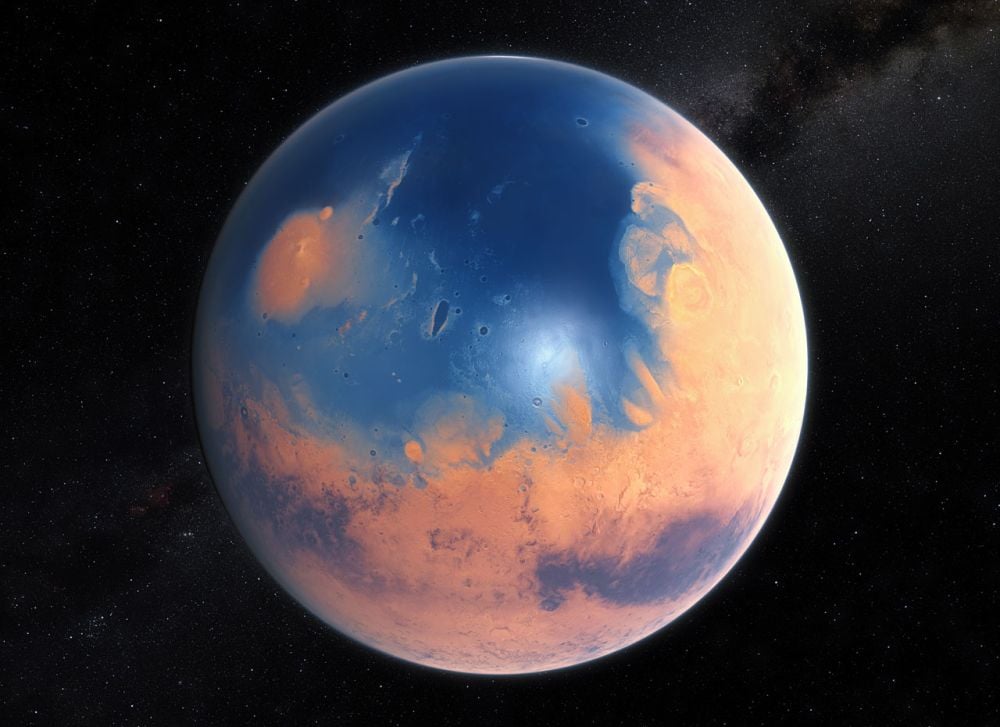
Mars holds a special place in the Solar System. It represents marginal habitability. This means it transitioned from warm and wet and potentially hospitable, to cold and dry and inhospitable.
What can its transition tell us about exoplanet habitability?
New research to be published in the Planetary Science Journal examines the question. It's titled "Mars as an Exoplanet: Lessons from a Planet at the Edge of Habitability." The lead author is Stephen Kane, Professor of Planetary Astrophysics in the Earth & Planetary Sciences Dept. at the University of California, Riverside. The research is currently available at arxiv.org.
"Mars is the Solar System's canonical small, rocky planet that transitioned from early geologic activity and surface liquid water to a cold and arid planet with a thin, cold, CO-dominated atmosphere," the authors write. "The evolution of Mars, in the context of such planetary parameters as size, mass, atmosphere, insolation flux, magnetosphere, and impact history, harbor important diagnostics regarding the development and sustainability of habitable surface conditions."
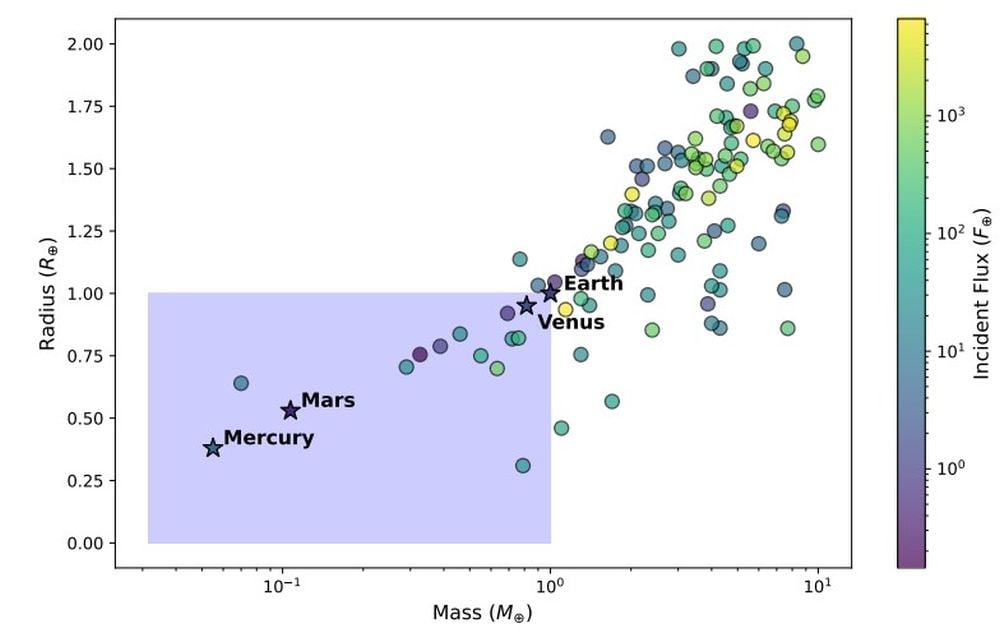 This figure shows the planetary mass and radius data for confirmed exoplanets that have measurements extracted for both properties, extracted from the NASA Exoplanet Archive on 2025, December 31. The data are color-coded in proportion to the flux received from their host stars. The Solar System terrestrial planets are shown as stars. The shaded region indicates the sub-Earth regime. Image Credit: Kane et al. 2026. PSJ
Our understanding of the exoplanet population has grown enormously in recent years. In exoplanet surveys, small rocky worlds are common and outnumber larger gas planets. But while we know they exist in large numbers, we lack a detailed understanding of their climates, their volatile budgets, and their long-term potential for habitability. According to the authors, Mars can help us understand its exoplanet cousins.
They point out that though size is a basic property of rocky planets, and a good starting point for understanding them, it doesn't dictate how a planet evolves. "Venus, Earth, Mars, and even the Moon each underwent distinct volatile, tectonic, and atmospheric trajectories despite sharing the same stellar environment, illustrating that planet size alone does not uniquely determine planetary evolution," they explain.
In this research, the authors synthesize research into how different aspects of Mars—including volatile delivery and loss, photochemistry, climate evolution, magnetism, and other factors—can help our overall understanding of exoplanets and their processes.
"Exoplanet studies often use Earth properties as standard units of measurements, particularly for those relevant to describing the capabilities of exoplanet detection methods," the authors write. Mars has many similar properties to Earth, but its diffferences are what's important in this work.
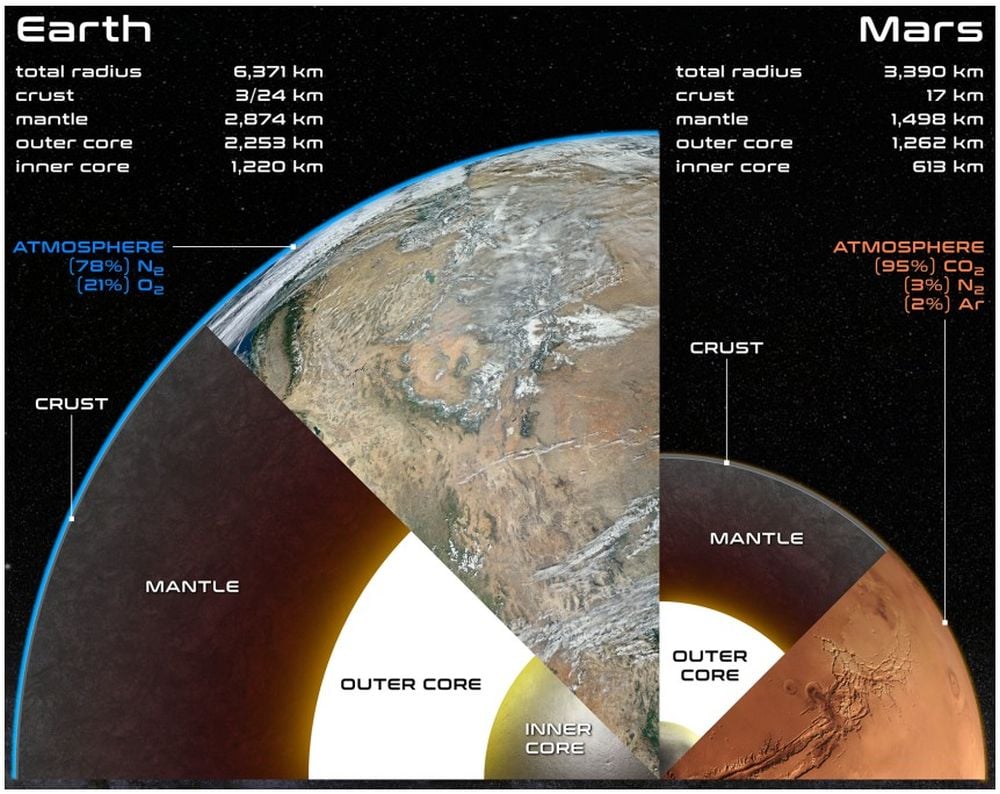 These schematic cross sections of Earth and Mars show the major internal components and atmospheric components to scale. For simplicity, oceanic and continental crust for Earth are not distinguished, nor is the interior structure of Earth’s mantle shown. Image Credit: Kane et al. 2026. PSJ
First of all, Mars formed differently from Earth. It's formation was rapid at first, then stalled at a sub-Earth mass. The authors describe it as a "stranded planetary embryo" instead of the result of later giant impacts.
The planet's mass is important in its evolution, which isn't surprising. "Mars occupies an important position in comparative planetology, since it is both a geologically rich world with a documented history of surface habitability, and a representative example of how small rocky planets can evolve toward atmospheric loss and climatic decline," they write.
Mars can serve as a framework for understanding rocky exoplanets. One of the main conclusions is that Mars shows how planetary habitability isn't a static condition. The authors describe it as "a time-dependent outcome governed by competing processes."
For example, early Mars was volcanic, and released volatiles built up a thick atmosphere that trapped heat. But as its interior cooled and its dynamo stopped, atmospheric escape led to cooling and eventual loss of habitability. "These coupled processes can define a pathway that may be common for Mars-mass planets," the authors write.
According to our understanding of Mars, habitability is likely to be fleeting more often than not, and Earth shines as a rare example of long-term habitability. "In this context, Mars represents the edge of the habitable regime, being large enough to host transiently clement conditions, but small enough that atmospheric retention and replenishment and long-term climate regulation are not guaranteed," the authors write.
While Mars-mass planets are widely detected, there are shortcoming in those observations. "Our discussion of exoplanet demographics have shown that, while terrestrial-size planets are abundant, confirmed Mars-mass planets with well-constrained masses and radii remain relatively rare, largely due to detection shortcomings," the authors write. That will change when the Nancy Grace Roman Telescope and its microlensing survey goes live.
As we discover more Mars-mass planets with well-measured constraints, we're also developing future telescopes that get better at observing exoplanets. "Direct imaging and thermal emission studies, particularly with next-generation facilities, will ultimately determine whether such planets commonly retain thin CO2 atmospheres, undergo desiccation, or exhibit transient volatile cycles," the researchers explain.
The key idea is that scientists can use what they learn about Mars to understand these observations. "Mars missions will continue to measure atmospheric escape rates, volatile inventories, and climate feedbacks with a level of detail unattainable for exoplanets, while exoplanet surveys contextualize Mars within a broader statistical population," the authors write.
The researchers explain that as Mars exploration and exoplanet characterization converge, it will deliver an effective new way to better understand the large numbers of small rocky worlds. Scientists will better understand key properties of exoplanets, like the mass necessary to sustain geological activity like plate tectonics. They'll also develop a better understanding the stellar environment and how it shapes atmospheric survival, as well as other planetary characteristics that shape habitability.
"Within this framework, Mars provides a fundamental benchmark for evaluating the diversity, evolution, and potential habitability of rocky planets throughout the Galaxy," the authors conclude.

