 Universe Today
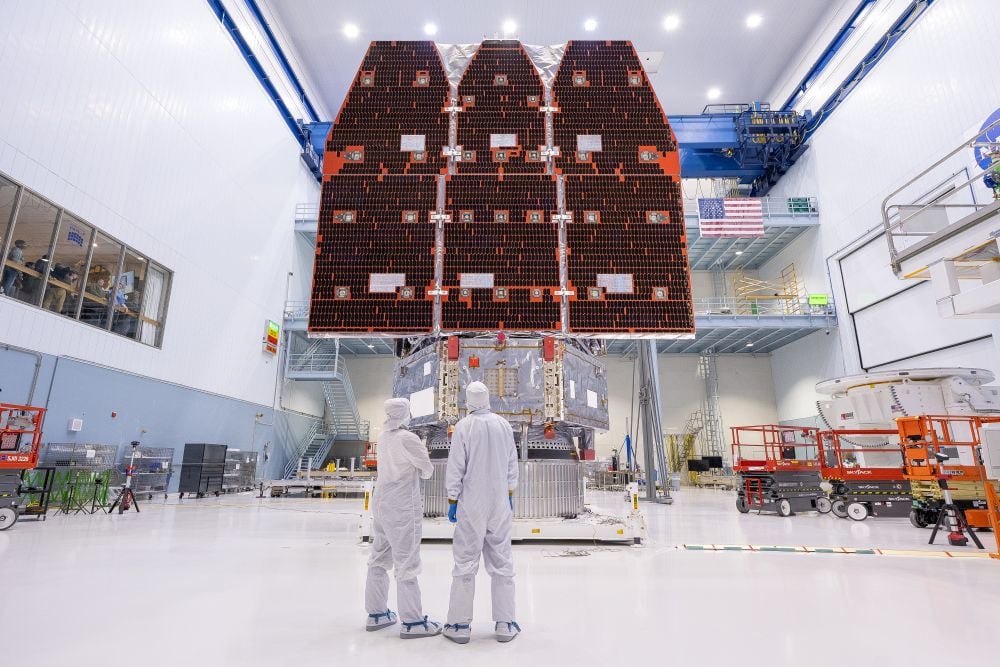
If you feel a thrill every time we discover something new about the cosmos, then November 25th may have been a noteworthy day to you. That's the day that NASA completed assembly of the Nancy Grace Roman Telescope. The two main segments of the powerful space telescope were joined together in the large clean room at Goddard Space Flight Center that day. This means that the telescope is on track for launch as early as Fall 2026.
The Roman is an infrared telescope that's set to become a flagship in the telescope fleet. It has only two instruments, the Wide-Field Instrument (WFI) and the Coronagraph Instrument (CGI). Its WFI gives it a view that's 100 times larger than the Hubble's, and its coronagraph will let it block out the starlight when observing exoplanets and exoplanet-forming disks. Its main science objectives are the study of dark energy, completing an exoplanet census, detecting primordial black holes, and using its coronagraph to directly image nearby exoplanets and their spectra.
This can be a difficult time for thinking people around the world who are interested in progress, especially scientific progress. The current US government has taken a decidedly anti-science stance, threatening to cancel the nearly-completed telescope. But all things pass eventually, and the current President's latest ham-fisted threat to cancel a project that's already had billions of dollars spent on it may come to nothing.
NASA has taken a beating from this administration, so it must be challenging for the people who work there to maintain their motivation. Still, this project is a decided step forward for NASA and for people around the world who care about a greater understanding of the cosmos, and our little place in it.
“Completing the Roman observatory brings us to a defining moment for the agency,” said NASA Associate Administrator Amit Kshatriya. “Transformative science depends on disciplined engineering, and this team has delivered—piece by piece, test by test—an observatory that will expand our understanding of the universe. As Roman moves into its final stage of testing following integration, we are focused on executing with precision and preparing for a successful launch on behalf of the global scientific community.”
The telescope will undergo thorough testing before moving to the Kennedy Space Center in Florida to prepare for launch. The scheduled launch date is May 2027, when a SpaceX Falcon Heavy is set lift it into space and send it on its way to orbit the Sun-Earth L2 point. But the telescope could be ready by Fall 2026, and if it is, that would be a noteworthy accomplishment. Complicated projects like space telescopes are known for going over budget and launching later than expected. For example, the Hubble was originally scheduled to launch in the mid-1980s, but wasn't launched until 1990. (In fairness, the launch was delayed partially because of the Challenger disaster). And most of us know the JWST's tortured path to completion. It was launched more than a decade after its originally scheduled date, but it's hard to argue the wait hasn't been worth it.
Whether it's launched several months earlier or not, the Roman is poised to make new discoveries.
"With Roman’s construction complete, we are poised at the brink of unfathomable scientific discovery,” said Julie McEnery, Roman’s senior project scientist at NASA Goddard. “In the mission’s first five years, it’s expected to unveil more than 100,000 distant worlds, hundreds of millions of stars, and billions of galaxies. We stand to learn a tremendous amount of new information about the universe very rapidly after Roman launches.”
New telescopes always discover new things about the cosmos, and those discoveries aren't just for hard-working scientists. They're for regular people with a healthy intellectual appetite who wonder about life's bigger questions. New discoveries can cultivate a slight shift in your understanding of your own life, and expand our understanding of Nature and our place in it.
The Nancy Grace Roman Telescope has a five-year primary mission. Unlike some other infrared telescopes, it doesn't rely on coolant, so running out of coolant isn't a problem. Instead, fuel is a limitation, just as it is with the JWST. These telescopes use fuel to maintain their orbits and point and reposition themselves. The five-year mission should be enough for the Roman to meet its primary science objectives, but it's possible that it can remain in operation for an extended mission, just like other missions have.
During its five year mission, it's expected to discover tens of thousands of supernovae, thousands of microlensing exoplanets, and hundreds of exoplanet systems in the process of forming. And that's just a sample of what it's expected to uncover. New missions always have some unexpected results too, and those are difficult to predict in advance.
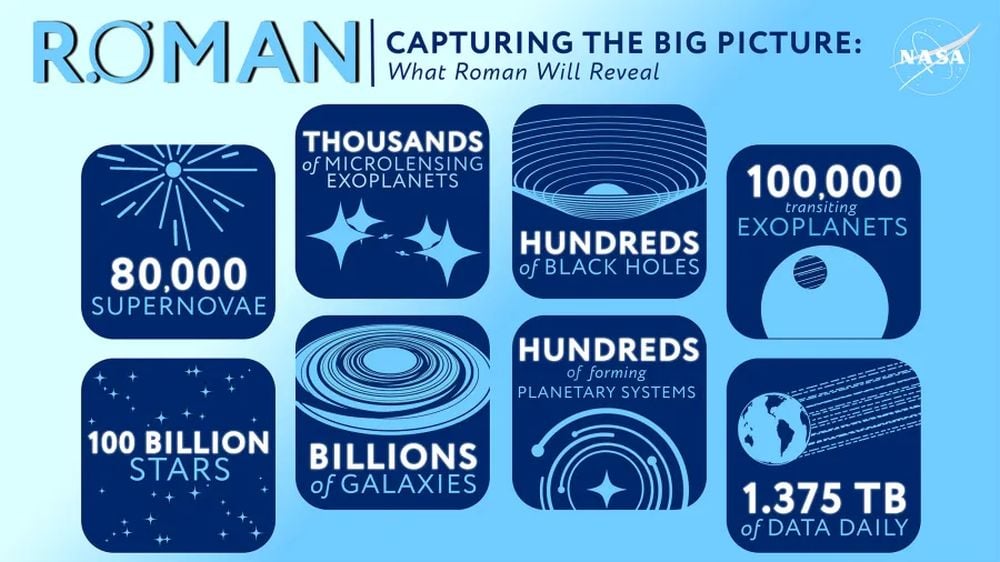 NASA’s Nancy Grace Roman Space Telescope will survey vast swaths of sky during its five-year primary mission. During that time, scientists expect it to see an incredible number of new objects, including stars, galaxies, black holes and exoplanets. This infographic previews some of the discoveries scientists anticipate from Roman’s data deluge. But new missions also deliver some surprising results, too, and those are difficult to anticipate. Credit: NASA’s Goddard Space Flight Center
One of the Roman's most important objectives concerns dark energy, the mysterious force that drives the expansion of the Universe. A greater understanding of that force requires a sweeping view of the cosmos, and that's something the Roman is built to provide with its WFI, a 288 megapixel camera. The only way to understand dark energy is to study vast swathes of the sky to detect its subtle effects. Mapping the large scale structure of the Universe and tracing its evolution through the development of galaxy clusters is also a critical part of its dark energy objective.
Other telescopes would take decades or even centuries to do what the Roman will do in only five years. In fact, the Roman will image as much of the sky in five years as the Hubble imaged in its first 30 years. In its five year primary mission, it will generate an astounding 20,000 terabytes (20 petabytes) of data.
“Within our lifetimes, a great mystery has arisen about the cosmos: why the expansion of the universe seems to be accelerating. There is something fundamental about space and time we don’t yet understand, and Roman was built to discover what it is,” said Nicky Fox, associate administrator, Science Mission Directorate, NASA Headquarters in Washington. “With Roman now standing as a complete observatory, which keeps the mission on track for a potentially early launch, we are a major step closer to understanding the universe as never before. I couldn’t be prouder of the teams that have gotten us to this point.”
The telescope's second instrument, the Coronagraph Instrument (CGI), is also poised to address an ongoing mystery. The search for exoplanets has been refined in recent years. Rather than bulk discovery of exoplanets, scientists want to find more Earth-similar planets that may be habitable. But these planets can easily be drowned out in the glare from the stars they orbit. The CGI was built to address that.
While other telescopes, including the Hubble, have coronagraphs, the Roman's is decidedly high-tech and will be the first active coronagraph to go to space. It's a sophisticated system of masks, filters, and self-flexing mirrors that's built to test these technologies across multiple observing modes.
“The question of ‘Are we alone?’ is a big one, and it’s an equally big task to build tools that can help us answer it,” said Feng Zhao, the Roman Coronagraph Instrument manager at NASA’s Jet Propulsion Laboratory in Southern California. “The Roman Coronagraph is going to bring us one step closer to that goal. It’s incredible that we have the opportunity to test this hardware in space on such a powerful observatory as Roman.”
The deluge of data that the Roman will deliver is akin to what other modern astronomical observatories generate. These massive datasets will be available to researchers in perpetuity, hopefully, and will inform research into multiple topics in astronomy.
“The mission will acquire enormous quantities of astronomical imagery that will permit scientists to make groundbreaking discoveries for decades to come, honoring Dr. Roman’s legacy in promoting scientific tools for the broader community,” said Jackie Townsend, Roman’s deputy project manager at NASA Goddard. “I like to think Dr. Roman would be extremely proud of her namesake telescope and thrilled to see what mysteries it will uncover in the coming years.”
The world may seem like a troubling place these days, but it always has been. The adage that "This too shall pass" is attributed to medieval Sufi poets, and it's worth remembering.
Hopefully, there's a brighter future ahead, one where political leaders embrace and understand the importance of scientific progress and how it can buoy a civilization. Maybe the Nancy Grace Roman Space Telescope will launch ahead of schedule in the Fall of 2026 and be a part of a resurgent interest in and respect for astronomy.

