 Universe Today
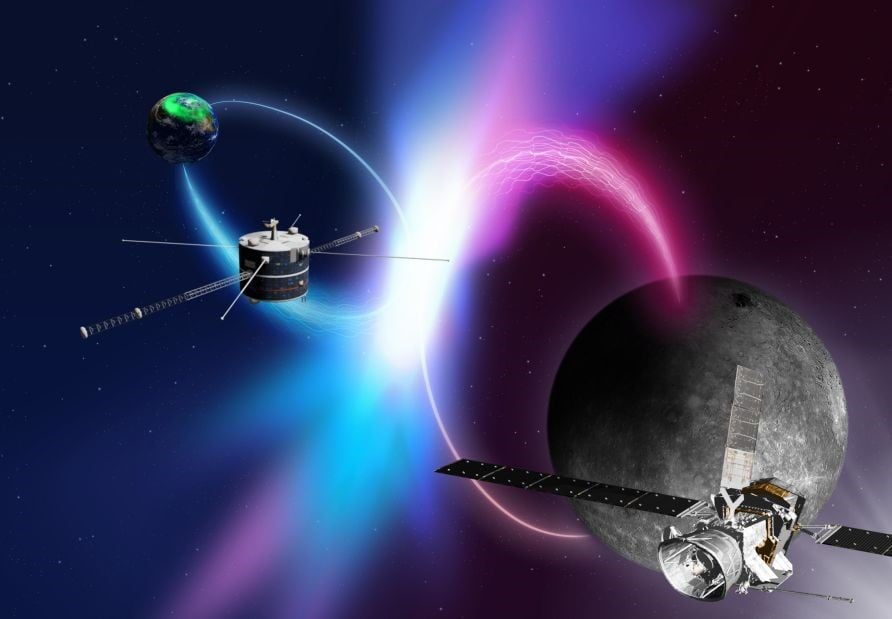
BepiColombo is slowly uncovering more and more fun facts about Mercury as it continues its preliminary mission. One of the more interesting things found so far is a magnetic “chorus” that appears similar to a phenomenon found in Earth’s much larger magnetic field. A new paper in Nature Communications from the researchers responsible for the probe’s Mio instrument that is studying Mercury’s magnetic field describes what could be thought of as a form of magnetic birdsong.
Magnetic fields are strange creatures. They can vibrate and create waves, which can interact with each other in complex and dynamic ways. One specific type of complex wave is known as a “whistler-mode” wave, which, when translated into audible frequencies, sounds like a chorus, or a chirping of birds. We’ve seen these types of waves before, on Earth. But Earth’s magnetic field is more than 7 times larger than Mercury’s, so it was unclear whether the first planet’s field was strong enough to create those complex types of waves.
Turns out it is, and BepiColombo observed them over a series of flybys between 2021 and 2025. They seem to have the same “musical” structure as those found on Earth. To compare the Mercury data to similar phenomena on Earth, the researchers looked at old data from the GEOTAIL mission, which was operational between 1992 and 2007. It appears that these musical magnetic waves represent a universal physical process around planets that have magnetic fields.
Timelapse of BepiColombo’s 6th flyby of Mercury, which collected data used in this paper. Credit - ESA YouTube ChannelBut, it appears, at least in Mercury’s case, they only happen on one side of the planet. The magnetic field of Mercury has a massive asymmetry, with much of the birdsong happening on the “dawn” side of the planet, where the Sun is just starting to rise. On the “night” side, the magnetic field is much calmer, with very little resonance or activity, eliminating the dynamic “chirping” seen on the brighter side.
Another feature of the bright side is the solar wind smashing into and compressing the magnetic field. This magnetic chaos makes the field very messy and uneven, which, paradoxically, actually helps the magnetic waves grow even stronger and faster than they do on Earth. But the solar wind has another impact on Mercury, according to the paper, this one in a much more literal sense.
Electrons that pass through the planet’s magnetic field, instead of creating auroras like they do in Earth’s atmosphere, slam directly onto Mercury’s surface, releasing elements like sodium and potassium out of the rocks and into the planet’s exosphere. Scientists used to think this would only happen when big magnetic explosions happened in its magnetic tail, forcing a large amount of electrons onto the surface. But, according to this new data, it appears that the magnetic field waves in some cases act like an accelerator for the electrons, scattering them onto the surface like a rainstorm.
Fraser discusses the technical issues BepiColombo is having.The picture this paper paints of Mercury’s magnetic field is complex, with dynamic interactions creating both “song” and “rain”. But it’s still early days in the BepiColombo mission. The six flybys the data for this paper were collected on technically happened even before the start of the mission, which now is scheduled for November of this year after a thruster issue discovered in 2024 slowed the spacecraft down. We’ll have to wait a little while longer for the full stream of data from the probe’s instruments to be collected and analyzed. Hopefully it will contain some more variations on the birdsong it’s found so far.
Learn More:
Kanazawa University / Mitsunori Ozaki - Demonstration of commonality of chorus radiation in planetary magnetospheres!
M. Ozaki et al. - Nonlinear spatiotemporal signatures of whistler-mode wave activity around Mercury during six flybys of BepiColombo mission

