Universe Today
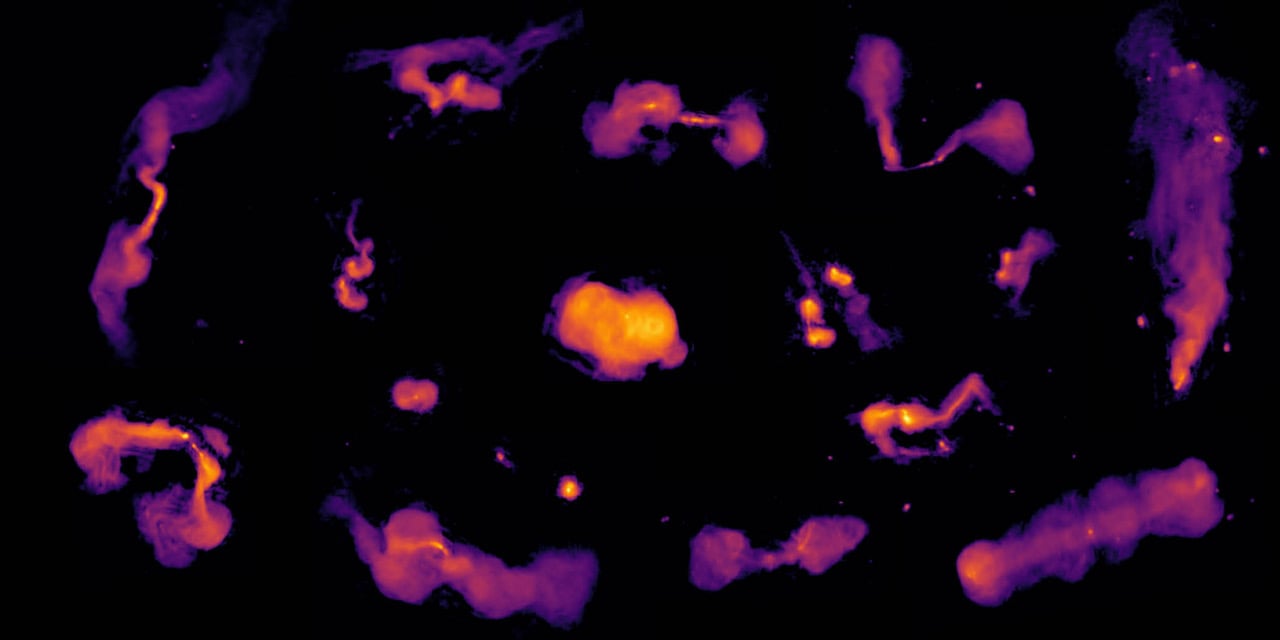
Radio astronomy offers scientists a means of observing the "unseen" Universe, where a wide range of natural phenomena take place that optical telescopes cannot observe. This is the purpose behind the Low-Frequency Array (LOFAR), a massive radio telescope with stations all across Europe. It is the largest and most sensitive radio telescope in the world, operating at low frequencies (10–240 MHz). After ten years of surveying the sky, the LOFAR Collaboration has produced the most detailed radio map of the Universe ever made.
The map is part of the third LOFAR data release, known as LoTSS-DR3, which includes the largest number of cosmic radio sources ever captured in a single survey (13.7 million). It also provides the most complete census to date of growing supermassive black holes (SMBHs). The release of this map marks an important milestone, not only for radio astronomy but for scientific collaborations across Europe. The results were published in a study, "The LOFAR Two-metre Sky Survey. VII. Third Data Release," that appeared on Feb. 19th in the journal Astronomy & Astrophysics.
The survey was carried out by the LOFAR European Research Infrastructure Consortium (LOFAR ERIC), a collaboration with institutions from eight countries. The majority of the radiation observed by LOFAR and other radio telescopes comes from particles moving at nearly the speed of light as they pass through magnetic fields. This allows astronomers to visualize energetic events, such as new stars forming in galaxies' disks and relativistic jets emanating from SMBHs at the center.
 The LOFAR 'superterp,' part of the core of the extended telescope located near Exloo, Netherlands. Credit: LOFAR/ASTRON
"Using statistics, we can now show how particle acceleration and the strengthening of magnetic fields are driven by shocks and turbulence across millions of light-years," said co-author Andrea Botteon of the INAF in a NOVA press release.
Developed by the Institute for Radio Astronomy (ASTRON) in the Netherlands, it includes 52 radio telescopes, with 38 located in the Netherlands, and 14 additional sites in Germany, France, the UK, Poland, Italy, Sweden, Ireland, Latvia, and Bulgaria. These telescopes are connected via fiber-optic networks, and the data is combined to create detailed images of the radio sky. The wide distribution of its facilities enables very high-resolution observations and makes LOFAR one of the largest and most sensitive radio telescopes in the world.
The technical challenges this survey presented were enormous, said co-author Reinout van Weeren, also from the Leiden Observatory. Foremost among them was the disruptive effect of Earth's ionosphere. To address this, the team had to develop new algorithms to filter out these disturbances, which were also used to compile the survey from the 18.6 petabytes of data collected by the LOFAR antennas over 13,000 hours of observation. "This data release is the result of more than ten years of observations, large-scale data processing, and scientific analysis by an international research team," says lead author Timothy Shimwell from the Leiden Observatory and ASTRON.
The high-resolution, sensitive survey data also yielded robust measurements of millions of SBMHs. This provides astronomers with an entire population of black holes for study, allowing them to address key questions about how black holes grow over cosmic history. The LOFAR Consortium is currently searching the data for rare astrophysical phenomena and has already found evidence of transient and variable radio sources. These have been identified as supernova remnants, some of the largest and oldest-known radio galaxies, and radio emissions that may be due to exoplanets interacting with their host stars.
Researchers engaged in the Search for Extraterrestrial Intelligence (SETI) are sure to find the survey very interesting. In the next few years, they too will be combing through the data for anomalous radio sources that could indicate extraterrestrial transmissions.
Further Reading: NOVA