Universe Today
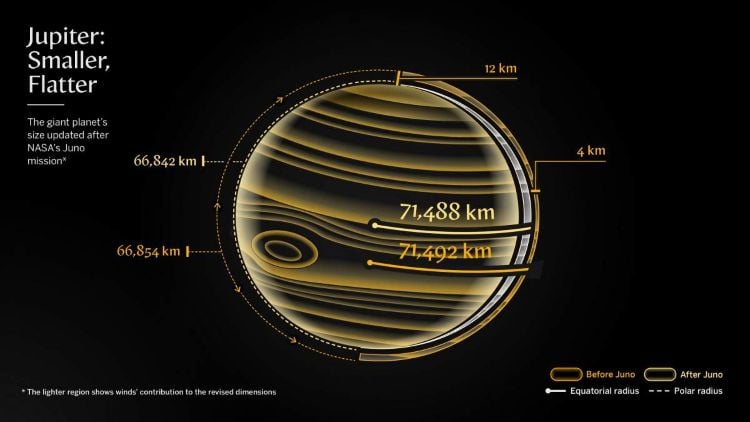
Jupiter is the largest planet in the solar system and has proudly boasted about this since time immemorial, with its scientific confirmation occurring by Galileo Galilei in 1610. It was later found that Jupiter has a bulging equator caused by its rapid rotation, turbulent atmosphere, and complex interior mechanisms despite its massive size, and scientists have even measured its “waistline” down to a tenth of a kilometer. Now, imagine being the largest planet in the solar system and you’re told you’re not as big as you thought. Where probably most humans would be thrilled to find this out, how do you respond if you’re Jupiter?
We might never know how Jupiter feels about being slimmer. But a team of international researchers led by the Weizmann Institute of Science in Israel are happy to explain how they feel about this incredible finding, which was recently published in Nature Astronomy. To accomplish this, the team used a combination of data obtained from NASA’s past missions of Pioneer 10 and Pioneer 11, which visited Jupiter in December 1973 and December 1974, respectively, Voyager 1 and Voyager 2, which visited Jupiter in March and July of 1979, respectively, and the currently active Juno spacecraft, which arrived at Jupiter in July 2016.
While the Pioneer and Voyager missions used a technique called radio occultation to measure Jupiter’s radius, with Voyager using an improved method, Juno used a combination of multi-angle radio occultation and gravity science to obtain its measurements.
Radio occultation involves using radio waves to estimate Jupiter’s size, with Pioneer using this method when the radio waves between itself and Earth were “cut off” as the spacecraft passed behind Jupiter. This not only estimating its radius but also confirmed Jupiter had an equatorial bulge, which was first proposed by Giovanni Cassini in 1666. Voyager improved this method by using radio waves to study Jupiter’s atmosphere, with the measured radius being the official measurement since then. Finally, Juno’s multi-angle radio occultation involves dividing Jupiter into “slices”, while the gravity science method involves measuring the tiny speed changes the spacecraft encounters that is produced by Jupiter’s massive gravity.
In the end, the researchers provided some of the most accurate measurements of Jupiter’s polar and equator radius ever. This includes a polar radius of 66,842 km (41,533 mi), an equatorial radius of 71,488 km (44,420 mi) and a mean radius of 69,886 km (43,487 mi), which are 12 km (7.4 mi), 4 km (2.5 mi) and 8 km (5 mi) smaller than longstanding estimates, respectively, along with a margin of error of 0.4 km (0.25 mi) for all estimates. This indicates a 7 percent larger difference between Jupiter’s equatorial radius and its polar radius.
For context, Earth’s equatorial radius is approximately 0.33 larger than its polar radius. These new estimates indicate that Jupiter is approximately 20 times flatter than Earth despite Jupiter being more than 300 times as massive as Earth, also being able to fit more than 1,300 Earths inside it.
“We tracked how the radio signals bend as they pass through Jupiter’s atmosphere, which allowed us to translate this information into detailed maps of Jupiter’s temperature and density, producing the clearest picture yet of the giant planet’s size and shape”, said the study’s co-author, Maria Smirnova, who is a PhD student at the Weizmann Institute of Science and spearheaded the development of a novel method for processing the latest data from Juno.
Despite being slightly slimmer, Jupiter still proudly boasts its massive size and remains the largest planet in the solar system. However, studies like this demonstrate how far methods have improved in just the 50 years since Jupiter was first explored by spacecraft. It also demonstrates how these methods could be employed to other planetary bodies throughout the solar system, including the other gas giants Saturn, Uranus, and Neptune.
What new insight into Jupiter’s physique will researchers make in the coming years and decades? Only time will tell, and this is why we science!
As always, keep doing science & keep looking up!