 Universe Today
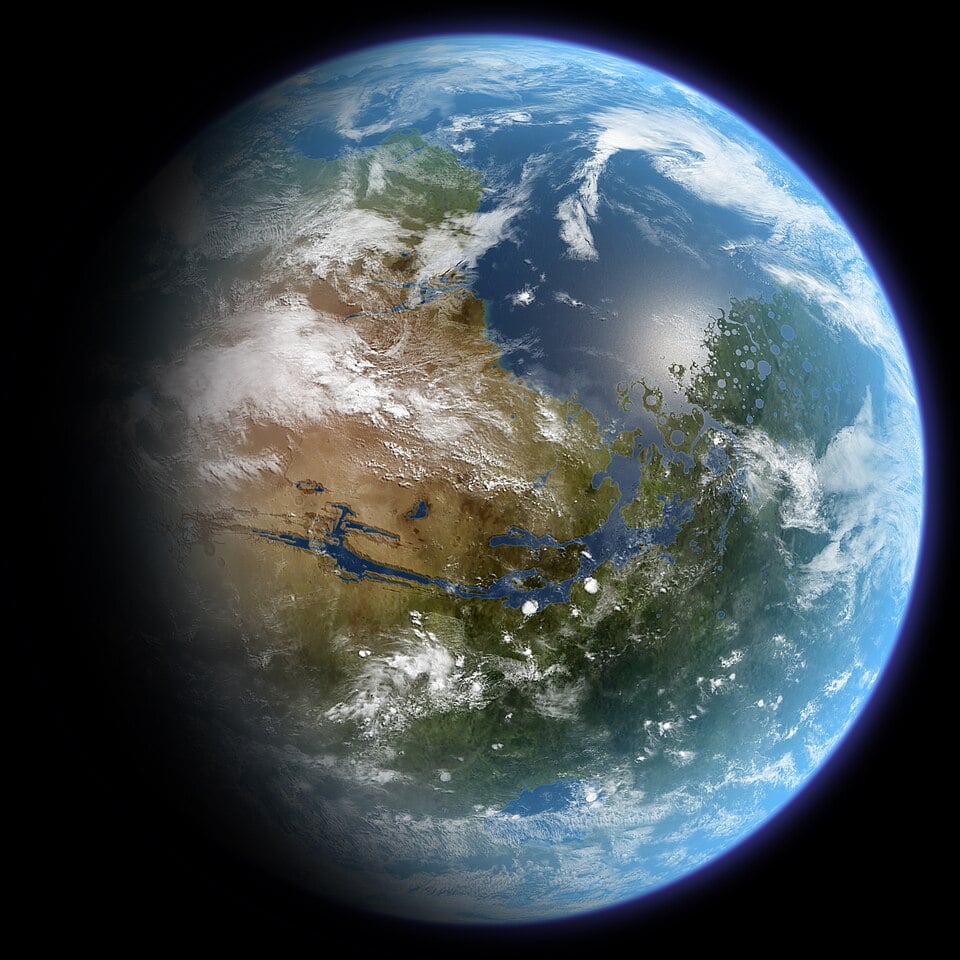
Even when the idea of terraforming Mars was originally put forward, the idea was daunting. Changing the environment of an entire planet is not something to do easily. Over the following decades, plenty of scientists and engineers have looked at the problem, and most have come to the same conclusion - we’re not going to be able to make Mars anything like Earth anytime soon. A new paper available in pre-print on arXiv from Slava Turyshev of NASA’s Jet Propulsion Laboratory, is a good explainer as to why.
But before we get into the constraints, let’s lay out some milestones. There are five “end states” of making Mars habitable. First is the current version - severely cold with minimal atmospheric pressure - not somewhere we can live without massive life support. Second is a state where the surface pressure rises above the “triple point” of water - roughly 6.1 millibar at 0℃ - at least for a little while. At this pressure and temperature, all three phases of water can co-exist in equilibrium.
Next up is an engineering goal of a “shirtsleeve greenhouse”, where large-scale farming can happen at a local or regional level. Typically this would involve the use of massive greenhouses, which is actually easier on Mars since the higher pressure (about 100 mbar) inside the domes would help keep the structural integrity against the lower pressure outside the dome. This method is often called “paraterraforming”, and can be scaled to encompass the entire planet if necessary, at which point it becomes a “world house”.
Fraser discusses how we would terraform Mars.Continuing to raise the overall atmospheric pressure would eventually result in a global pressure of 62.7 mbar, which is enough pressure so that human blood wouldn’t boil on the surface at 37℃. That sounds like a necessity if we’re truly going to “terraform” Mars. The final step would be a fully breathable atmosphere with a thick nitrogen buffer and around 210 mbar of oxygen (and 500 mbar total pressure), along with a much higher temperature.
While those might seem like reasonable goals for a project as massive as terraforming the planet, the scale really gets terrifying when talking about what each of those milestones actually means. For example, to get to just 1 mbar of pressure, we would need to add 3.89x10^15 kg of gas. That is almost equivalent to the entire mass of Deimos - Mar’s smaller moon. Scaling that up to a full breathable atmosphere requires more like 10^18 kg, such as Janus, an irregular moon of Saturn. To be fair to the optimists out there, there are expected to be hundreds of bodies of that size in the solar system, so for the purpose of giving atmosphere to one of the eight planets, it might be worth sacrificing one.
But pressure is only one part of the equation - temperature is the other. We would have to raise Mars’ temperature by an average 60℃ to reach globally stable water-melting temperatures. There are several ways to do this, ranging from injecting shortwave-absorbing nanoparticles into the atmosphere to releasing a whole ton of carbon dioxide. Some engineers have suggested adding massive mirrors to concentrate sunlight on the Red Planet, but Dr. Turyshev’s calculations would require around 70 million square kilometers of mirrors - far beyond our current industrial capabilities.
When (and if) we do decide to terraform Mars, we will need technology to do. Fraser explains a few of the key ones.To create a breathable atmosphere where our blood doesn’t boil, we would need to produce 8.2x10^17 kg of oxygen - the easiest way would be to split it from water. That would require even slightly more water, since the water/oxygen conversion process loses some mass to the hydrogen that it is split from. This amount of water would be the equivalent of six cubic meters of water for every square meter of Mars’ surface.
Throwing a bone to the optimists again - there is actually enough water on Mars’ surface to do so - and even creating oceans and lakes left over. In fact, all of the water needed to create the atmosphere is only around 20% of the known, easily accessible surface ice on the planet. So some of the more extreme versions of terraforming, such as having to slam multiple watery comets into the surface of the planet in order to create oceans, lakes, and an oxygen-rich atmosphere, is likely unnecessary. But it might be easier than the alternative.
Energy is really the true bottleneck for this process. In order to convert the amount of oxygen needed for the atmosphere, we would need a minimum of 1.2x10^25 Joules of energy. Even spread over 1,000 years, that would require a continuous power output of 380 terrawatts - almost 20 times our current annual global energy consumption here on Earth.
Realistically, there’s no way around that amount of needed energy - and producing it is beyond our current capabilities at our level of civilization. But it might not be beyond our descendents, and in the meantime we can get started on it. The easiest way to do so would be to get to the second milestone and have compact greenhouses where the living conditions inside would be stable. Anyone who has ever read the Mars Trilogy from Kim Stanley Robinson will be familiar with the concept, and while he pretty obviously got the math wrong on the amount of time and energy needed to complete his vision, the Red Planet still has a massive appeal as a destination for future space explorers. It just might take awhile to get it to be similar to Earth, if they decide they want it to be.
Learn More:
S. G. Turyshev - Terraforming Mars: Mass, Forcing, and Industrial Throughput Constraints
UT - Terraforming Mars Could Be Within Reach
UT - New Study Shows Mars Could be Terraformed Using Resources that are Already There
UT - Terraforming Mars Will Require Hitting It With Mulitple Asteroids

