 Universe Today
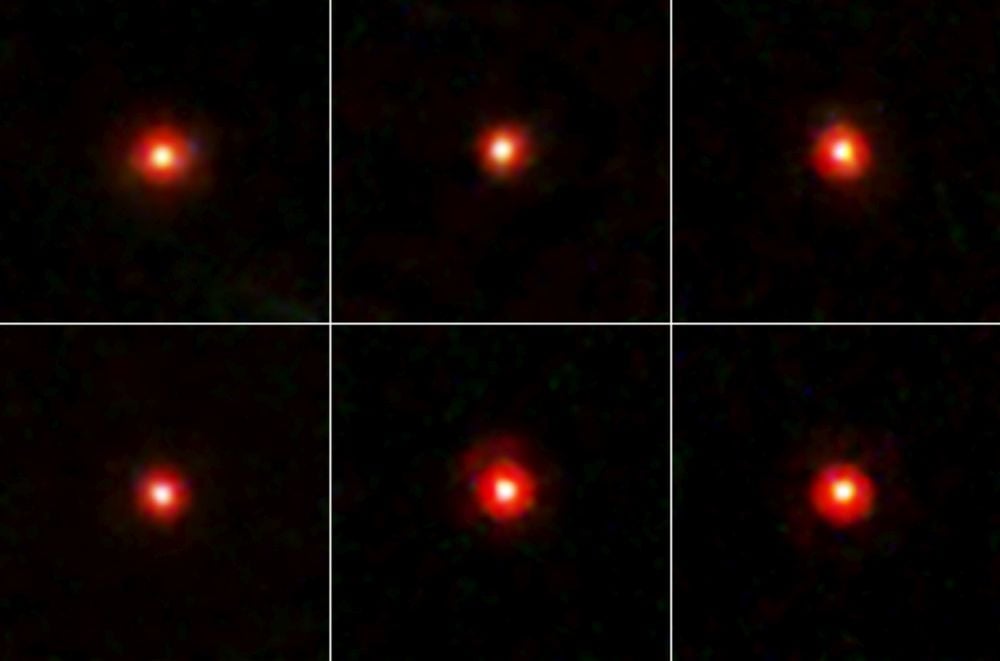
One of the things astronomers find when they look around at galaxies is a correlation between a galaxy's mass and the mass of its supermassive black hole. Contrary to popular belief, these SMBH don't anchor their galaxies; they make up only a small portion of a galaxy's mass. In local galaxies, the ratio of SMBH mass to galaxy mass is about 0.1–0.5%.
But the JWST has upended that notion. Its deep infrared observations have shown that galaxies in the early Universe can have much larger SMBH than that, leading to questions about our understanding of galaxy growth. Simply put, these galaxies shouldn't have such huge black holes so early in the Universe's life, according to our understanding.
Now some new research based largely on the JWST has identified a pair of dwarf galaxies that appear to have rule-breaking SMBH. They're not the first dwarf galaxies with such massive black holes, but they're different than many others. They're not as ancient and are at intermediate redshifts.
The research is titled "JWST Reveals Two Overmassive Black Hole Candidates in Dwarf Galaxies at z≈0.7: Pushing Black Hole Searches into the Dwarf-Galaxy Regime." The lead author is Eduardo Iani, a PhD Fellow at the Institute of Science and Technology Austria. The research has been submitted to the journal Astronomy and Astrophysics and is available in pre-print form at arxiv.org.
"We report the discovery and characterization of two compact galaxies, Pelias and Neleus, at z ~ 0.71 and z ~ 0.75," the researchers write. "Both exhibit unusual spectral energy distributions (SEDs), with very blue rest-frame UV-optical emission and a steep rise toward near- and mid-infrared wavelengths."
There's a discrepancy in the observations of this pair of galaxies. In the UV-optical that the JWST's NIRISS/NIRSpec can observe, the galaxies look like pristine, low-mass starburst galaxies. That means they're very blue, have low levels of dust, and young stars that ionize their surroundings.
But in the JWST's MIRI observations, they look different. Those reveal an excess of mid-infrared emissions that the galaxies' stellar masses can't account for. The only other explanation is that there's an active galactic nuclei (AGN) deeply embedded in dust. "JWST/MIRI photometry reveals a strong mid-infrared excess that cannot be explained by stellar populations or star-formation-heated dust alone, requiring a hot-dust component most naturally associated with a deeply embedded active galactic nucleus (AGN)," as the authors explain.
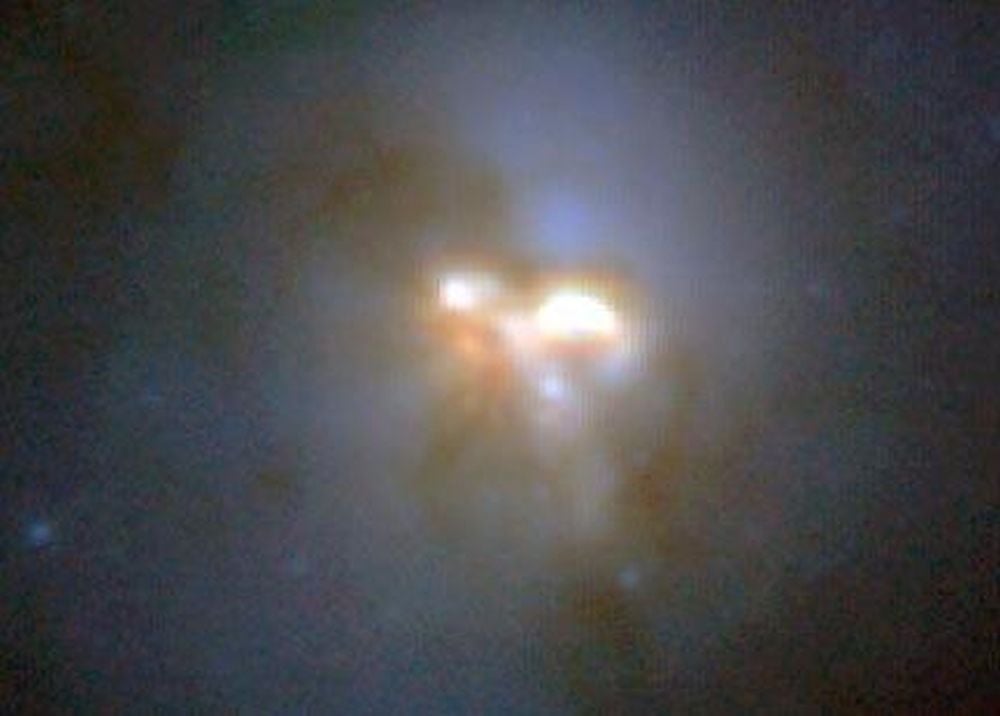 Though not related to this research, this image illustrates the difficulty in studying AGN in distant galaxies. It shows the galaxy Arp 220, and illustrates how the region in the galactic center is shrouded in thick dust that blocks optical light. Most of the observable radiation comes from the dust itself, which absorbs radiation from the AGN and re-emits it as infrared light. Even X-ray light can be absorbed by the thick shroud of dust. Though the JWST is better than any other telescope at examining the infrared light from arrangements like this, it still faces limitations. Image Credit: R. Thompson (U. Arizona) et al., NICMOS, HST, NASA
The central black holes in both galaxies have up to 60% of the mass of the galaxy, though that's at the upper range of the researchers' estimates. That is a staggering number. This shows that even intermediate redshift galaxies can have extraordinarily overmassive black holes. It may be because they grew first before enough stars formed to build up the galaxies' stellar masses.
But there's more to the story. AGN typically emit X-rays, and none have been detected. "The lack of X-ray detections suggests that the accretion may be either heavily obscured or intrinsically X-ray weak," the researchers write. This could be because of Super-Eddington accretion. While the black holes in Pelias and Neleus have high masses in relation to their galaxies, there standalone masses are quite low, and that's consistent with Super-Eddington accretion.
These are some of the smallest galaxies ever found that have active galactic nuclei. "The inferred stellar masses place our targets among the least massive confirmed AGN hosts and within the extreme low-mass tail of candidate AGN-host dwarf galaxies compiled in recent studies," the authors write.
According to Iani and his co-researchers, only Super-Eddington accretion can explain these galaxies. "Super-Eddington phases are thought to enable rapid early black-hole growth, particularly in low-mass galaxies," they explain. But they also explain that "systematic uncertainties in black-hole mass estimates when local scaling relations are extrapolated into the dwarf regime" can look like Super-Eddington accretion even when it's not.
The authors also explore a possible connection between this pair of dwarf galaxies and the famous Little Red Dots (LRD), due to their similar spectral energy distributions. "The shape of the SEDs observed in our targets also motivates a comparison with the recently identified class of LRDs," they write. The pair of dwarfs could be lower-redshift analogues of LRDs, with an AGN embedded in thick dust dominating the emitted light while the galaxy is still being assembled.
"Overall, Pelias and Neleus demonstrate that rapid, dust enshrouded black-hole growth can occur in galaxies with stellar masses of only ∼ 107 solar masses," the authors explain. That conclusion adds to the JWST's other body of work showing that massive black holes were much larger than astrophysicists thought they could be, not only in the most ancient galaxies, but also in dwarf galaxies at more intermediate redshifts.
Like most things in astronomy, the next step is to find more examples of these types of dwarfs and to study them intently. That will require some hard work from X-ray telescopes like Chandra and the future Athena mission. JWST/MIRI observations and radio observations from ALMA will also play a role. Ultimately, researchers need to find out how common DGs like Pelias and Neleus are.
"At longer timescales, facilities such as the Roman Space Telescope and ELT-class observatories will enable systematic searches for similar low-mass obscured AGN and resolve their internal structure, providing crucial tests of whether the embedded accretion phase inferred here represents a common pathway in DG evolution," the researchers conclude.

