Universe Today
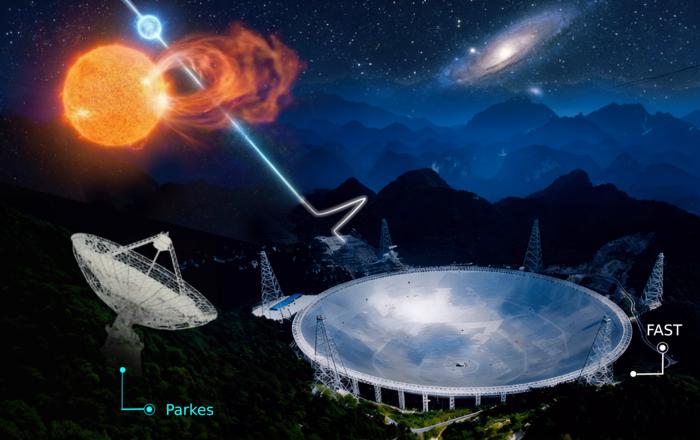
Astronomers have puzzled over Fast Radio Bursts (FRBs) since the Lorimer Burst (the first confirmed FRB) was detected in 2007. These rapid bursts of radio waves coming from distant galaxies last between milliseconds and a few seconds and release as much energy as the Sun produces in days. Whereas most FRBs are one-off events, astronomers have found some rare cases where FRBs were repeating in nature. For years, scientists have speculated as to what causes these events, with theories ranging from neutron stars and black holes to extraterrestrial communications.
In a recent study, an international team of astronomers presented the first definitive evidence that at least some FRBs originate in binary star systems. The team, led by Ye Li of the Purple Mountain Observatory and the University of Science and Technology of China, relied on data collected by the Five-hundred-meter Aperture Spherical Telescope (FAST), aka the "China Sky Eye," which monitored a specific FRB for almost two years. This radio source, FRB 20220529, was traced to a binary star system in a disk galaxy roughly 2.2 to 2.4 billion light-years from Earth. The paper detailing their findings appeared on Jan. 15th in the journal Science.
When studying FRBs, astronomers are on the lookout for changes in frequency and polarization properties that can reveal important information, including the nature of the environment near the source. The FAST array has been monitoring repeating FRBs since 2020 through a dedicated FRB. These repeating sources have been continuously monitored by FAST since 2020 through a dedicated FRB Key Science Program co-led by Bing Zhang, the Chair Professor of Astrophysics and the Founding Director of the HKU Hong Kong Institute for Astronomy and Astrophysics (and a co-author on the paper).
While analyzing data collected on FRB 20220529, the team observed a rare phenomenon known as a "rotation measure flare" (RM flare): a sudden, dramatic change in the polarization properties of the radio signal caused by changes in its environment. "Near the end of 2023, we detected an abrupt RM increase by more than a factor of a hundred,’ said Dr. Li. "The RM then rapidly declined over two weeks, returning to its previous level. We call this an 'RM flare'."
Ordinarily, FRBs have been shown to have near-perfect linear polarization. But as radio waves travel through magnetized plasma, their polarization angle rotates with frequency - an effect known as Faraday rotation. The nature of this RM flare, including the fact that it was short-lived, is consistent with a dense cloud of magnetized plasma crossing the line of sight between FAST and the source. This led the team to conclude that the RM flare was likely caused by a coronal mass ejection (CME) from a companion star. Said Zhang:
FRB 220529A was monitored for months and initially appeared unremarkable. Then, after a long-term observation for 17 months, something truly exciting happened. This finding provides a definitive clue to the origin of at least some repeating FRBs. The evidence strongly supports a binary system containing a magnetar—a neutron star with an extremely strong magnetic field, and a star like our Sun.
Given the distance between Earth and FRB 20220529's parent galaxy, astronomers cannot directly observe its companion star. Nevertheless, its presence was revealed through continuous radio observations with FAST and the Parkes Observatory's radio telescope in Australia. "This discovery was made possible by the persevering observations using the world’s best telescopes and the tireless work of our dedicated research team," said co-author Xuefeng Wu, who is also a professor at the Purple Mountain Observatory and the University of Science and Technology of China.
These findings challenge previously held assumptions that FRBs originate from single star systems. This discovery also supports a recently proposed unified physical model for repeating FRBs made by Professor Zhang and Wu. As they theorized, all repeating FRBs originate from magnetars interacting with binary companions, which would enable more frequent and repeating bursts. With premier radio observatories like FAST continuously monitoring repeating FRBs, astronomers hope to learn just how common binary systems are as a source.
Further Reading: University of Hong Kong, Science