 Universe Today
When astronomers look out into the cosmos, they see supermassive black holes (SMBH) in two different states. In one state, they're dormant. They're actively accreting only a tiny amount of matter and emit only faint, weak radiation. In the other, they're more actively accreting matter and emitting extremely powerful radiation. These are normally called active galactic nuclei (AGN).
AGN emit radiation from their accretion disks. As the SMBH draws material toward it, it gathers in an accretion disk. The matter heats up and emits optical and UV radiation. AGN can also have hot coronas of material above the disks that can emit x-rays.
But sometimes AGN also emit relativistic jets in opposite directions from their disks. They're sometimes referred to as radio jets because they're most easily detected and observed in radio emissions, even though they emit energy across the spectrum.
These jets can turn on and off, and astrophysicists aren't certain why. Changes in the rate of accretion seem like a likely cause, but magnetic fields and the black hole's spin could also be involved.
But new research has a different take on SMBH and their episodic jets. They found an opportunity to examine how these jets behave inside galaxy clusters. It's titled "Probing AGN duty cycle and cluster-driven morphology in a giant episodic radio galaxy," and it's published in The Monthly Notices of the Royal Astronomical Society. The lead author is Shobha Kumari, a PhD student and lead researcher at Midnapore City College in Kharagpur, India.
"The evolution of radio jet morphology and its energetics is significantly influenced by the environment in which the host galaxy resides," the authors write. "As giant radio galaxies (GRGs) often extend to the scale of entire galaxy clusters (Mpc) and beyond, they are a suitable class of objects for studying jet–intracluster medium interactions."
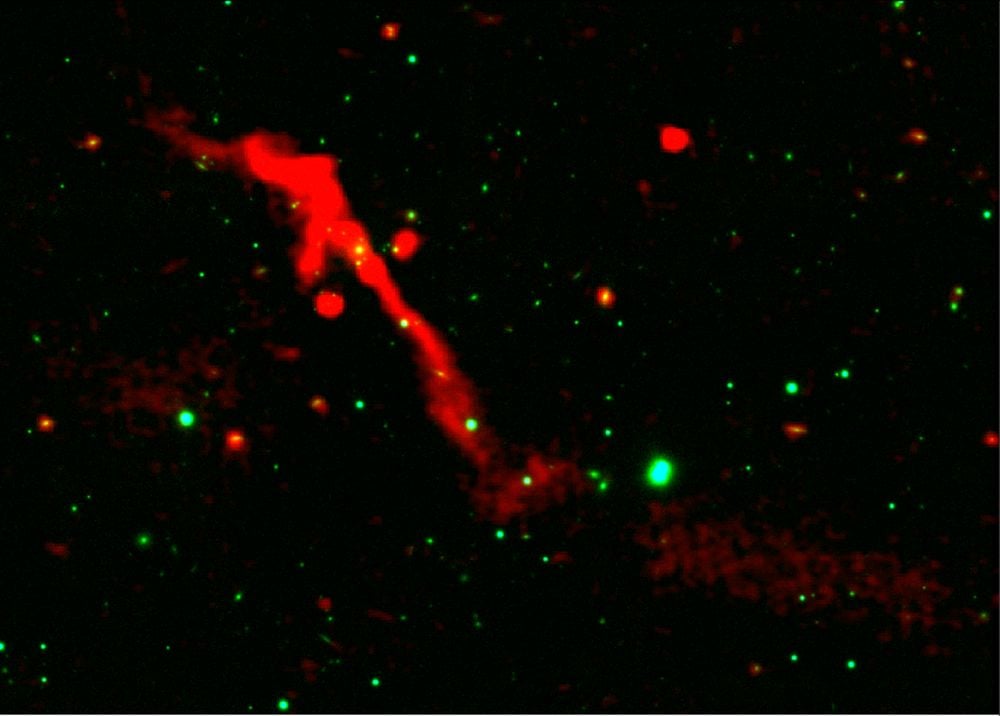
The paper is focused on J1007+3540 (3540 hereafter), a GRG inside a galaxy cluster. The researchers probed the GRG in a multiwavelength study. 3540 produces jets of magnetized plasma that emit radiowaves. It's unique because the researchers found evidence of these jets turning on and off.
"The source exhibits clear signatures of recurrent jet activity, a one-sided, extended, tail-like diffuse structure with a morphological break in the tail," the authors write. "The estimated radiative ages of the inner lobes and outer north lobe are 140 and 240 Myr, respectively."
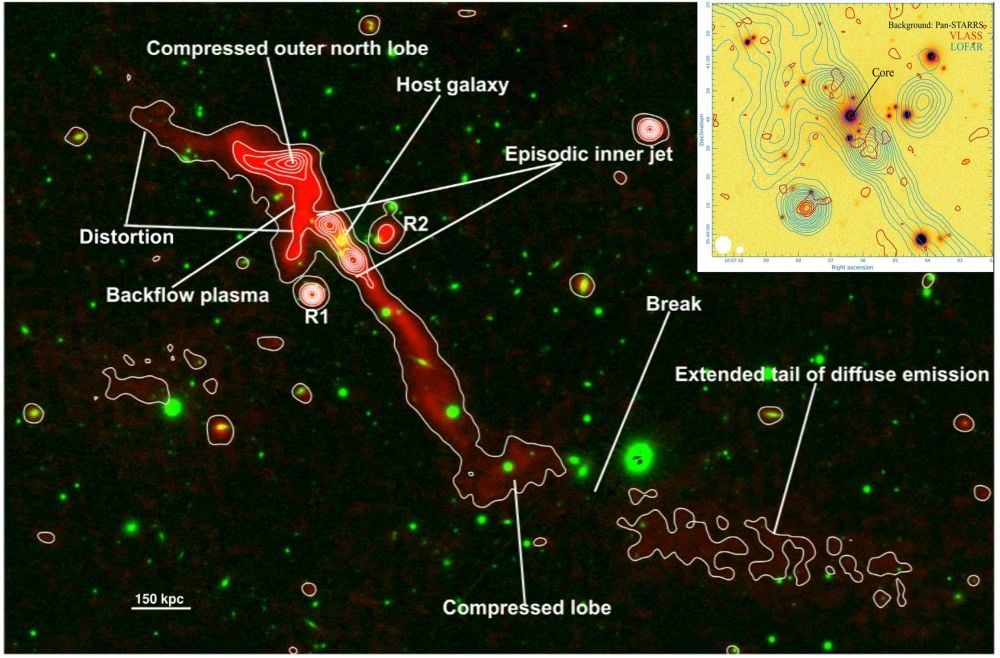 This figure from the research shows the detail in the jet. Note the extended tail of diffuse emissions, the break, the compressed lobe, and episodic inner jet. Image Credit: Kumari et al. 2026. MNRAS.
The features are clear evidence of episodic jets. The bright inner jet is just turning on, while a cocoon of older, faded plasma form previous jets lies further away.
The outer northern lobe has a "distorted backflow signature" aimed toward the southeast, more evidence of interactions with the surrounding cluster. "Such backflowing plasma is often observed when radio jets encounter a dense surrounding medium, causing the lobe material to be deflected and redirected away from the jet axis," the researchers write.
"The inner lobes are younger with radiative ages of 140 Myr," the authors explain. "The outer north lobe appears significantly older with a radiative age of 240–260 Myr. This stark difference suggests that the outer north lobe is a relic of a previous jet activity cycle, while the inner lobes result from a more recent phase of AGN jet activity."
“It’s like watching a cosmic volcano erupt again after ages of calm – except this one is big enough to carve out structures stretching nearly a million light-years across space”, said lead author Kumari in a press release. “This dramatic layering of young jets inside older, exhausted lobes is the signature of an episodic AGN – a galaxy whose central engine keeps turning on and off over cosmic timescales.”
3540 isn't alone in space. It's inside a galaxy cluster, and so is surrounded by the intracluster medium (ICM). The ICM is super-heated plasma heated either by plasma jets from AGN, or from the merging of clusters, or from both. The plasma in the ICM is shaping both the older jets and the newer jets.
“J1007+3540 is one of the clearest and most spectacular examples of episodic AGN with jet-cluster interaction, where the surrounding hot gas bends, compresses, and distorts the jets,” said co-author Dr. Sabyasachi Pal, also from Midnapore City College.
The authors say that the host galaxy is an evolved elliptical galaxy with heavy dust extinction. Their observations show that it likely has an active though obscured central engine. "These conditions are consistent with merger-driven fueling or a rejuvenated accretion episode, potentially linked to the observed jet restarting," they explain.
3540 is a scientifically important galaxy because it's giving astrophysicists an opportunity to study how jets turn on and off, and how they interact with their surroundings. It illustrates the fact that galaxies don't necessarily grow peacefully. Instead, 3540 is engaged in an energetic, chaotic struggle with the galaxy cluster it's a member of.
"The morphological asymmetries, jet bending, backflow plasma, episodic AGN activity, a large tail of diffuse emission with a morphological break, spectral gradients, and radiative age distribution collectively point toward a complex history of jet–ICM interaction and a possible re-acceleration process occurring in the surroundings of J1007+3540," the authors write in their conclusion.
To find out more, deep multiwavelength studies are necessary in the future.
"These findings emphasize the importance of future deep, multiwavelength studies, including X-ray, optical, and multiwavelength radio observations, to further probe the dynamics and energetics of this interesting source," the authors conclude.

