 Universe Today
Molecular hydrogen is the raw stuff of star formation. Stars form in massive clouds of it called Giant Molecular Clouds (GMCs). When young stars form, their radiation shapes the clouds they formed in. Stars need cold, dense hydrogen gas to form, and the young stars heat up and disperse the surrounding gas, creating a barrier against further star formation. This much is known.
But there's still much more to learn about stellar feedback and how it shapes GMCs and their chemistry. There's a lot of complex chemistry inside what are called photodissociation regions, and new research shows how they shape the overall structure of a GMC.
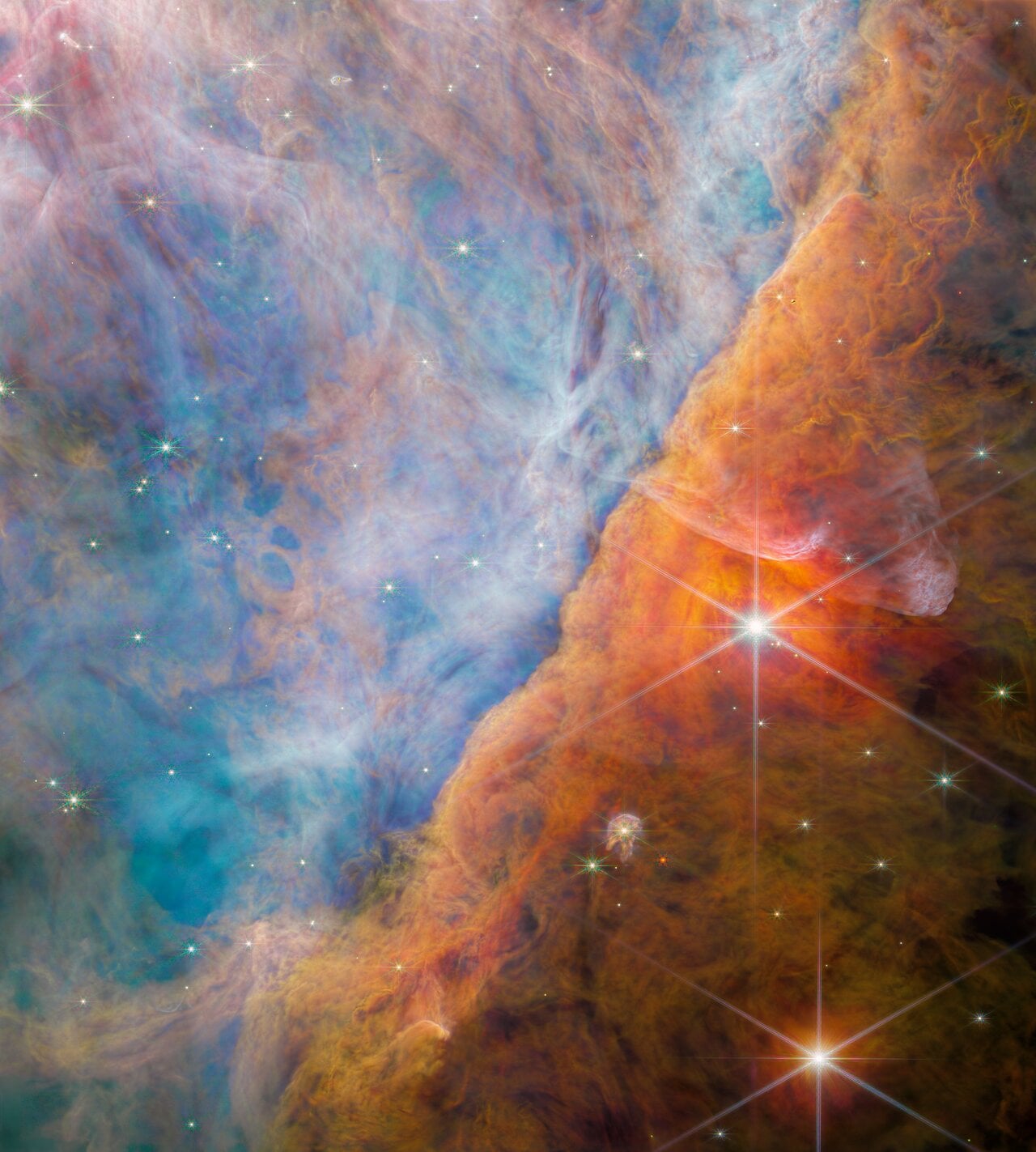
The new research examines photodissociation regions in the Orion Bar, a ridge of gas and dust in the Orion Nebula. The research is "Resolving dense photodissociation regions: The structure of photochemical fronts in three-dimensional gas distributions," and it's published in Astronomy and Astrophysics. The lead author is Dr. Brandt Gaches from the University of Duisburg-Essen.
"For decades, the Orion Bar has been the prototypical photodissociation region (PDR)," the authors write. "Viewed nearly edge-on, it offers a unique window into the stratified chemical structure of the atomic-to-molecular transition of the interstellar medium." According to the authors, understanding the photochemistry in the Orion Bar is important in order to "interpret key observations originating from dense PDRs."
ALMA and the JWST have observed the region and discovered that the molecular hydrogen (H2) photodissociation front overlaps with another important feature: the C+ recombination front. The front is like a layer in the Orion Bar where another transition occurs. Ionized carbon (C+) converts to neutral C there.
The takeaway from this concerns modelling. When trying to understand GMCs and how stellar feedback shapes them, researchers don't rely solely on observations. They build models and watch to see what happens, and how close the models line up with observations. In the case of PDRs, 1D models use stratified layers. But ALMA and the JWST shows that layers actually overlap one another. Since the models are based on the current understanding of GMC's and feedback, and since observations don't agree with them, there's work to do.
"Despite considerable theoretical effort, existing modeling approaches based on simplified geometrical assumptions have difficulties reproducing the spatial emission structure," the authors write. "We investigate the response of photochemistry in realistic three-dimensional density distributions using the Orion Bar as a representative application."
The Orion Bar is nearly a perfect place to do this work, both because we see it from an advantageous angle, and because it's only about 1,350 light years away.
‘The Orion Bar is an ideal natural laboratory for studying these processes,’ lead author Gaches said in a press release. ‘We see it nearly edge-on, so its different chemical layers are particularly easy to distinguish. That makes it a benchmark for testing models of photon-dominated regions."
The researchers created the "first fully three-dimensional high-resolution model of an Orion Bar analog," that captures the complex, clumpy, even messy reality of GMCs. Its high-resolution reveals more detail of how intense radiation from nearby stars drives changes in star-forming regions.
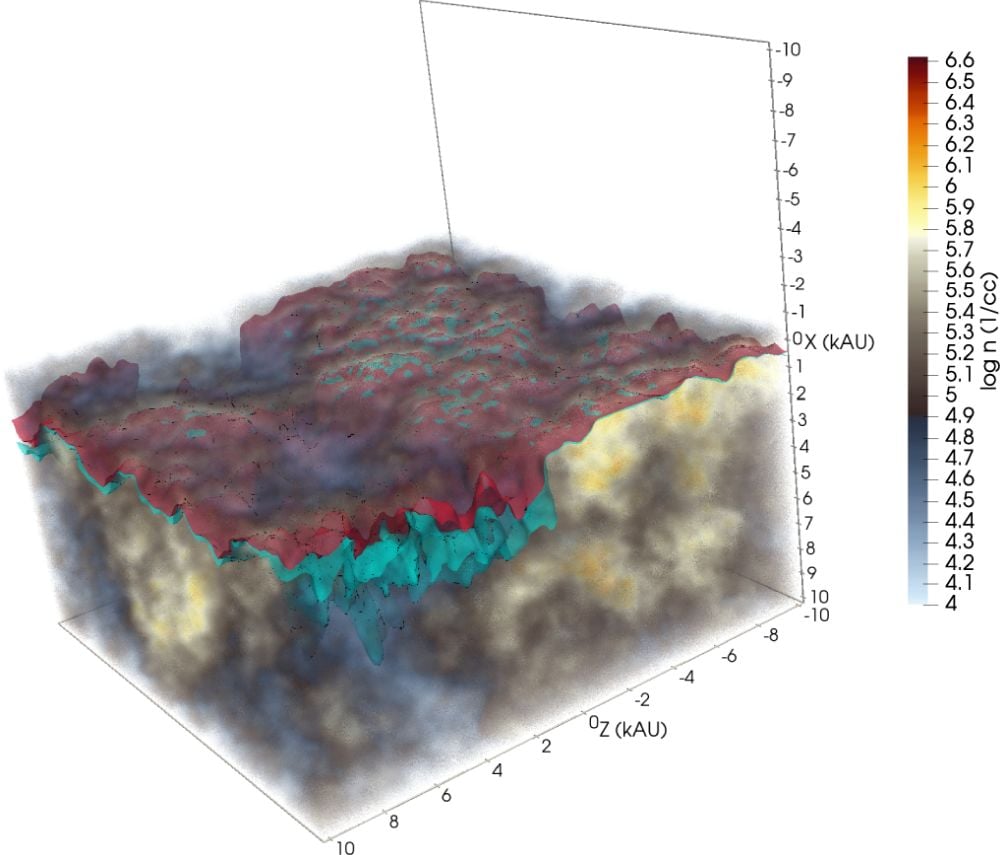 This rendering shows the the location of the H2 dissociation front and the C+ recombination front. The H2 dissociation front is shown in red and the C+ recombination front is shown in cyan. Unlike previous work, it shows how H2 and C+ co-exist in some regions. Image Credit: Gaches et al. 2026. A&A
The overlap of H2 and C+ is important in astrochemistry. It drives what's called 'excited-state hydrocarbon chemistry.' That means that chemical pathways that are usually forbidden are open. It can create compounds like methane, acetylene, and polycyclic aromatic hydrocarbons (PAH). PAH can be important building blocks for organic matter, and act as an important carbon reservoir.
But this work is mostly about the morphology in GMCs, and how photodissocation helps shape it.
"Our three-dimensional model can reproduce the complex morphology of H2 emission seen in observations, in particular, the arc- and filament-like features, and it provides a physical explanation of its chemistry," the authors write.
"The three-dimensional structure of the gas makes a crucial difference,’ said Gaches. "It creates shadows and shields parts of the cloud from the intense radiation. That changes the chemistry and leaves a clear signature in the infrared- to radio- wavelengths of light we observe."
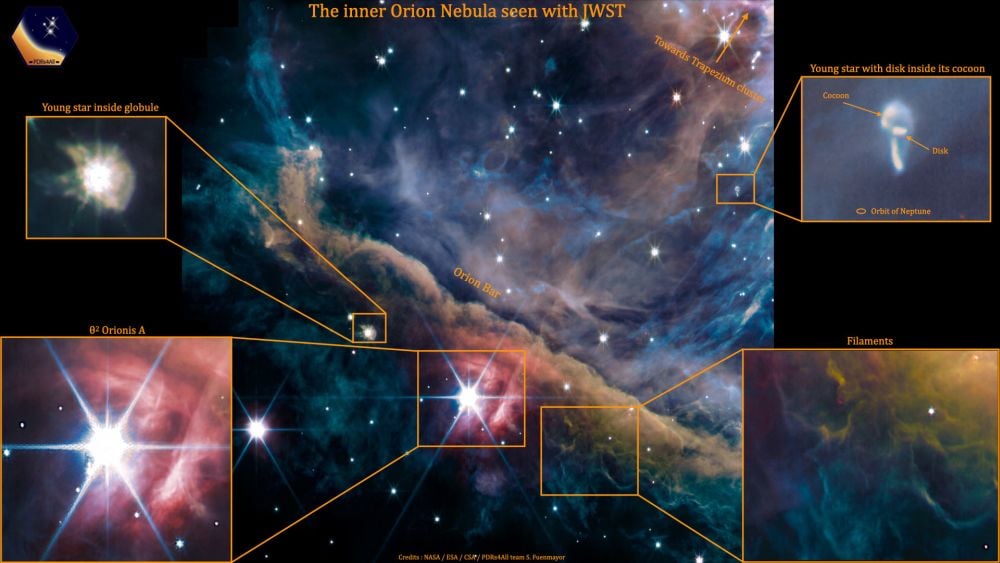 This JWST image of the Orion Bar highlights some of the features. The bottom right panel shows the filaments and arcs in the Bar. The new model reproduced some of these features. Image Credit: NASA / ESA / CSA / PDRs4All ERS Team / Salomé Fuenmayor.
When scientists create models whose results match observations, they know they're on the right track to a better understanding. That's what happened in this case, even though that wasn't necessarily what they set out to do.
"We note that while the main objective was not to provide an optimized fit to the Orion Bar, our three-dimensional chemical model was able to reproduce many of the features found in observations of the Bar," the authors write in their conclusion. They determined that the spatial dimensions of the PDR front plays a critical role in determining the emissions at the front.
"Our results mark a turning point for astrochemistry, where three-dimensional steady-state models can deliver fundamentally new insights into the chemistry and fundamental structure of the interstellar medium," the researchers explain.
"Future works can now investigate gas morphologies induced by different physical mechanisms and examine their photochemistry and emissions in three dimensions," they conclude.