 Universe Today
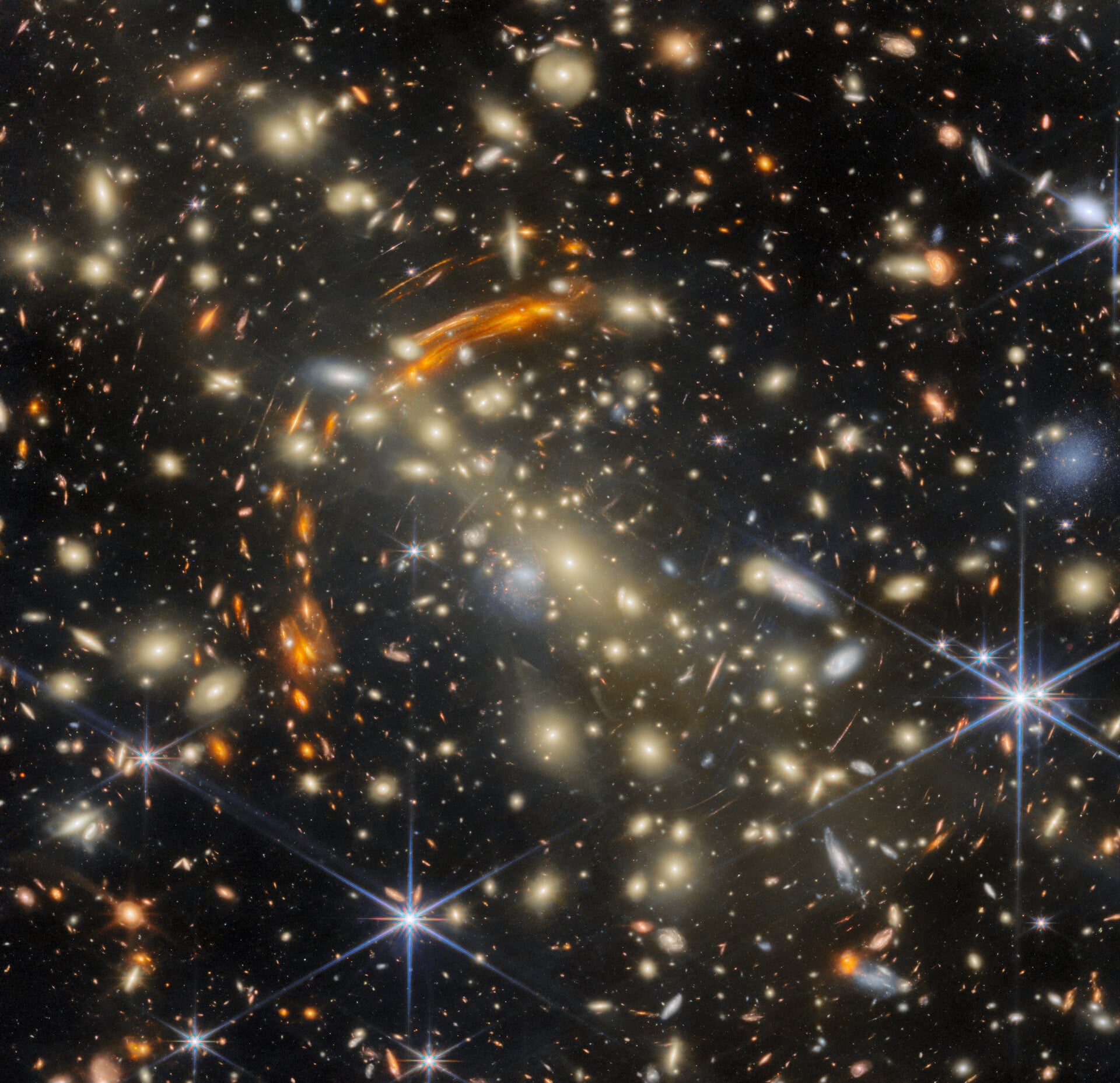
The NASA/ESA/CSA James Webb Space Telescope (JWST) has provided something truly wonderful for its latest Picture of the Month. While observing the famous MACS J0454.1-030 galaxy cluster, Webb captured brilliant golden galaxies in great and glorious detail! Light from these galaxies traveled about 6 billion light-years to reach us and is warped by the gravitational lens created by the galaxy cluster.
In essence, the cluster's enormous mass warps spacetime around it, causing light from more distant objects to bend and magnify. Astronomers routinely exploit this effect to observe distant objects that telescopes cannot see under normal conditions. This technique, known as Gravitational Lensing, has opened new windows into the cosmos and made this image possible, especially when combined with next-generation instruments like Webb.
Based on various analyses of this image, astronomers estimate that some objects in the lensed area are magnified by a factor of more than 300. Whereas the golden galaxies are part of the cluster, which existed when the Universe was 8 billion years old, those that appear in the lensed areas (orange and red) predate them considerably. The red galaxies in particular existed when the Universe was just 2 billion years old.
Astronomers have also determined that one galaxy in the image existed just 800 million years after the Big Bang. Analysis of this galaxy's light suggests it was undergoing a merger that triggered an enormous burst of star formation. Our current cosmological models suggest this is how galaxies in the early Universe grew and became more complex, eventually becoming the elliptical and lenticular galaxies astronomers regularly observe near the Milky Way.
Further Reading: ESA