Universe Today
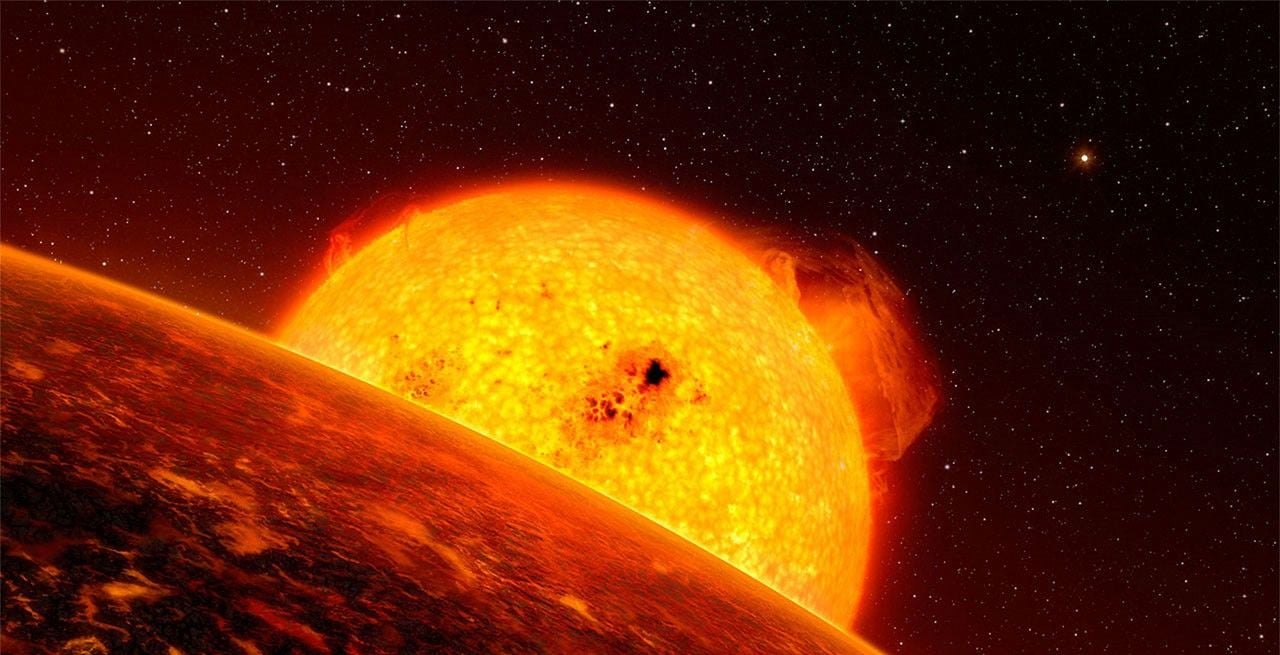
When stars like our Sun reach the end of their main sequence, they enter their Red Giant Branch phase and expand to become several times their original size. During this time, the star will undergo chemical changes in its interior, altering the composition of its surface layer. For decades, researchers have wondered how the changing chemical composition in the interior drives changes in the upper layers. Central to this question is the stable layer that connects the core to the outer layer and serves as a barrier between the two.
How elements created through nuclear fusion in the interior cross that layer has remained a mystery. Using advanced supercomputers, a team of researchers at the University of Victoria’s Astronomy Research Centre (UVic-ARC), and the University of Minnesota appears to have found the answer. According to their research, supported by the Natural Sciences and Engineering Research Council (NSERC), the National Science Foundation (NSF), and the US Department of Energy, the key is stellar rotation.
Since the 1970s, scientists studying Red Giants have noticed that as these stars expand, changes occur in their surface layers. One in particular is the observed decline in the carbon-12-to-carbon-13 ratio. The only possible explanation for this behavior is matter transfer from the interior, but researchers have been unable to show how that transport happens until now. Led by Simon Blouin, a UVic postdoctoral fellow with the ARC, the research team conducted large 3D hydrodynamic simulations that model how material in the star moves.
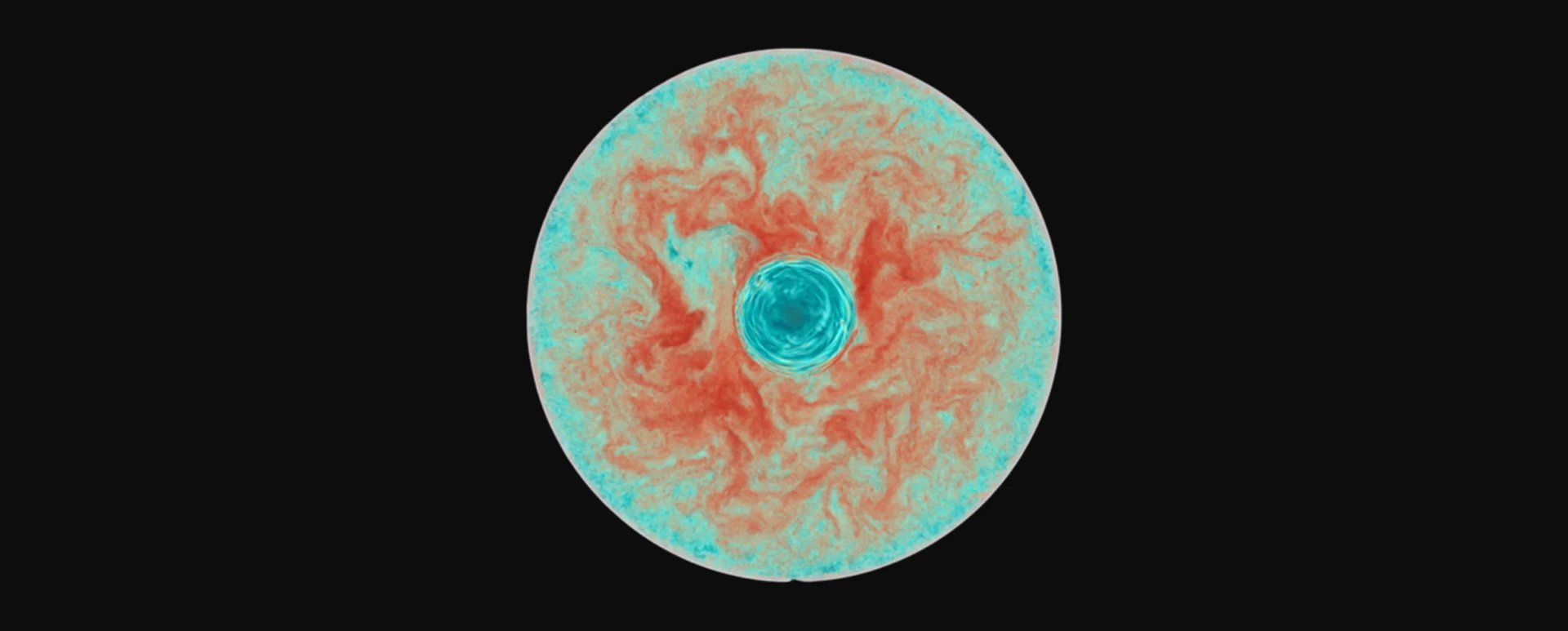 A slice through the simulated interior of a red giant star. Credit: Blouin, S. et al. (2025)
To run their simulations, the team used two supercomputers located at the Texas Advanced Computing Centre (TACC) at the University of Texas at Austin, and the new Trillium supercomputing cluster at SciNet at the University of Toronto. They revealed that stellar rotation dramatically increases the effectiveness of these waves in mixing material across this barrier, and that the mixing rates can exceed those in non-rotating stars by over 100 times, increasing with faster rotation rates. Said Blouin in a UVic News release:
Using high-resolution 3D simulations, we were able to identify the impact that the rotation of these stars was having on the ability for elements to cross the barrier. Stellar rotation is crucial and provides a natural explanation for the observed chemical signatures in typical red giants. This discovery is another step forward in understanding how stars evolve. We were able to show that the rotation of the star dramatically amplifies how effectively these waves can mix material across the barrier, to an extent that matches the observed changes in surface composition.
This confirms what previous simulations showed: how churning motions in the convective envelope can pass through the barrier layer. But these simulations also showed the waves transported very little material. This was largely due to there being limited computational resources for conducting simulations. Leveraging recent advances in supercomputing and distributed networks, the team created the first detailed simulation of a star's internal motion. Said Falk Herwig, principal investigator and director of ARC:
These simulations allow us to tease out small effects to determine what actually happens, helping us to understand our observations. We were able to discover a new stellar mixing process only because of the immense computing power of the new Trillium machine. These are the computationally most intensive stellar convection and internal gravity wave simulations performed to date.
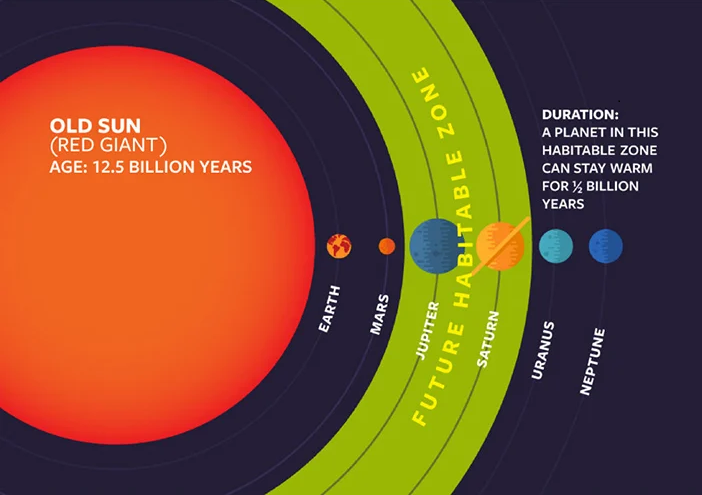 Graphic representation of the migration of the Solar System's habitable zone as the Sun evolves through the red giant phase. Credit: NASA
These results offer a detailed prediction of the kinds of changes our Sun will undergo in the future. In about 5 billion years, it will exhaust its hydrogen fuel and expand outward, likely consuming Mercury, Venus, and even Earth in the process. At this point, scientists venture that objects beyond the Frost Line (the boundary beyond which volatiles freeze solid) will orbit within the Sun's new habitable zone.
What's more, the same computational techniques employed in this study have numerous applications beyond simulating stellar evolution. It could also be very useful for research in fields ranging from ocean currents and atmospheric dynamics to blood flow, benefiting climate science, oceanic monitoring, and medicine. Herwig is currently working with researchers in these fields to develop protocols and the infrastructure needed for large-scale simulations.
Blouin plans to continue using the techniques to investigate stellar rotation by extending them to other types of stars, in the hopes of learning more about how these massive objects evolve.