 Universe Today
Space science is interesting in its diversity. At times, it's an extremely complex, expensive and time-consuming effort to gather data. Look how challenging it was for Curiosity and Perseverance to reach the surface of Mars safely. Look at the JWST's long journey from clean room to Sun-Earth L2, and its eventual science results.
Other times, science is so simple you can get started with a plastic bin full of water.
That's what a group of habitability researchers did in an effort to understand some of our Solar System's most promising worlds: the frozen ocean moons.
The Solar System contains multiple frozen ocean moons, but the two that are most intriguing to science are Saturn's Enceladus and Jupiter's Europa. There's strong evidence that both moons host warm oceans under thick layers of global ice. Both the ESA and NASA have launched robotic orbiter missions to Europa, but neither the Europa Clipper nor Juice will arrive in the Jovian system for many years.
In the meantime, scientists aren't letting the question of habitability in these oceans lie dormant while we wait for the spacecraft to reach their destination. Researchers are still working on understanding these moons. Modelling and simulations play a big role, just as they do across the sciences. But sometime in space science you can find things or locations on Earth that are useful analogues for those on other bodies in the Solar System.
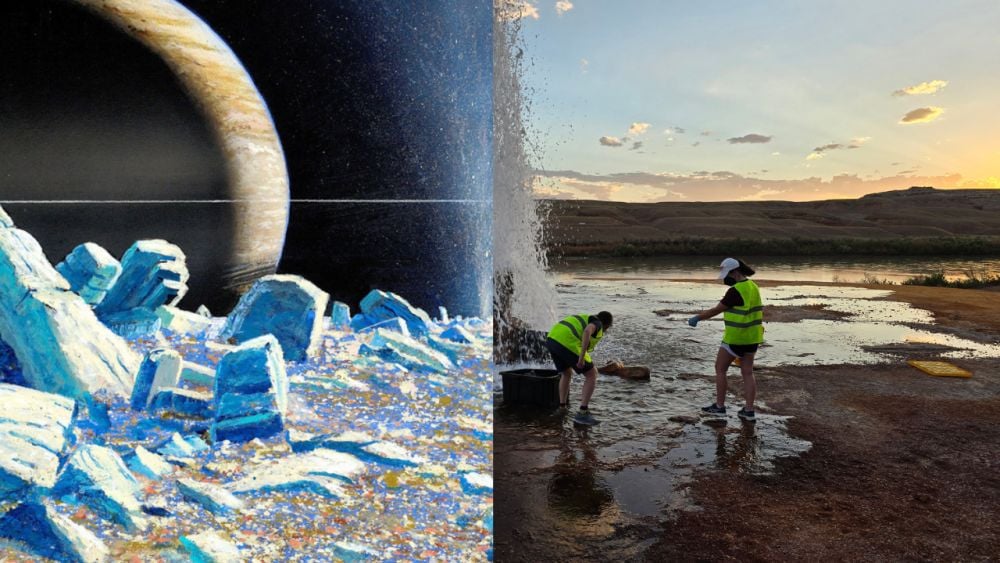
That's what drew researchers to the desert in eastern Utah near the small town of Green River. Natural, CO2-saturated cold water geysers erupt from the ground there. They're analogues for Europa, Enceladus, and even Neptune's moon Triton, where observations have detected similar eruptive plumes.
These plumes offer simulated access to the oceans hidden under layers of ice on these moons. The Europa Clipper and JUICE will both examine these plumes. To prepare for this, scientists try to ask as many pertinent and helpful questions about their mission before the missions start returning science results.
In new research, a group of researchers collected water from two geysers in Utah and analyzed it. They published their results in a paper titled "Cold-Water CO2 Geysers as Ocean World Plume Analogs: Investigation of Habitability Indicators in Crystal and Champagne Geysers Pre- and Posteruption." It's published in the journal Astrobiology, and the lead author is Morgan Cable, Senior Scientist at the Planetary Science Institute.
"Ocean world plumes at Enceladus, Triton, and possibly Europa are astrobiologically significant," the authors write. They could be bringing fresh material from the ocean to the surface, which can reveal a lot about the concealed oceans and their habitability. Without them, our only option would be to somehow "drill" through the ice and collect samples, which is well beyond our technology.
But the problem is these materials could be modified as they're transported. "However, it is currently unclear if chemical fractionation or other modification processes might occur during subsurface transport and eruption and potentially lead to changes in concentrations of habitability indicators relative to the source reservoir," the researchers explain.
"To explore this phenomenon in a natural setting, we investigated the cold CO2 geysers in Green River, Utah, which have eruptions driven by volatile exsolution," the authors write. They gathered samples from two of the many geysers in the Jurassic Navajo Sandstone aquifer. One of the two, named Crystal geyser, is the largest one in the group, and is in fact one of the largest ones on Earth.
“The same mechanics driving the cold-water geysers in Utah may also be occurring at the south pole of Saturn’s moon Enceladus, and at Jupiter’s moon Europa, where recent carbon dioxide-rich deposits have been identified on its surface,” lead author Cable said in a press release.
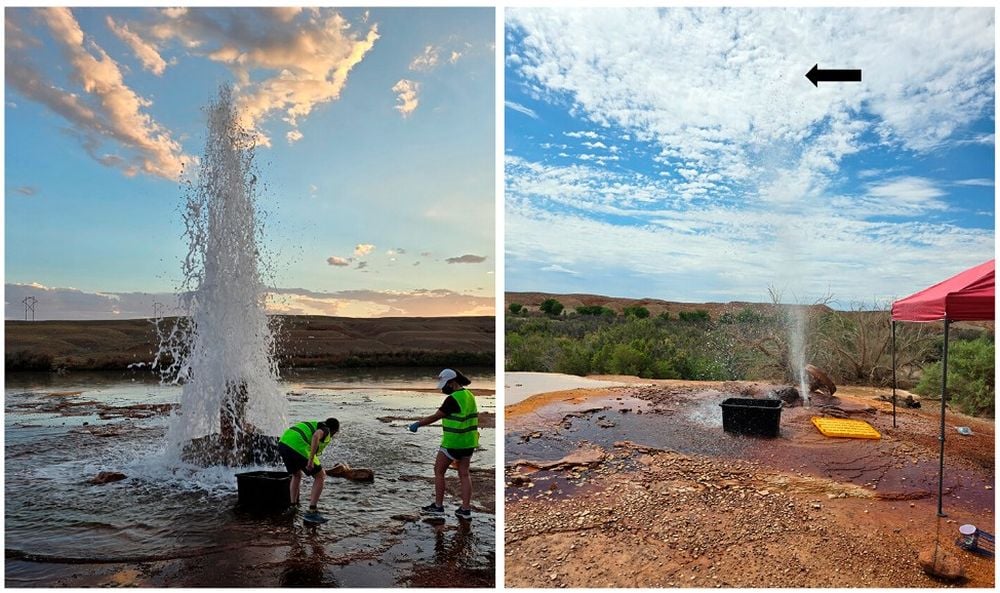 The researchers used plastic bins to gather samples from the Crystal geyser (left) and the Champagne geyser (right). The black arrow highlights how high material from Champagne travels. The samples were subjected to both chemical and biological analyses. Image Credit: Cable et al. 2026 AstroBio
The the pair of geysers have different diameters and discharge amounts. The researchers sampled the large Crystal geyser and a smaller one named Champagne. They analzyed them, and also compared them to nearby evaporated deposits from previous eruptions. They also compared the erupted samples with unerupted samples.
While the image of plastic bins collecting geyser water may indicate a lack of rigour, that's not the case. Samples for biological analyses were collected with standard sterile techniques, using sterile gloves and masks. The results from those samples will be reported in a separate paper.
The plastic bins that collected the effluent for chemical analysis were likewise sterile, and once samples were collected, sterilized lids were put in place and the samples were transported to a safe area for analysis.
What did these samples reveal?
“While there’s no perfect Earth-based analog for the plumes on other worlds, this study did provide important constraints and lessons learned about the abundance and detectability of habitability indicators,” Cable said.
For the Champagne geyser, the results showed some differences in erupted samples vs unerupted samples. There were greater levels of the cations (Na+, K+, Li+) and anions (Cl–) in the erupted samples than in most unerupted samples. In a stark difference, only one sample contained dissolved iron. Other things were different, too, like manganese concentrations. "There was a greater difference in manganese between the two geysers compared with erupted/unerupted for a single geyser," the authors explain.
Results were similar for the Crystal geyser.
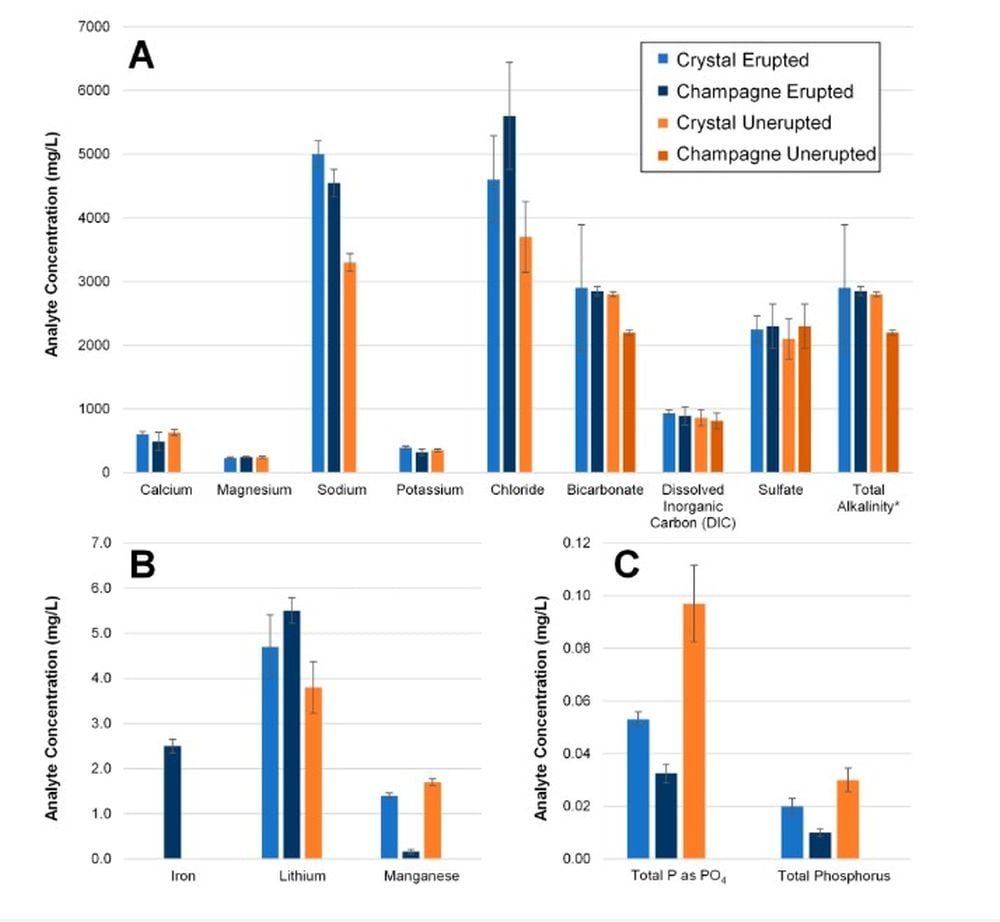 Chemical analysis results for erupted and unerupted samples form the Champagne and Crystal geysers. Differences between erupted and unerupted samples indicate the difficulty in understanding how plumes on ocean moons can differ from the oceans they erupt from. Image Credit: Cable et al. 2026 AstroBio
Critically, the results show that the geysers are ejecting material from deep within the sandstone aquifer. They also show that erupted samples can be different than their sources. To determine how they changed during eruption, the researchers used geochemical modelling. "Our geochemical model can provide insights into the chemical states of waters from the Crystal and Champagne Geysers along a degassing path," the researchers explain.
Their models show that the subsurface waters are extremely rich in CO2. The subsurface water's CO2 pressure exceeds the atmospheric pressure of CO2, and it's that pressure that drives eruptions.
The researchers also sampled and analyzed surface evaporated deposits from previous eruptions. What's puzzling is that despite coming from the same source water, the geysers differ in some ways. "Despite the fact that both geysers are part of the same aquifer system, one generated evaporites that were nearly entirely carbonate minerals (Crystal Geyser), and the other was primarily sulfate minerals (Champagne Geyser) over the same evaporation period," the authors write.
Despite all of the differences, the samples are similar to those on ocean moons, at least in some ways. "In terms of salts in erupted effluent, both geysers have some compositional similarities to Cassini measurements of ocean-derived ice grains (Type III) of the Enceladus plume and predicted levels for the ocean of Europa," the researchers write.
Those salts could become a problem when it comes to identifying the all-important biosignatures. "In terms of measuring ocean world materials in situ, high concentrations of salts can have detrimental effects on techniques that aim to quantify biosignature molecules," the researchers explain.
We study Europa and Enceladus because they tease us with their potential habitability. Observations show that Enceladus is most likely transporting ocean water to the surface and into space. The same thing might be happening on Europa. "However, it is still not clear the extent to which ocean samples are modified before they become accessible to spacecraft," the authors explain.
By tracing the CO2 degassing backward, the researchers created a reasonable idea of how carbonated the oceans could be before erupting. This helps place important constraints on the contents and state of the subsurface oceans, even it it's not totally definitive. "This finding enabled a reasonable inference to be made on the initial degree of carbonation before eruption. This type of inference is not definitive, but it opens a door to constructing a model-based framework for constraining the chemistry of the source fluid," the researchers write.
“If we extrapolate these findings to ocean worlds, missions should consider targeting large vents or areas of output to ensure access to materials from depth,” Cable said. “And, if possible, analysis of material from multiple sources of varied flux might provide a ‘depth profile’ of the host underground reservoir.”
The results inform future missions to the ocean moons and how scientists can work with and interpret data from the Europa Clipper and Juice. The differences in composition between ejected and unejected samples is particularly informative.
“This means that future research will benefit from combining measurements of plume ejecta by spacecraft, Earth-based telescope observations and geochemical computer models to fully characterize plume deposits and make robust inferences of ocean composition,” Cable said.

