 Universe Today
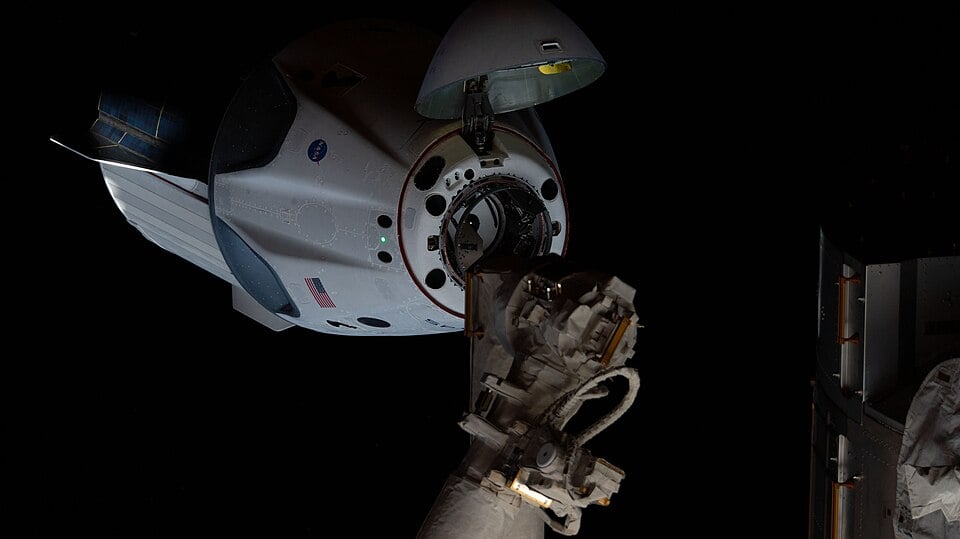
Docking with the ISS may seem simple. However, actually doing so is a showcase in how difficult orbital mechanics can be. It’s equivalent to traveling down a highway at 28,000 km/hr and parallel parking into an open garage on a multi-billion dollar laboratory traveling at the same speed. If you try to accelerate forward you actually drift up, and there’s no air friction to naturally slow you down. Oh, and if you hit the lab, everyone onboard both your craft and the station dies, and the resultant debris field could both wipe out dozens of satellites and even people on the ground. No pressure, obviously. For decades, aerospace engineers have been docking successfully using hard coded physics equations and human pilots to correct them. But now, a new paper, available in pre-print on arXiv from researchers at Stanford, is taking a shot at building an AI to perform a series of “mental simulations” that could fundamentally change how future spacecraft interact with each other.
Their solution is called the Out-of-this-World-Model (OWM), but before we get to what that is, it's best to do a recap of how we typically navigate in Low Earth Orbit (LEO). Traditionally, navigation computers use a type of algorithm called a Guidance, Navigation and Control (GNC) algorithm. They also take advantage of another mathematical trick called an Extended Kalman Filter, which helps them take in data from GPS receivers and star trackers, and output thruster burn duty cycles.
Unfortunately, Kalman filters are terrible at processing high-speed video. So engineers turn to traditional computer vision techniques. However, they themselves face a huge hurdle in space - they’re very fragile. If sunlight glints off a solar array, or part of the target is suddenly covered in shadow, those computer vision algorithms are completely thrown off.
Video describing how Proximity operations work. Credit - Knowledge @ NASASounds like a perfect place for AI, right? Researchers thought so too, so they began applying Reinforcement Learning (RL) algorithms - the kind famously behind computers winning at chess or Dota. However, they are only good at dealing with scenarios with very specific sets of rules. Change the rules - such as flipping what side of the ISS the docking port you’re supposed to attach to is on - and the algorithms don’t know what to do.
Enter the “World Model”. The best way to describe this type of algorithm is through an analogy with a baseball (or cricket) player. When an outfielder moves to catch a fly ball, they don’t immediately begin solving partial differential equations in their head - they have a mental simulation that predicts where the ball will land. That mental simulation is based on past visual cues, but, notably, doesn’t involve a lot of direct calculations.
In the world of machine learning, a “World Model” is a type of AI architecture that learns the fundamental physics of the environment it’s interacting with directly from experience rather than from equations directly programmed into it, or updated based on a specific reinforcement algorithm. The Stanford OWM model uses this idea to “dream” dozens of potential futures, and controls the system outputs to “step” towards that dream future.
Demonstration of vision-based Redezvous operations in action. Credit - Spacecraft Robotics Lab YouTube ChannelCrucially, instead of just guessing, it measures an outcome’s probability. Such certainty is key to ensuring an AI can react to unexpected situations or adjust an output when some of its outcomes weren’t exactly met.
Teaching such a model remained the biggest challenge, though, with a world model requiring hundreds of thousands of simulated flights. Doing so on a traditional computer CPU would have taken weeks. So the researchers came up with a library they dubbed AstroJAX, which is designed to run on Graphics Processing Units (GPUs), similar to what early AI models were trained to run on, but originally intended for use in video gaming computers.
The algorithm that resulted from this effort performed admirably - the OWM model required only 500,000 iterations to master docking maneuvers, whereas a comparable RL system required 25,000,000 permutations. The OWM model also performed better when being asked to dock at a never-before-seen docking port on the ISS, and was better able to deal with unexpected situations - such as when the researchers intentionally introduced a docked capsule at the docking port the AI was supposed to interface with.
Admittedly, there’s still a long way to go in this software’s development. Across all the docking ports on the ISS, the model only successfully docked with them about 53% of the time - though that should be compared to the RL algorithm’s 29% success rate. However, close-up operations appeared difficult for the OWM - likely because of high penalization weighting of collisions, which the authors state can be adjusted in future iterations.
It will likely be a while yet before we see a fully automated AI take control of a docking sequence - and probably much longer before one takes control of anything with humans on either end. But, with the increasing number of satellites that either need serviced or de-orbited, and potentially plenty more people in space itself in the coming decades, it’s only a matter of time before we let the robot take the wheel. Or thruster control, in this case.
Learn More:
D. Eddy et al - GPU-Accelerated Astrodynamics World Models for Spacecraft Rendezvous and Proximity Operations
UT - Stunning Look at ISS and Docked Disovery -- From the Ground!

