Universe Today
In his blockbuster 1982 novel "Space", the writer James A. Michener wove a gripping tale of astronauts trapped on the Moon during a major solar storm. Warnings from Earth didn't come soon enough to save them from death by radiation sickness. To avoid such a tragedy happening with the Artemis crews (and as NASA did with the Apollo crews of the past), the agency is working with the National Oceanic and Atmospheric Administration (NOAA) to monitor solar activity. If the Sun acts up, the teams will be able to send warnings and instructions to the Artemis crews to protect them.
Human missions to the Moon are more vulnerable to space weather than astronauts on the International Space Station (who are sheltered somewhat by orbiting within Earth's magnetosphere). A trip to the Moon takes crews outside that protective "shell" that wards off most solar radiation that poses a threat to Earth.
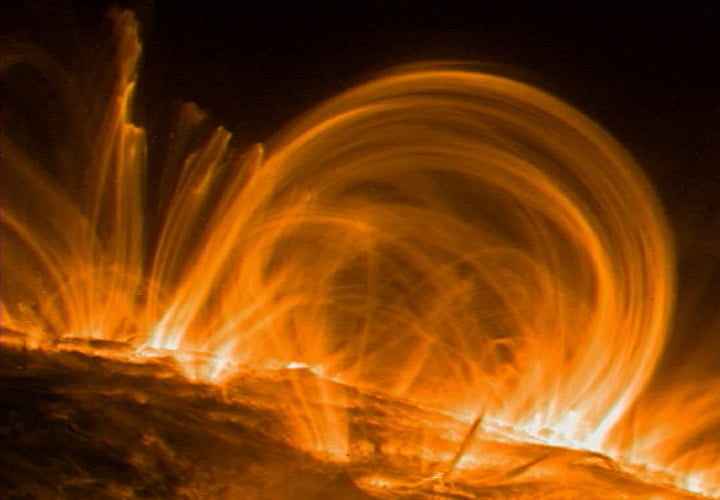
Space weather is caused by outbursts from the Sun such as X-class flares and coronal mass ejections. They carry a stream of highly charged particles toward Earth and out through the Solar System. The radiation from those storms is lethal to most life. If a significant solar storm occurs near the Artemis II crew, it could raise radiation levels inside their spacecraft or on the lunar surface. Too high a total lifetime exposure can contribute to increased risks of developing cancer or health disorders that could impair cognition and performance. During the Artemis II mission, NASA wants to minimize that risk. That's why spacecraft are built to withstand some of the radiation, and why astronauts are trained to "hide away" during intense storms.
Protecting the Crew From Solar Outbursts
The energetic particles that stream from the Sun during an outburst travel through space on the solar wind. Ultimately, the swarm can overtake the spacecraft from all directions, swamping it with radiation. “It’s more like you’re sitting in a bathtub and it’s gradually filling with water,” said Stuart George, a space radiation analyst at NASA Johnson.
Fortunately, the "swarm" doesn't happen all at once. It takes time for the ejected particles to travel from the Sun to Earth, giving the observation teams and the astronauts time to plan. Plus, the spacecraft are "hardened" to some extent. For example, the Orion capsule carries radiation sensors as part of an assessment system. They measure the radiation doses and dose rates in different parts of the ship. The astronauts also wear radiation dosimeters that measure the dosage as they work. If something happens, and a high amount of radiation is detected, onboard alarms call their attention to the event and they can take steps to monitor the situation closely. If the radiation is too strong, the as tronauts will be prompted to take shelter.
So, let's imagine that the alarms sound and it's bad enough that the crew has to take action. The astronauts need to be "behind" walls thick enough to slow the charged particles down or stop them completely. That's why the crew is trained to reconfigure the environment inside the capsule. They remove stowed equipment and other materials from storage bays and use it to add mass between themselves and incoming particles. The Artemis II crew in particular will be testing this procedure during the upcoming mission. “Once crews add mass to the places that tend to be hotter in terms of radiation exposure, they can then continue to go about their duties,” George said.
Using Data from Solar Probes
The Sun is particularly active these days, and observers are carefully monitoring its sunspot activity for signs of future outbursts. Those events can be pretty strong and complex. The NASA/NOAA teams will be using data from various probes around the system. These include such Sun-watching spacecraft strategically placed across the solar system, such as NASA’s recently launched Interstellar Mapping and Acceleration Probe, NASA’s Solar Dynamics Observatory, the ESA (European Space Agency)/NASA Solar and Heliospheric Observatory, NOAA’s Geostationary Operational Environmental Satellites-19 satellite, and many others. In addition, the Mars Perseverance rover will get a glimpse of the far side of the Sun and watch space weather outbursts from the side of the Sun invisible to Earth during the Artemis II mission.
 NASA’s Perseverance Rover captured these images of sunspots crossing the Sun from its vantage point on the Martian surface between February 24 - 27, 2026. Mars is currently on the opposite side of the Sun, giving the rover a view of sunspots not visible from Earth. Perseverance will monitor sunspots leading up to and during the Artemis II launch window, giving the Moon to Mars Space Weather Analysis Office (M2M SWAO) and Space Radiation Analysis Group (SRAG) teams advance notice of regions that could produce solar eruptions before they rotate onto the Earth-facing side of the Sun. Credit: NASA/JPL-Caltech/ASU/MSSS/SSI
Outbursts from the Sun aren't the only radiation hazards the Artemis astronauts will face. As they leave Earth, they'll pass through the Van Allen Radiation Belts, which pose a threat. In addition, cosmic rays can also deliver radiation hits to astronauts in space. Together, the radiation exposure from these sources is expected to be comparable to a 1-month stay on the International Space Station, or about 5% of an astronaut’s career limit. Any exposure from solar radiation events would add to this baseline.
So, unlike the unlucky astronauts of Michener's dramatic book, the Artemis astronauts should have a wealth of information available to them well in advance of solar outbursts that could send clouds of charged particles their way. The Moon to Mars Space Weather Analysis Office, based at NASA Goddard Space Flight Center, will continuously assess solar activity and any eruptions that occur. The team will send its analysis to the Space Radiation Analysis Group, based at NASA’s Johnson Space Center in Houston. Together, their forecasts and those from NOAA’s Space Weather Prediction Center, plus real-time measurements from inside the Orion spacecraft will inform recommendations for the flight control team.
For More Information
To Protect Artemis II Astronauts, NASA Experts Keep Eyes on Sun