 Universe Today
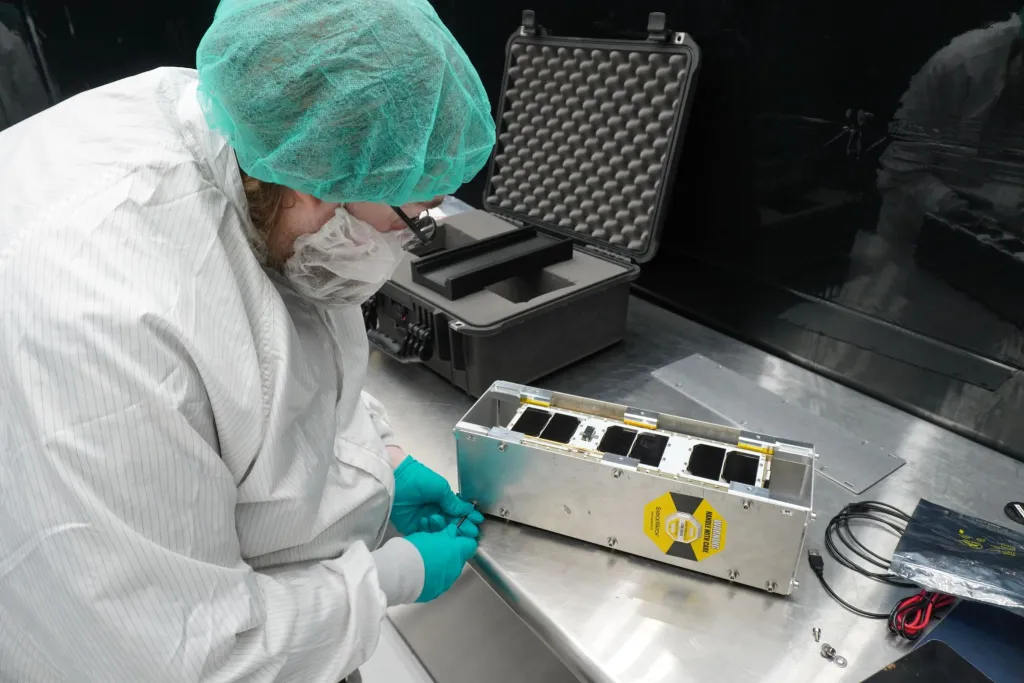
Neutrinos, the second most common fundamental particles in the universe, are notoriously difficult to detect. So far we’ve only been able to do so by building giant vats of water far underground with hundreds of photodetectors watching for brief flashes of light. But a new CubeSat mission hopes to change that dynamic and enable the neutrino detectors of the future a much less constrained and expensive existence - in space.
The Solar Neutrino Astro-Particle PhYsics CubeSat (SNAPPY) officially launched in the early hours of May 3rd 2026 from a Falcon 9 Rocket launch at Vandenberg Space Force Base in California. But its journey even to that point had been almost a decade in the making.
SNAPPY is an example of a NASA Innovative Advanced Concepts (NIAC) program made good. It was originally funded as a Phase I by NIAC back in 2018, then received Phase II funding in 2019, and Phase III in 2021 to enable the CubeSat to get to flight readiness, and eventually launch 5 years later. Even before that, the inspiration from SNAPPY came from another famous solar explorer - the Parker Solar Probe.
Fraser explores a more traditional neutrino detector - buried in the ice.Nick Solomey, a professor of mathematics, statistics, and physics at Wichita State University (WSU) realized that, as part of its mission, Parker would be passing through a region of space that has 1,000 times the neutrino flux as any area here on Earth. That would increase the likelihood of the rare collision that marks us “finding” a neutrino by a factor of 1,000. But we would have to do it in space.
That would not be easy. We had never tried to build a neutrino detector in space before. And the main challenge wouldn’t necessarily be detecting the neutrinos themselves - it would be eliminating the noise from all the other space phenomena that weren’t neutrinos but certainly looked like them in the data. SNAPPY is hoping to develop ways to do exactly that.
It is equipped with a prototype solar neutrino detector that weighs about half a pound and is composed of four crystals encased in a highly specialized shielding block. That block, made from epoxy and loaded with tungsten dust, is meant to mimic the lead commonly used in Earth-based neutrino detectors as a medium for the neutrinos to collide with.
Fraser talks about the highest energy neutrino ever detected.SNAPPY was a joint effort, involving research from at least four different universities, one NASA center, and a few different companies. The CubeSat platform the satellite is housed in was designed by Kongsberg NanoAvionics, the electronics were designed by engineers as NASA’s Marshall Spaceflight Center, and 36 different undergraduate and graduate students have worked on the SNAPPY project, with responsibilities like programming the payload computer, which was handled by some WSU graduate students.
The current mission is only a technology demonstrator, though. Proving the algorithms can successfully block “noise” in the signal is a necessary step to move on to a more complete mission profile later. That mission, which will be much bigger and admittedly more costly, will visit the actual location Dr. Solomey had noted during his original Parker research. And if his calculations are correct, and SNAPPY proves we are able to successfully differentiate between neutrinos and other types of cosmic phenomena, then soon we will have a much different way of finding the pesky neutrinos that scientists have been trying so hard to study for decades.
Learn More:
NASA - NASA-Supported Small Spacecraft Launches to Study Solar Particles
UT - The Most Energetic Neutrino Ever Detected Could Be Primordial
UT - A New Neutrino Detector In China Is Coming Online
NASA / Nick Solomey - Cube-Sat Space Flight Test of a Neutrino Detector

