 Universe Today
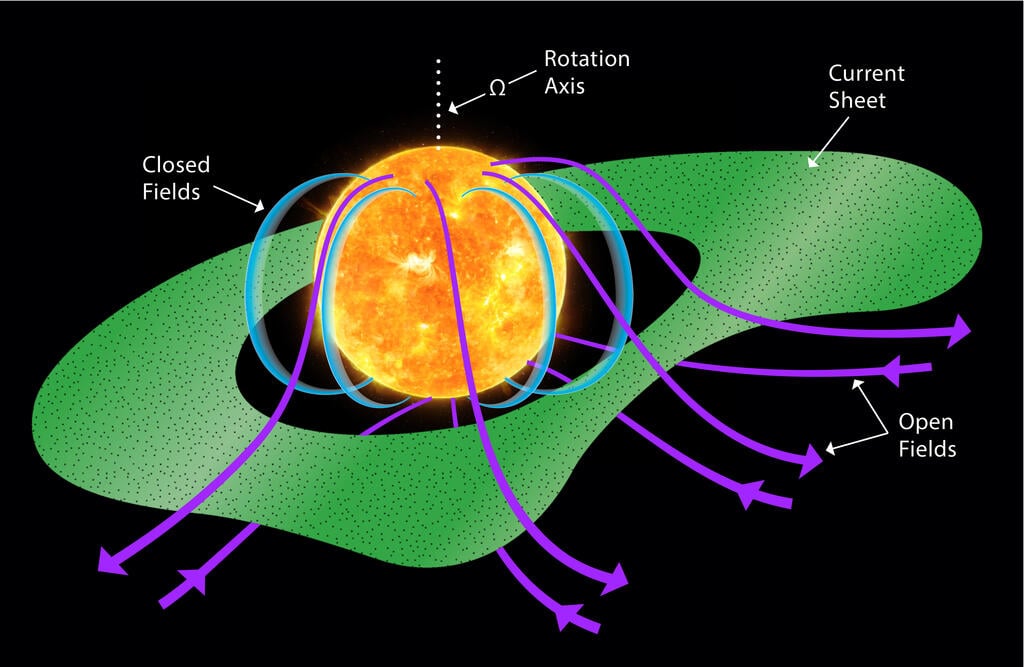
Out in the solar system, there is a giant rippling curtain of charged particles that is actually the largest structure in our solar system. Known as the Heliospheric Current Sheet (HCS), it marks the spot where the sun flips its magnetic north and south poles, and grows directly out of giant, glowing loops of plasma on its surface called helmet streamers. However, so far, studies of it have only occurred near Earth, using space-based instruments such as SoHo and Wind. But now, a new paper from Keiichi Ogasawara of the Southwest Research Institute (SwRI) and his team used the joint ESA/NASA mission Solar Orbiter to capture the HCS at only about ⅓ the distance to Earth - before interactions with interstellar space and the solar wind change it. In other words, this paper represents the clearest ever picture of what the solar system’s largest coherent structure is actually made out of.
Solar Orbiter crossed a part of the HCS at 0.3 AU on April 13th, 2023, with all of its instruments on high alert. Of specific note in this paper, the Heavy Ion Sensor (SWA-HIS) played a key role in collecting data on the particles that make up the HCS. And what it saw wasn’t just a flat magnetic line, but more like a multi-layered highway filled with magnetic anomalies and changing plasma pressures.
One main discovery had to do with electrons. Just before the spacecraft got to the main body of the HCS, it encountered an area where fast beams of electrons (known as strahls) suddenly stopped. But protons in the solar wind also seemed to be going around 50 km/s faster. These two features led the researchers to believe this area serves as a focus of magnetic reconnection - where the magnetic field lines of the Sun snap and shoot out bursts of plasma.
Fraser discusses new findings about the SunDespite the massive changes in magnetic field through the HCS, the heavy-ion ratios for carbon and oxygen (i.e. different charge states of the specific element) stayed remarkably stable. These ionic variations are created close to the Sun, and when the ions are pushed out into the solar system on the solar wind, they eventually reach the “freeze-in height”, about 1-2 times the radius of the Sun. At that point, the ionic ratios are locked in as the atoms can no longer easily capture or lose electrons. Solar Orbiter discovered that, despite the magnetic chaos happening in the HCS, it still has no effect on those atoms' ability to capture or lose electrons - which in turn allows researchers to track those ratios all the way back to their birthplace before the freeze-in height.
Even with the ionic ratios of an individual element remaining stable, there were notable changes in concentrations of different elements. Specifically, the researchers noted a sharp drop in the iron-to-oxygen (Fe/O) ratio. The solar wind typically picks up elements with a low first ionization potential (FIP), a measure of how much energy is needed to strip an electron from a neutral atom. Iron is one of the most common examples. However, that also means the solar wind ignores oxygen, as it has a very high FIP.
As Solar Orbiter neared the middle of the HCS, it tracked a sharp drop in Fe/O ratio. Eventually it settled down to a value very similar to what is found in Earth’s photosphere, rather than the typical solar wind. The researchers believe this is because of a force that might be unexpected when talking about giant magnetic structures in outer space - gravity. Heavy ions, such as iron, get trapped in giant, closed magnetic loops near the Sun for a long time, causing the iron itself to sink down towards the Sun before the plasma holding it is finally released into space.
Fraser talks about one of Solar Orbiter's other features - capturing the Sun's poles.Another part of the study looked at the temperature of oxygen compared to protons in the HCS. Oxygen hasn’t had time to equilibrate in temperature with its surrounding protons yet at 0.3 AU, making measurements at that point invaluable to understanding what happens to it on its journey through the solar system. Since oxygen is typically about 16 times heavier than a proton, that translates into the ratio at a point known as the super-mass-proportional limit.
Oxygen experienced numerous temperature spikes above that limit throughout the HCS. Interestingly, those same temperature spikes correlated positively with an increase in the O7+ / O6+ charge ratio, but also correlated negatively with the charge ratio for carbon. Scientists think this selective heating of oxygen is driven by a phenomenon called Alfven cyclotron waves, which they believe dump their energy into specific ions (such as oxygen) perpendicular to the magnetic field, whereas alpha particles absorb the energy that would otherwise be captured by carbon atoms, essentially starving them of a temperature increase.
Those are a whole lot of very varied discoveries for one quick trip through a massive magnetic field. Such visits are rare, but Solar Orbiter isn’t done with its mission yet, nor is its Sun-visiting cousin the Parker Solar Probe. As we collect more and more data closer to the Sun, we’ll begin to unlock an even better understanding of how complex the Sun truly is, and hopefully how that complexity impacts life here on Earth.
Learn More:
SwRI - SwRI Study Helps Unravel How the Sun’s Corona Transforms into Solar Wind
K. Ogasawara et al - Resolving Compositional Features of Solar Wind Source Regions near the Heliospheric Current Sheet at 0.3 au
UT - Is the Sun More Active Than it Looks? An Innovative Method to Characterize the Solar Cycle
UT - The Next Solar Cycle Has Started... But the Current One Hasn't Finished Yet

