 Universe Today
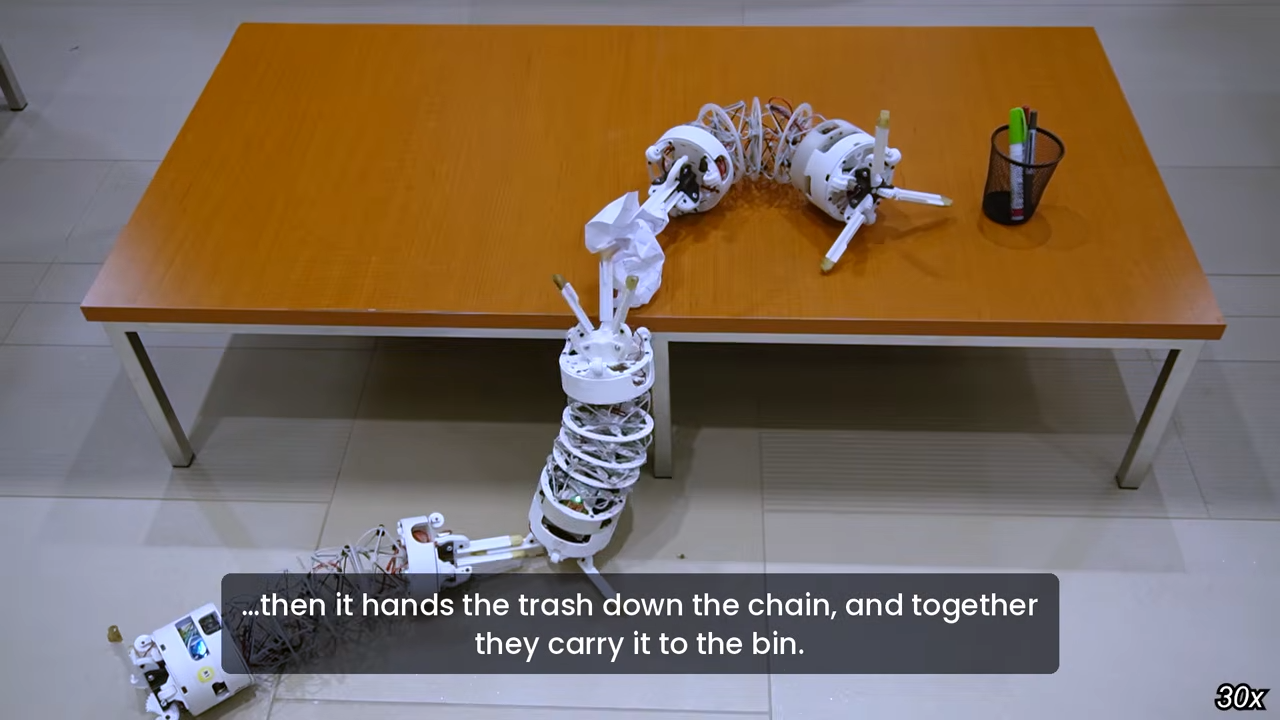
Robots have been a mainstay of our early space exploration efforts. But they normally have wheels. Or in some cases, rotors. While those solutions are great on flat ground, they struggle with jagged boulders or tight crevices. So engineers have been working on alternative robotic form factors, and a recent paper in Nature Machine Intelligence from researchers at Colorado State University’s Adaptive Robotics Lab, describes a unique morphology using a design principle typically seen in architecture rather than robotics - tensegrity.
Tensegrity was originally made popular by Buckminster Fuller in the mid-20th century. It’s a blend of the words “tension” and “integrity”, and at its core it uses rigid rods that push outwards against elastic cables that pull inwards. So, instead of relying on heavy metal hinges, the rods “float” on a web of tension.
This isn’t the first time the idea has been brought to space exploration, though. NASA has been exploring its use cases for over a decade, perhaps most notably with the SUPERball - a spherical cage designed to withstand high-speed planetary landings without parachutes by absorbing the shocks of impact across its network of cables.
Fraser talks about some other robots that could end up exploring other worlds.But this is one of the first times the idea has been applied to robotics. The CSU researchers have developed what they call the Tensegrity-based Continuum Robot (TeCoBot). Measuring in at around 587 mm (~2 ft) long and weighing around 600 grams, the cylindrical bot combined a squishy, flexible spine with adaptable dual mechanical claws, which provide the real interesting use cases of the technology.
TeCoBot’s body is made out of four stacked icosahedral tensegrity modules that create a continuous, flexible backbone. Each module is built around six lightweight rods suspended inside a 3D printed stretchy lattice. Three cables made up of 40-lb braided fishing wire run through the center of the robot, and by pulling on each of them with small motors attached to its base, the robot can bend in any direction - like an “elephant’s trunk” as a press release puts it. It can also scrunch down to around half its original size if all three lines are pulled at the same time.
But what’s most interesting about the technology is its modularity, which relies on the claws on either end. These claws are swappable, so if a robot needs to handle delicate cargo engineers can put a soft-padded claw on it. But, if needed, those soft pads can be swapped out for a heavier duty gripper claw that uses a worm gear to clamp and hold onto another gripper without draining any battery.
Fraser talks about the concept of "grey goo" - or self-replicating robots able to automate space exploration.This unlocks all sorts of additional opportunities. As a stand-alone single robot, TeCoBot is already relatively capable - it can inch along like a caterpillar, roll sideways, and even climb vertically. It also exhibits what roboticists call “embodied intelligence” that means its body can naturally give way when bumped or when it runs into something without needing a whole control system to adjust to the changed environment.
But when they combine together, they unlock whole new operating modes. Using their claws to grab one another, three TeCoBots can self-configure into a wide variety of shapes. The paper discusses three robots wrapping themselves around a large pipe, and forming a H-shaped walker to crawl through tight spaces. But perhaps most interestingly for anyone who hates cleaning as much as this author, they are also capable of teaming up to clean off a table.
Those feats might not seem immediately applicable to space exploration, but the underlying modularity and adaptability would be extremely useful in the rough craters of the Moon or underground caverns on Mars. We’ve already reported on a snake robot designed to explore those exact locations, and this seems like a step up in functionality from that.
Video of the TeCoBot in action. Credit - Adaptive Robotics Lab YouTube ChannelThat being said, it still has a long way to go before we’d see it on another heavenly body. Currently, engineers have to manually control the bots via a WiFi connection - which isn’t exactly easy on deep space missions. But they do plan to make improvements on the design, upgrading the motors for faster movement and adding swarm intelligence to allow dozens of these modular robots to band together. If that development goes as planned, these elephant trunk styled robots might serve as some of our most intrepid deep space explorers.
Learn More:
CSU / EurekAlert - Inspired by elephant trunks, these shape-shifting robots bend, grab and team up
M.H. Saikot et al - Tensegrity continuum robots enable task-adaptive morphologies for cooperative behaviours
UT - NASA Tests a Robotic Snake That Could Explore Other Worlds
UT - Snake Rovers Might be the Best Way to Explore the Surface and Tunnels on Mars

