Universe Today
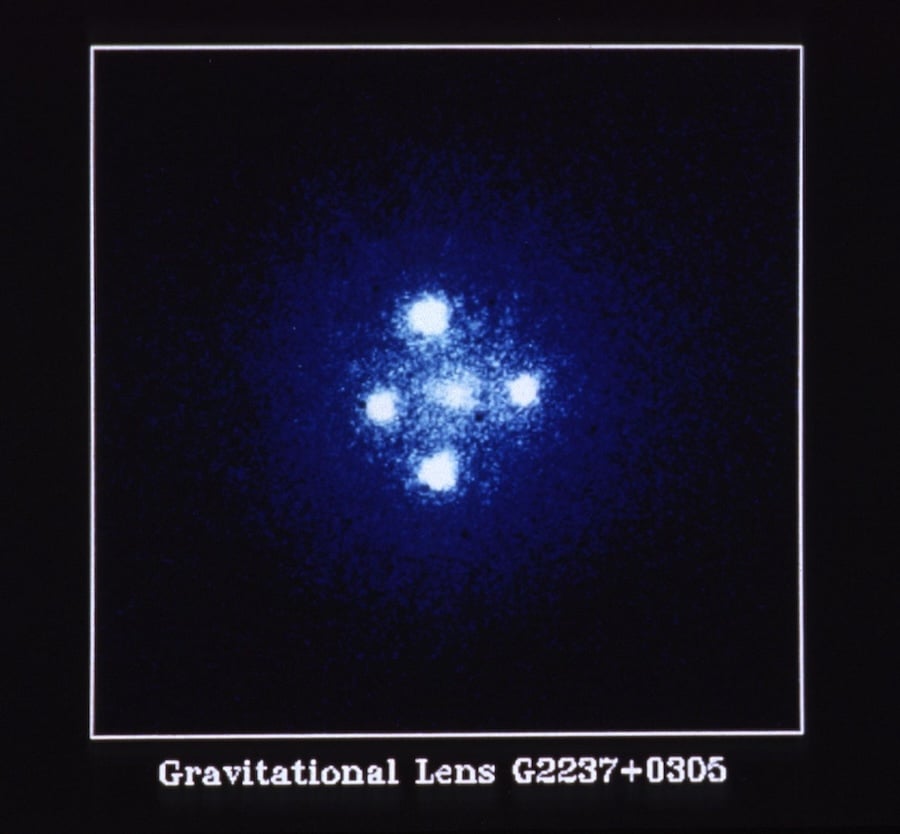
Quasars are the brightest sustained objects in the universe, the cores of distant galaxies where a supermassive black hole is actively swallowing matter and blazing as it does. Some shine tens of thousands of times brighter than the entire Milky Way. That makes them easy to spot and thoroughly awkward to study, because the glare from the middle swamps the galaxy around it. You can see the beacon and not the lighthouse.
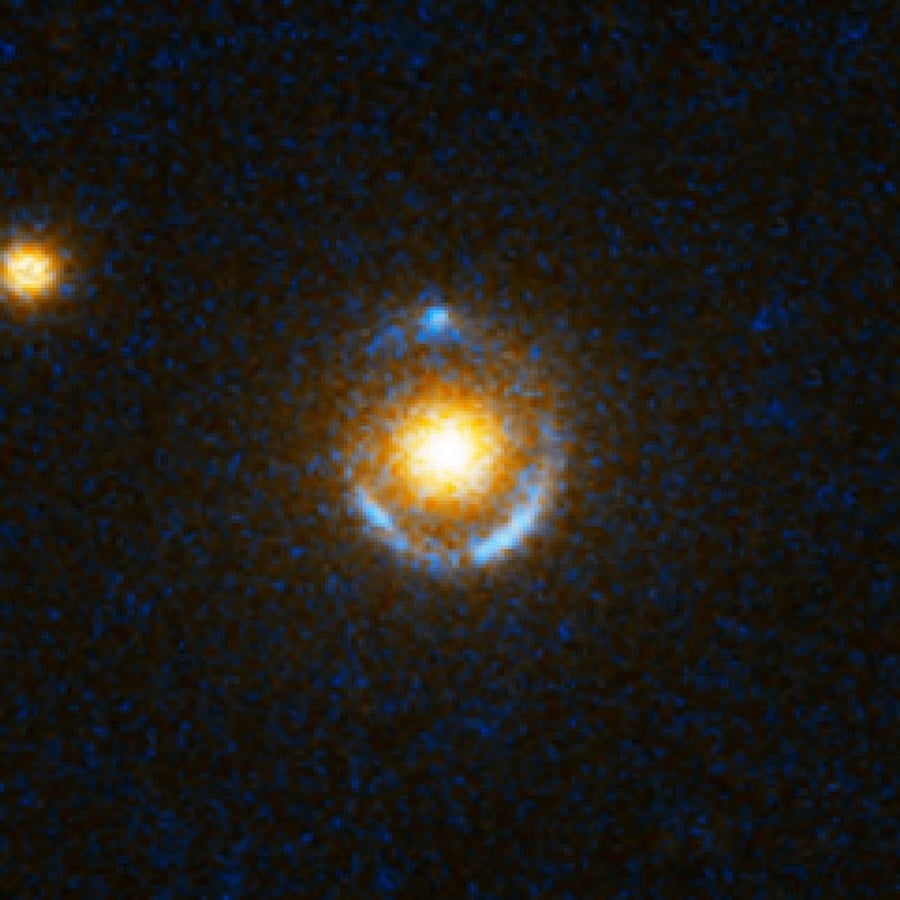 The blue rings are distant galaxies smeared into circles by the mass of the reddish elliptical galaxies in front of them (Credit : NASA/ESA/SLACS Survey Team: A. Bolton (Harvard/Smithsonian), S. Burles (MIT), L. Koopmans (Kapteyn), T. Treu (UCSB), L. Moustakas (JPL/Caltech))
Gravitational lensing offers a way in. Mass bends light, so if a galaxy sits between us and something more distant, it distorts the background object's light, and the degree of distortion reveals how much mass is doing the bending. It works regardless of how bright the foreground galaxy happens to be which is precisely what you want when the foreground galaxy has a quasar in it.
It’s not as easy as it sounds as the problem is finding one. A quasar host that also happens to be lensing a background galaxy needs a chance alignment along a very particular line of sight, and they are pretty rare.
Everett McArthur, a graduate student at Ohio State, went looking in the catalogue from the Dark Energy Spectroscopic Instrument, which holds around 800,000 quasar spectra. Checking all of that lot is not just a project, it’s work for a lifetime! Instead, the team trained a neural network and here is the clever part. There were nowhere near enough real examples to learn from, so they manufactured them, blending genuine quasar spectra with genuine background galaxy spectra to produce mock lenses. The network learned what the combination ought to look like from fakes assembled out of real ingredients, then went hunting in the actual data. It cut 800,000 down to 200. Human eyes took it from there, and settled on seven.
Seven does not sound like many but even so it roughly doubles the number already known!
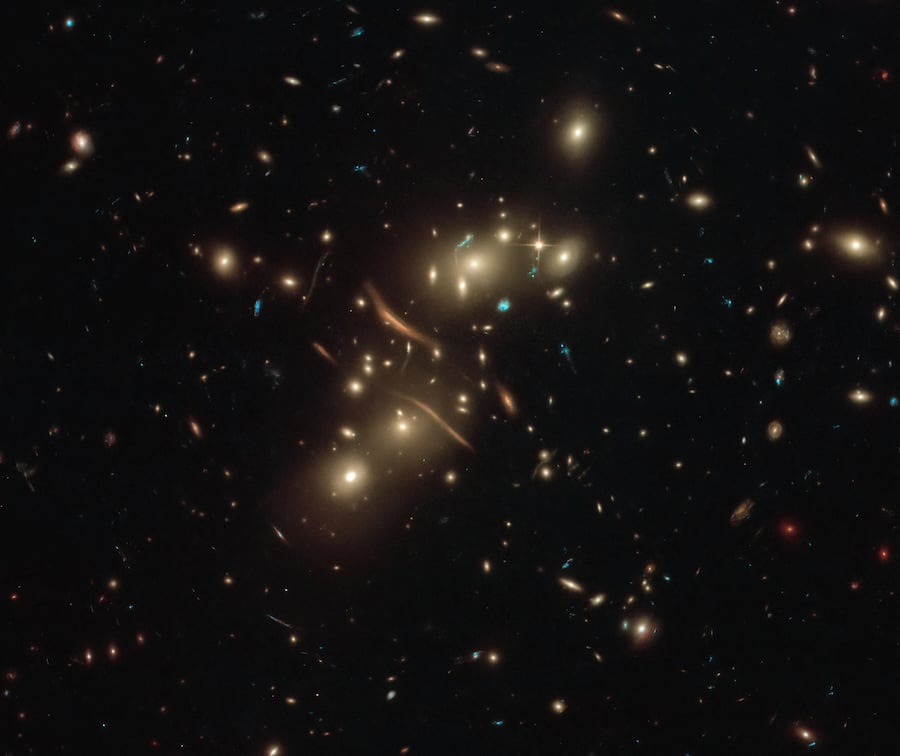 A foreground galaxy's gravity warps and magnifies the light of a quasar behind it, producing multiple distorted copies of a single object (Credit : NASA, ESA)
They sit at least five or six billion light years away, and confirming them will need something sharper, something like Hubble, most likely. But if they hold up, each one is a rare thing, a measurable mass for a galaxy that also contains an active black hole, which is the pairing that lets you test how the two grew in step.
McArthur's argument is that the technique generalises that a network trained to spot one kind of oddity in a spectrum can be retrained to spot others. As survey catalogues swell past the point where anyone can look at everything, the interesting question stops being what we have observed and becomes what we can still find in what we already have!