 Universe Today
As the oldest observable light in the cosmos, the Cosmic Microwave Background is a fundamental signal that has a lot to teach us about the Universe. It dates back to the recombination epoch, when photons could first travel freely through the cosmos. The CMB is like a snapshot of the state of energy and matter about 380,000 years after the Big Bang.
But the CMB has also changed over time with the expansion of the Universe. As the Universe has expanded, the CMB has been stretched into microwave wavelengths that we can't see. That's why, despite containing the overwhelming majority of the Universe's photons, we can't see it without the help of telescopes.
Two space telescopes have played important roles in mapping the CMB: the Wilkinson Microwave Anisotropy Probee (WMAP), and the Planck satellite. They were both up above the obscuring effect of Earth's atmosphere, which is the main obstacle to observing the CMB. The CMB is nearly uniform, but not quite. It has tiny irregularities that cosmologist have mapped in increasing detail. These small temperature inhomogeneities can reveal a lot about the Universe and the Big Bang.
 This is the Wilkinson Microwave Anisotropy Probe's heat map of temperature fluctuations in the Cosmic Microwave Background. (Credit : NASA / WMAP Science Team)
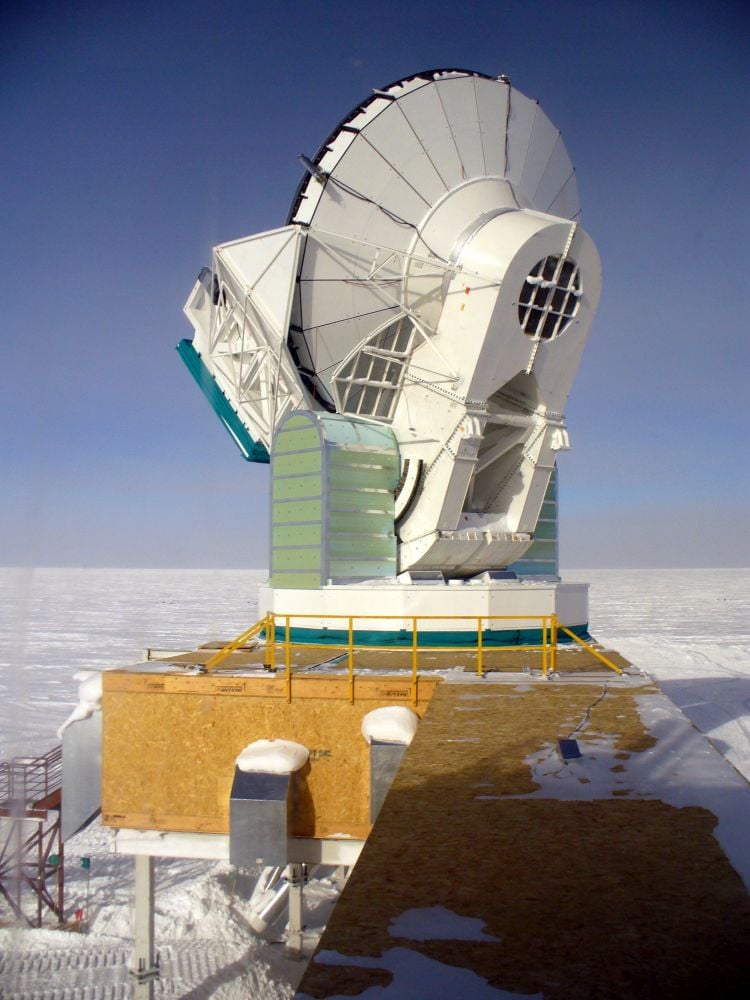
But there's also another way of studying the CMB. The South Pole Telescope is a 10-meter radio telescope in Antarctica that takes advantage of a small atmospheric window to observe part of the CMB. It's also in a designated "radio-quiet zone." It's credited with discovering a new feature of the CMB called the B-mode polarization. Gravitational lensing by intervening matter like galaxy clusters created this B-mode polarization. That proved that the CMB can hold evidence of gravitatonal effects.
That was a big deal because the polarization had been predicted decades earlier. The CMB's polarization is almost perfectly uniform. But almost isn't completely, and there are tiny variations in the B-mode polarity. In this case, these tiny changes were created by intervening matter.
The CMB's polarization was first detected in 2002, and that was a massive accomplishment. John Carlstrom from the University of Chicago led the collaboration that detected it, and he is now the director of the South Pole Telescope. “We were sitting around with a small team, looking at our computer. There were peaks and wiggles, just as predicted,” Carlstrom said. “We were just staring at it and it was just phenomenal.”
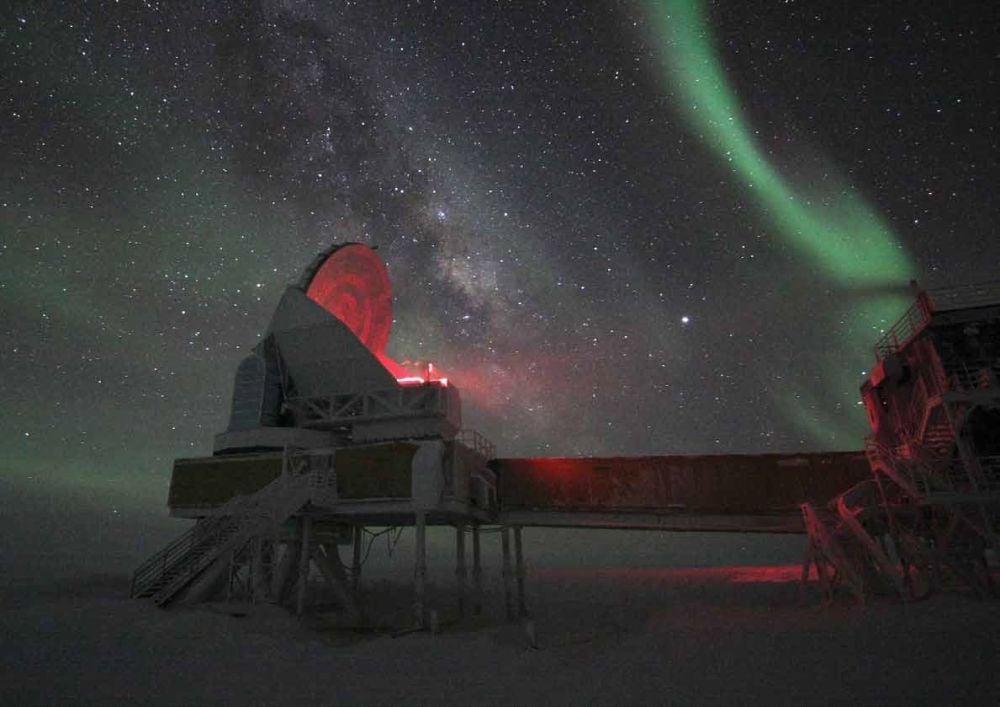 The South Pole Telescope hard at work during the long polar night. Image Credit: Report of the U.S. Antarctic Program Blue Ribbon Panel - More and Better Science in Antarctica Through Increased Logistical Effectiveness, Public Domain, https://commons.wikimedia.org/wiki/Special:Redirect/page/25790806
“It’s one of the ways that we can understand gravity at these very extreme scales,” said Kimmy Wu, an assistant professor at the California Institute of Technology, one of the institutions involved in the south pole observations. “The fact that there could be primordial gravitational waves means that at the early fraction of a second when the universe was quantum fluctuations, gravity worked.”
Quantum gravity can only be detected in this very early fraction of a second. It's beyond the capabilities of supercolliders to examine, and these tiny waves are the only way to observe quantum gravity. If quantum gravity can be detected in the very first moments of the Universe, then it can help physicists bridge the gap between General Relativity, which describes things on a massive scale, and quantum physics, which describes things on a tiny scale. So finding these tiny primordial gravitational waves brings us closer to a unified theory of how everything works. That would be nice; just ask any physicist.
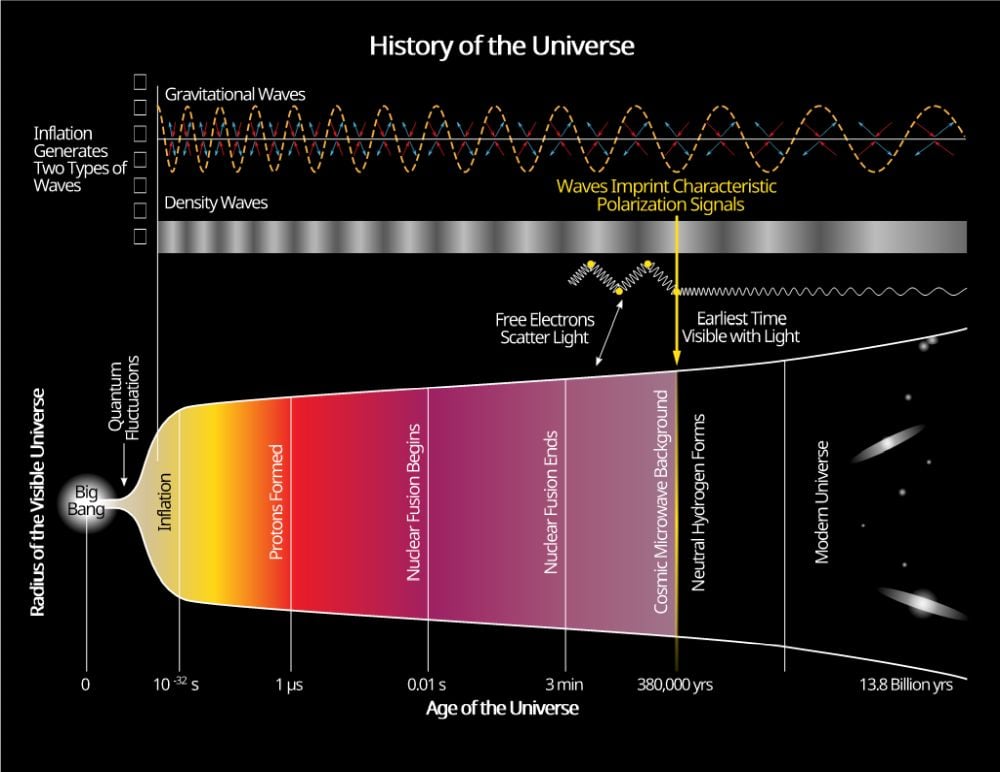 This graphic helps explain the complicated problem facing physicists. If they can detect B-mode polarization in the CMB, it's evidence that quantum fluctuations generated primordial gravitational waves. Image Credit: By Original: Drbogdan Vector: Yinweichen - Own work, CC BY-SA 3.0, https://commons.wikimedia.org/wiki/Special:Redirect/page/31825049
But as stated earlier, these first B-mode detections were due to gravitational lensing, not quantum gravity. The next natural question was, can the B-mode contain evidence of primordial, quantum gravity? A new instrument was needed to find out.
Next to the South Pole Telescope is the Background Imaging of Cosmic Extragalactic Polarization (BICEP) array. BICEP was built to measure the B-mode polarization of the CMB that come directly from quantum gravity. The current iteration of BICEP is the fifth, and overall, it's been working since 2006.
If BICEP can detect these tiny gravitational ripples from the Universe's very beginnings, then our understanding of the tiniest workings of the Universe will take shape. It would provide the most robust evidence for inflation and Big Bang cosmology.
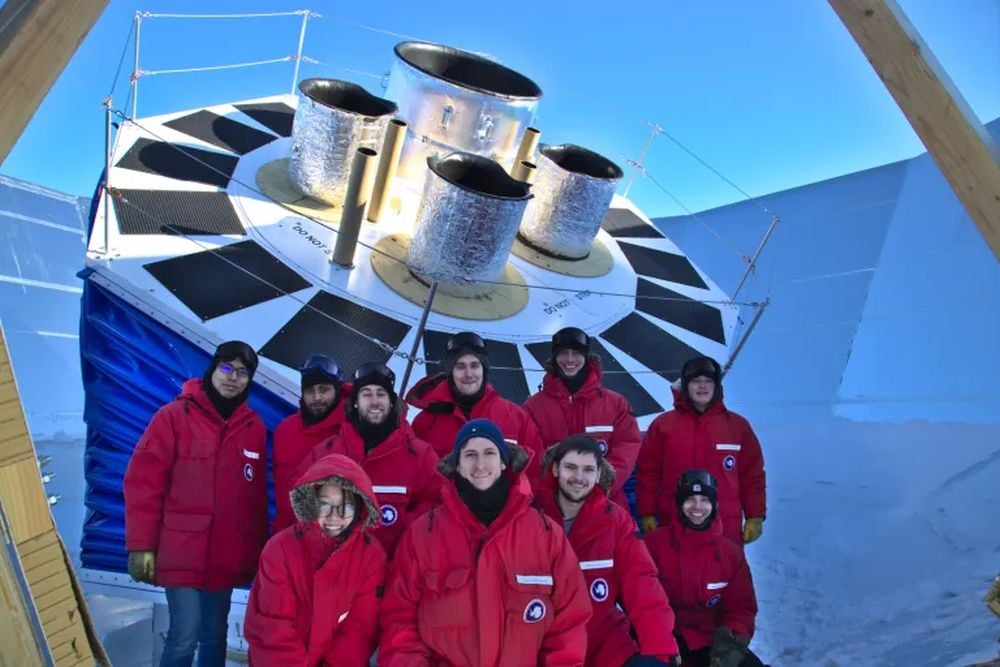 Members of the BICEP team in front of BICEP. The array is articulated and sits inside a specially designed protective blue windproof and thermally insulated cover. Image Credit: BICEP Array.
“If we could detect these B-modes robustly, then it’s bulletproof,” said Lindsey Bleem, a physicist at DOE’s Argonne National Laboratory who worked at the South Pole in 2008 and 2014.
If they can rule out these B-modes, then physicists need to revise models of inflation or work on other ones. Either way, it's progress.
But there's another mode of CMB polarization called E-mode. They are both weaker and harder to detect than temperature fluctuations in the CMB. In fact, the E-mode is only one-tenth as strong as the temperature fluctuations, and the B-mode is even weaker.
“We are here in the business of making a super, super precise measurement. This is basically a few nanokelvin on top of the 2.725 [degrees] of the CMB,” said Zeeshan Ahmed, associate professor at Stanford University and researcher at DOE’s SLAC National Accelerator Laboratory.
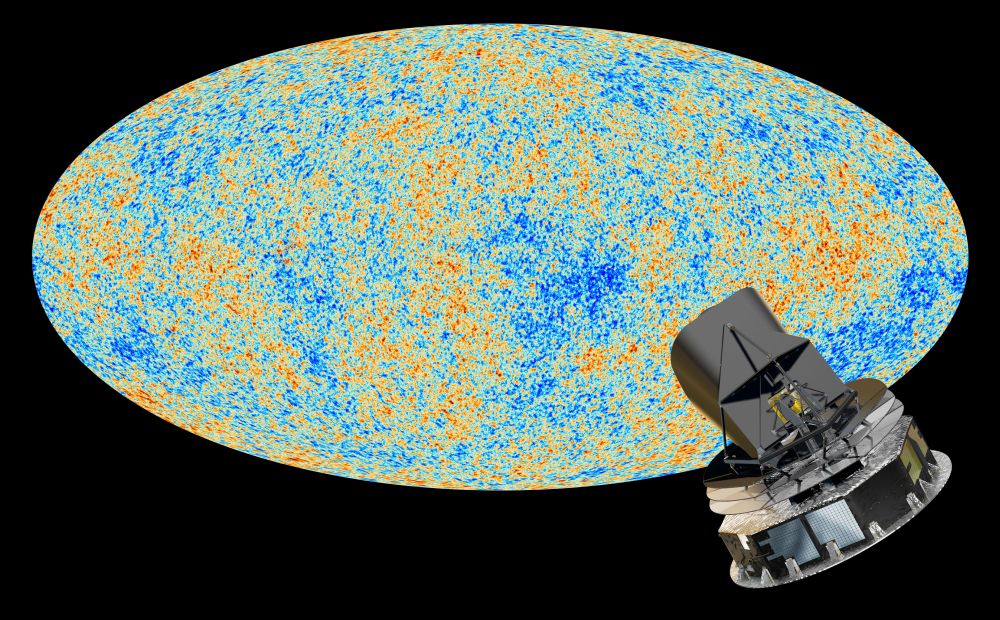 This image shows an illustration of the Planck satellite over the satellite's map of the CMB. It's work was an improvement of the WMAP's map. Image Credit: ESA and the Planck Collaboration - D. Ducros
When measuring something so faint, interference becomes a major problem. Other radiation sources can pollute signals, the Milky Way's dust can add its own polarization, and some E-modes can transform into B-modes. It all adds up to one of the most complicated challenges in science.
But the SPT and BICEP each have different strengths, and by working together, scientists think they can find a way forward. “It’s like a marriage,” said Bleem. “BICEP has the intense sensitivity at large scales and SPT can make these wonderful gravitational lensing maps, without which BICEP would be completely limited by the systematics. Together, they can achieve the targeted goals.”
Other telescopes like Herschel and Planck contribute too, by sorting out and mapping sources of interference in the signal that can lense the E-mode signal.
“If there is a signal, you should be able to see that in both places,” said Wu. “These are excellent ways to really check whether a claim of detection is substantiated.”
That was an important step. It provided a way to determine what E-modes had been warped by gravity to appear like B-modes. That was a potential way through the mess.
“Being able to measure that signal for the first time … was very exciting,” recalled Carlstrom.
In 2014, the BICEP2 team presented a paper to their peers showing that they had detected B-mode polarization indicating a gravitational wave signal from inflation. Their excitement was short-lived though. Subsequent examination and new data from other researchers showed that the signal could be attributed to the Milky Way's problematic dust.
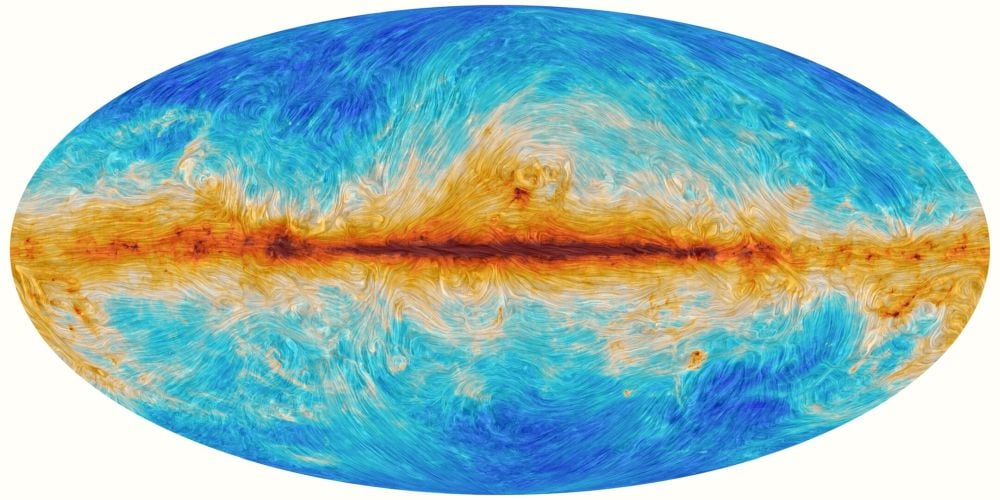 This image illustrates how the Milky Way's dust can polarize the CMB. Image Credit: ESA
“We dialed up our skepticism on these things in the last ten years,” said Ahmed, who works on the BICEP Array. “If new data is coming in and it can be co-analyzed with ours, we would love that.”
Work continues on this complicated problem, and the potential payoff is so monumental that setbacks aren't deterring the researchers. They continue to work on eliminating sources of uncertainty in the data.
They're getting a better handle on how gravitational lensing affects data and how to understand what mode of polarization they're sensing. They're improving instrument precision and eliminating more noise. Upcoming improvements to both the South Pole Telescope and BICEP will drive further progress.
For now, there's no unambiguous detection of primordial gravitational waves. But work continues in the extreme conditions at the bottom of the world, with ever-improving telescopes and the apparent unbreakable will of the dedicated researchers.
“It is really rewarding to see the SPT. When I started working on it, it was just a proposal – we hadn’t built the telescope yet,” said Benson. “The fact that we can still do cutting-edge science with it and sustaining it over 20 years has been really satisfying.”