 Universe Today
Astrophysicists think that the supermassive black holes (SMBH) we see in the modern Universe are the result of a long drawn-out process. That process is referred to as the hierarchical black hole mergers framework. It explains how some SMBH can reach such staggering masses. Some of the most massive appear to have billions of solar masses.
The idea is that these SMBH start out as seeds, and those seeds are stellar-mass black holes. Two processes create them. One is when massive stars between about 8 and 50 solar masses reach the end of their lives of fusion. They either explode as supernovae, and their cores collapse, forming black holes, or they collapse directly into black holes. The other is when two neutron stars merge.
In between stellar mass black holes and SMBH are intermediate mass black holes (IMBH.) These black holes range in mass from about 100 solar masses to 100,000 solar masses. The observational evidence for IMBHs is still thin, but it's persistent.
A 2024 paper focused on Omega Centauri, a globular cluster on the outskirts of the Milky Way, as the site of an IMBH. A group of fast-moving stars in the center of Omega Centauri can only be explained by the presence of an IMBH with about 8,200 solar masses, according to that work.
Gravitational waves from a black hole merger are also evidence of an IMBH. A 2020 paper presented the only direct evidence of an IMBH when the waves showed that two black holes, with 85 and 66 solar masses, merged to create an IMBH with about 142 solar masses.
But what are the birthplaces of these IMBH? Some must have formed in the early Universe to act as seeds for the SMBH we see today.
Research titled "Massive star clusters detected by JWST as natural birth places to form intermediate-mass black holes" may have the answer. It's published in Astronomy and Astrophysics, and the lead author is Viola Bocchi. Bocchi is from the Sapienza University of Rome.
"The James Webb Space Telescope (JWST) has revealed a population of dense stellar systems at high redshifts, including the “Cosmic Gems” arc (z ∼ 10.2) and the “Firefly Sparkle” (z ∼ 8.3). With masses in the range 105 M⊙–107 M⊙ and half-mass radii in the range ∼0.4–15 pc, these systems are ideally suited to form intermediate-mass black holes (IMBHs) via collision-based models," the authors write.
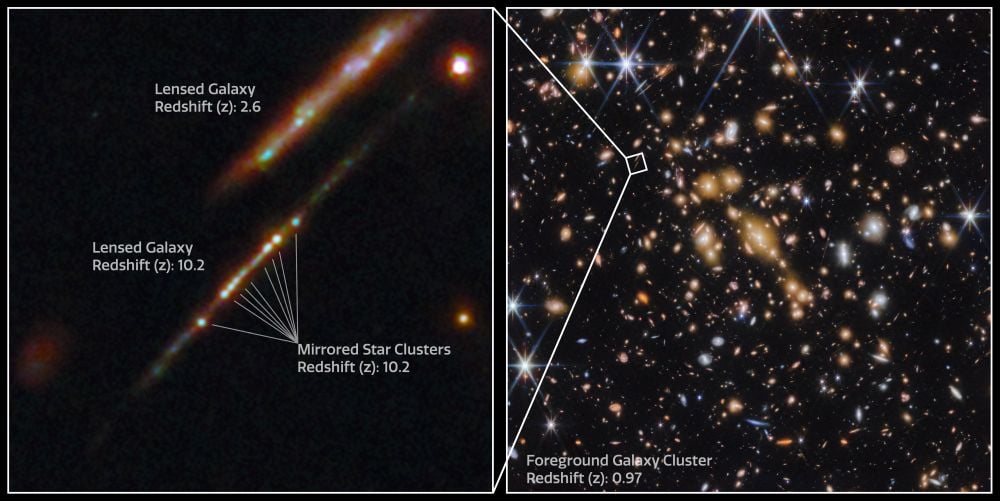
The Cosmic Gems arc is a gravitationally lensed galaxy, and the JWST observed its light when the Universe was only about 460 million years old. The JWST found five dense star clusters there.
The Cosmic Gems was first discovered by the Hubble during its Reionization Lensing Cluster Survey (RELICS) and was identified as a powerful source of radiation during the Epoch of Reionization. In 2024, the JWST took another look and found the five Young Massive Clusters (YMC), the first discovery of such ancient clusters.
The Firefly Sparkle is another gravitationally lensed early galaxies, imaged only about 600 million years after the Big Bang. The JWST found 10 YMCs in the Firefly Sparkle.
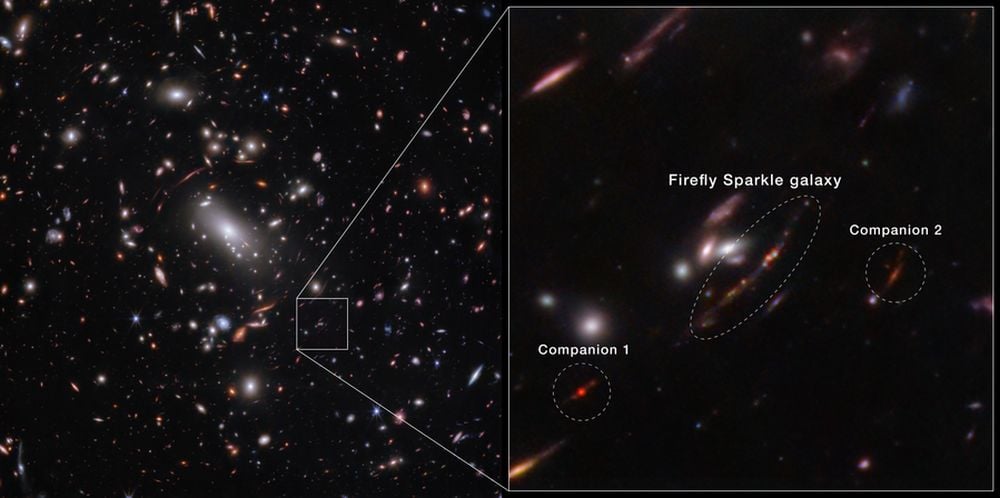 This image shows the Firefly Sparkle galaxy, where the JWST found 10 YMCs. It also shows a pair of companion galaxies. Image Credit: NASA, ESA, CSA, STScI, Chris Willott (National Research Council Canada), Lamiya Mowla (Wellesley College), Kartheik Iyer (Columbia University)
This research shows that not only were all these YMCs sources of ionizing radiation, they may have been the birthplaces of IMBH.
Due to the density in these YMCs, n-body simulations weren't viable. Instead, the researchers used a model based on runaway collisions and mass-loss by stellar winds to estimate the resulting IMBH masses. They then validated these results against direct N-body simulations of compact star clusters.
"With masses in the range 105 M⊙–107 M⊙ and half-mass radii in the range ∼0.4–15 pc, these systems are ideally suited to form intermediate-mass black holes (IMBHs) via collision-based models," the authors write. "Our estimates yield typical IMBH masses in the range ∼102 M⊙ to ∼4 × 10³ M⊙, implying typical formation efficiencies on the few percent level."
The clusters in the Cosmic Gems yieled the heaviest IMBH, with masses ranging from 1600–2700 M⊙. "The extreme compactness of the Cosmic Gems clusters (Rh ∼ 1 pc) facilitates the formation of black hole seeds with high masses of 1600–2700 M⊙," the authors write. Rh ∼ 1 pc is the radius of the sphere that contains half of the cluster’s total mass and measures how compact a cluster is.
"The low metallicity (Z ≲ 0.02 Z⊙) is a critical factor for retaining the seed mass despite stellar winds," the authors write.
These young clusters also have low metallicities because not enough stars have lived and died in them to generate higher metallicity. Their low metallicity played a critical role in forming IMBH. Low metallicity limits mass-loss due to stellar winds, and that let the objects keep growing.
The results from the Firefly Sparkle are different. "In contrast to the Cosmic Gems, these clusters exhibit significantly larger radii (Rh ∼ 4 − 6 pc) for typically lower total masses (105 − 106 M⊙)," the authors write. That creates cores that are less massive, limiting the potential for the runaway collision process to create IMBH. The black hole masses in Firefly Sparkle range 1.8 × 10² − 8.1 × 10² M⊙. That's about 180 to 810 M⊙, which represents the lower boundary for IMBH masses.
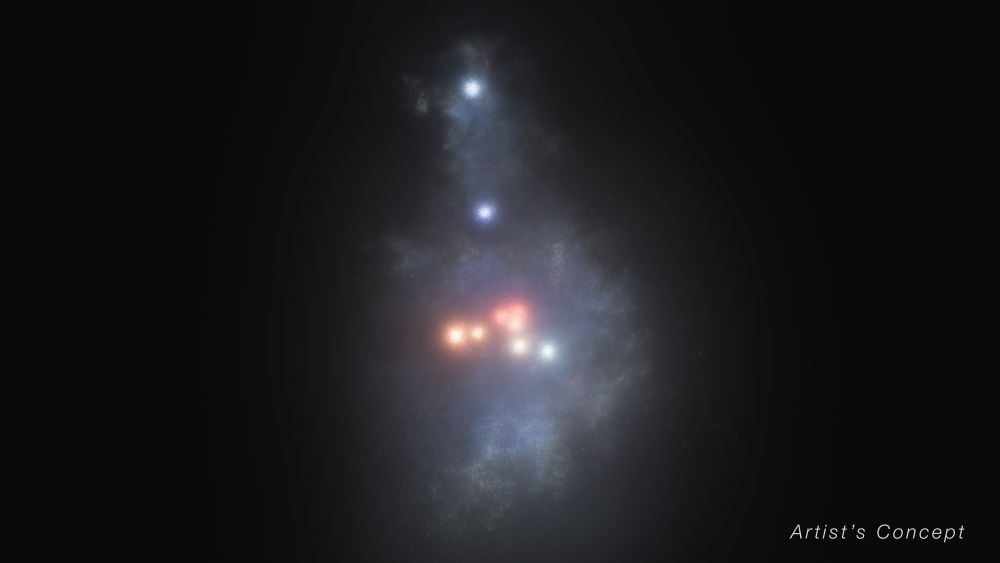 This artist's illustration shows what the Firefly Sparkle galaxy looked like about 600 million years after the big bang if it wasn’t stretched and distorted by gravitational lensing. This illustration is based on images and data from NASA’s James Webb Space Telescope. Image Credit: NASA, ESA, CSA, Ralf Crawford (STScI). Science: Lamiya Mowla (Wellesley College), Guillaume Desprez (Saint Mary's University)
Overall, the lower range for IMBH masses in this work (~100 solar mases) is comparable to black holes formed by massive Population III stars, the Universe's hypothetical first stars, which were likely extremely massive. But, "the upper bound extends significantly higher, allowing the most massive clusters to produce objects firmly in the “heavy seed” regime," the authors write. "Forming such heavy seeds is highly beneficial to form SMBHs at high redshift."
These results aren't observational in the sense that the JWST didn't observe any IMBH. But they do show a plausible environment where IMBH could form and potentially lead to the SMBH we see in the centers of galaxies like ours.
These results could also explain the JWST's Little Red Dots. Their spectra are often interpreted as being powered by SMBH. "Our results suggest that dense massive star clusters could provide possible massive seeds from which the SMBHs in the LRDs may have grown," the researchers write.
The researchers state some caveats, based on some acknowledged weaknesses in their work. Many properties of these clusters are unknown, including their rotation and their internal structure, which could change the outcomes and lower the IMBH masses.
The initial mass function also isn't known, but it could be top-heavy. "This possibility, along with a possible primordial mass segregation, would favor the formation of massive IMBHs, though we did not explore it here in detail," the authors explain.
Researchers will no doubt dig deeper into these young massive clusters and try to fill in some of the blanks that remain. But this research shows that they could be the source of the heavy seed IMBH that eventually form SMBH.
"Our results suggest that these dense, metal-poor clusters are viable factories for heavy seeds that are capable of growing into the supermassive black holes observed in the early Universe," the authors conlude. .
