 Universe Today
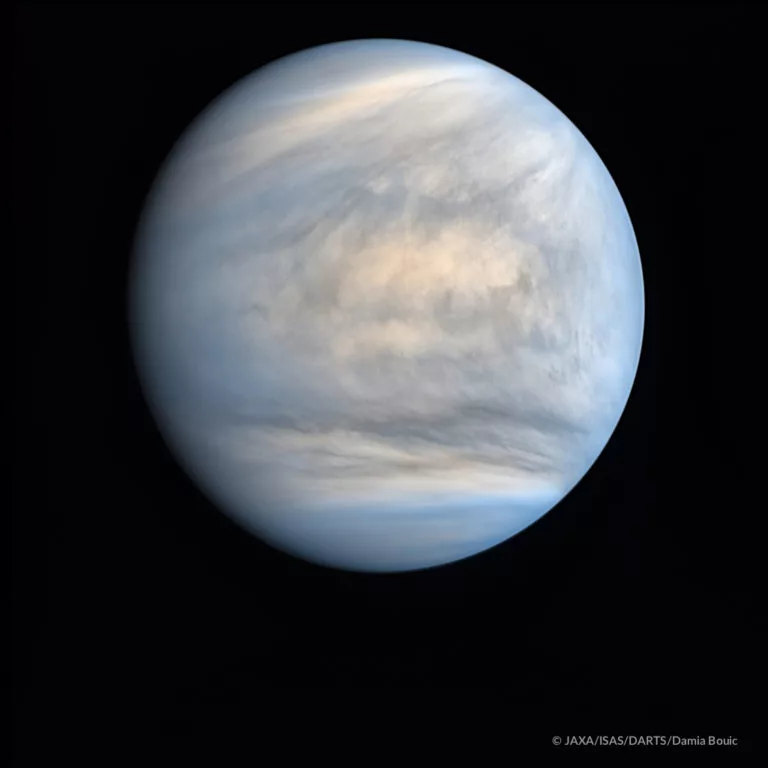
As any amateur astronomer can tell you, Venus is famous for its yellow coloration in visible light. But, ask a professional planetary scientist and they will tell you the strangest thing about Venus is how it appears in ultraviolet. In this spectrum, stark, high-contrast streaks are splattered across the planet’s cloud cover, and rotate on its four-day atmospheric rotation period. For over 100 years, scientists have wondered what could be causing those patterns, referring to an unknown “UV absorber”. A new paper, published in Astrobiology from Jan Spacek and an international team of researchers, hopes to answer that long-standing question by answering a simpler one - if you scooped Venus’ clouds into a test tube, how dark would they be?
To understand the uncertainty, we need to differentiate between scattering vs absorption. A good analogy is with a waterfall. The water in the river leading up to a waterfall might appear to be dark. But as soon as it falls and is aerosolized into tiny particles, that spray appears white. It’s the same material (in this case water), so why does its coloration change so drastically in those two different states?
Tiny particles, such as those tiny water droplets in waterfall spray, or, in Venus’ case, the aerosolized sulfuric acid that makes up the planet’s clouds, are very effective at scattering light, making them appear much brighter than they do when clumped together. This effect, known as Mie scattering, explains the difference in color between aerosolized particles and bulk groupings of them. But what does that practically mean for Venus’ ultraviolet absorber?
Video from Event Horizon describing the UV absorber on Venus. Credit - Event Horizon YouTube ChannelAnswering that question requires first looking at reflectance data from Venus itself. The authors used the latest high-resolution reflectance data from JAXA’s Akatsuki spacecraft, and stripped away the optical effects of scattering, gas absorption, and particle sizes. They then back-calculated a feature known as the linear decadic absorption coefficient, which shows the absorption of a material at any given wavelength.
They found an absorption peak at 375nm - near the ultraviolet end of the spectrum - which dropped off precipitously at higher wavelengths. But at its peak, the absorption level is exceptionally high, meaning whatever is floating into those droplets must be an extremely efficient light-absorption molecule (known in technical terms as a chromophore). So then the next question becomes, given the ongoing debate about what makes up Venus’ clouds - is that light-absorbing molecule organic or inorganic?
Inorganic compounds, such as iron chloride or sulfur compounds have been the favorite of modelers of Venus’ atmosphere for decades. However, they face a major reality check in light of this new evidence. To meet the necessary absorption numbers, they would have to make up a fraction of the cloud droplets that is physically impossible according to other aerosol models.
Here’s Fraser’s argument for why we need a Venus exploration program.That leaves organic molecules, which certainly are capable of absorbing that extraordinary amount of light. However, there’s a catch for them too. In the presence of sulfuric acid, which we already know forms the majority of the droplets in Venus’ clouds, simple organics, such as formaldehyde or glucose, break down into featureless “red oils” that look akin to tar. Tar itself is very good at absorbing light (hence its blackness) - but it is very good at doing so over all the visible spectrum.
However, the data from the Akatsuki probe very clearly shows a sharp drop-off around 455 nm, which wouldn’t happen if the material were made up of simple “red oils”. This implies that, if organics are responsible, they must maintain a very specific, stable molecular structure, or hit some sort of chemical equilibrium that avoids turning them into just a mass of completely black tar.
It’s going to be almost impossible to test which of those two solutions is correct remotely. Luckily, there are missions planned to visit Venus in the near future, including a private mission from Rocket Lab that will send an Autofluorescence Nephelometer (AFN), which will shine a 440nm laser into the clouds and check for a telltale glow that is a hallmark of complex, conjugated organic molecules. And while that might not be able to differentiate between abiotic and biological processes, knowing that there are organic molecules floating in sulfuric acid droplets could finally solve one of the solar system’s longest standing atmospheric puzzles - why Venus is so good at absorbing ultraviolet light.
Learn More:
Newswise - Venus’s Mysterious Clouds May Hide an Exceptionally Strong Light Absorber
Jan Spacek et al - A Model of UV–Blue Absorbance in Bulk Liquid of Venusian Cloud Aerosols Is Consistent with Efficient Organic Absorbers at High Concentrations
UT - A Private Mission to Scan the Cloud Tops of Venus for Evidence of Life
UT - There's Enough Sunlight Getting Through Venus' Clouds to Support High-Altitude Life

