Universe Today
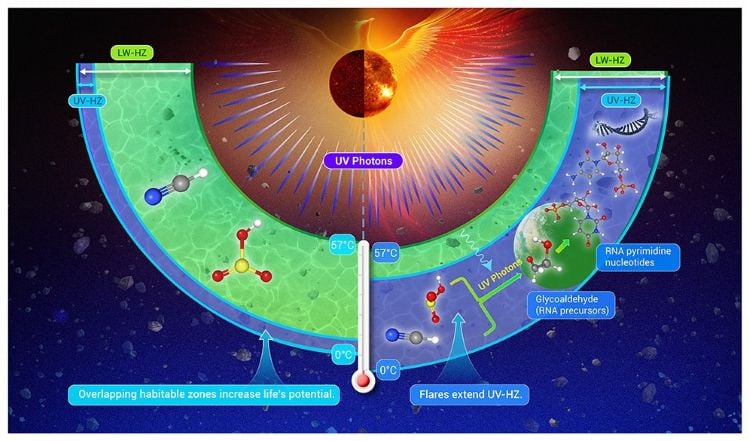
The search for life beyond Earth has traditionally focused on exoplanets orbiting Sun-like stars, which is a G-type star. However, low-mass stars, which are designated as K-type and M-type stars, have rapidly become a target for astrobiology, primarily due to their much longer lifetimes. This also means the habitable zone (HZ), which is the distance from a star where liquid water could exist, is much smaller than our solar system’s HZ, and is referred to as the liquid water habitable zone (LW-HZ). In contrast, another type of HZ that involves a star’s ultraviolet (UV) radiation potentially enabling life-harboring conditions is known as UV-HZ.
Now, a team of researchers from China have improved upon the definition of UV-HZ. Their findings were recently published in The Innovation and could help scientists better understand the parameters and conditions of finding life beyond Earth, and specifically in exoplanetary systems.
For the study, the researchers used a series of models and scientific calculations to evaluate whether increased solar flare activity could refine the distance parameters of a UV-HZ. Through these models, the team aspired to ascertain the likelihood of RNA precursor synthesis occurring, which is the chemical processes that occur for producing the building blocks of RNA. Additionally, they evaluated how much low-mass star solar activity contributed to the UV-HZ and how this compares to distance parameters for LW-HZ. One of the primary goals of the study was to ascertain whether the UV-HZ and LW-HZ overlapped.
The researchers applied their models to nine confirmed exoplanets orbiting K-type and M-type stars: Kepler-1540 b (K-type), KOI-7703.01 (K-type), KOI-8047.01 (M-type), Kepler-155 c (K-type), KOI-5879.01 (M-type), Kepler-1512 b (M-type), Kepler-438 b (M-type), KOI-7706.01 (K-type), and KOI-8012.01 (M-type). All these exoplanets have been confirmed or likely confirmed as being rocky except for Kepler-1540 b, which has been designated as a Neptune-like exoplanet.
In the end, the researchers found that while both the UV-HZ and LW-HZ can overlap around low-mass stars, only three of the nine exoplanets surveyed in the study were found to orbiting within this overlapped region (KOI-8012.01, KOI-8047.01, and KOI-7703.01). the researchers note how further observations on Kepler-1540 b, Kepler-438 b, and Kepler-155 c are needed to confirm the habitability of their surface temperatures.
The study notes, ”Although many exoplanets have been studied statistically, assessing the habitability of individual planets in the habitable zone is still challenging from both astrobiological and observational perspectives. Evaluating habitable zones around stars in various aspects helps us better understand exoplanet habitability. By re-evaluating the habitable zones and creating a comprehensive catalog of planets within them, we can infer that terrestrial planets in both liquid water and UV radiation habitable zones are more likely to support life.”
As noted, K-type and M-type stars are both smaller and cooler than our Sun with average masses of 0.45-0.8 solar masses and 0.08-0.45 solar masses, respectively. Despite being smaller and cooler, interest in finding exoplanets orbiting both types of stars has increased in recent years. This is especially true for M-type stars, as they are estimated to comprise approximately 70 percent of the stars in the Milky Way Galaxy. Additionally, while our Sun has an approximate lifespan of 4.5 billion years, K-type and M-type stars are estimated to live between 15-70 billion years and 100 billion to 14 trillion years, respectively.
Arguably one of the most intriguing M-type exoplanetary systems is TRAPPIST-1, which hosts seven rocky worlds. While all the exoplanets orbit very close to their star with orbital periods between 1 to 12 days, three of the exoplanets orbits within the star’s habitable zone. Despite this promising knowledge, astronomers hypothesize the exoplanets are tidally locked with their host star, the latter of which also exhibits large amounts of stellar activity and solar radiation. This means the potential habitability of the seven exoplanets remain in question.
What new insight into habitable zones around low-mass stars will researchers make in the coming years and decades? Only time will tell, and this is why we science!
As always, keep doing science & keep looking up!