Universe Today
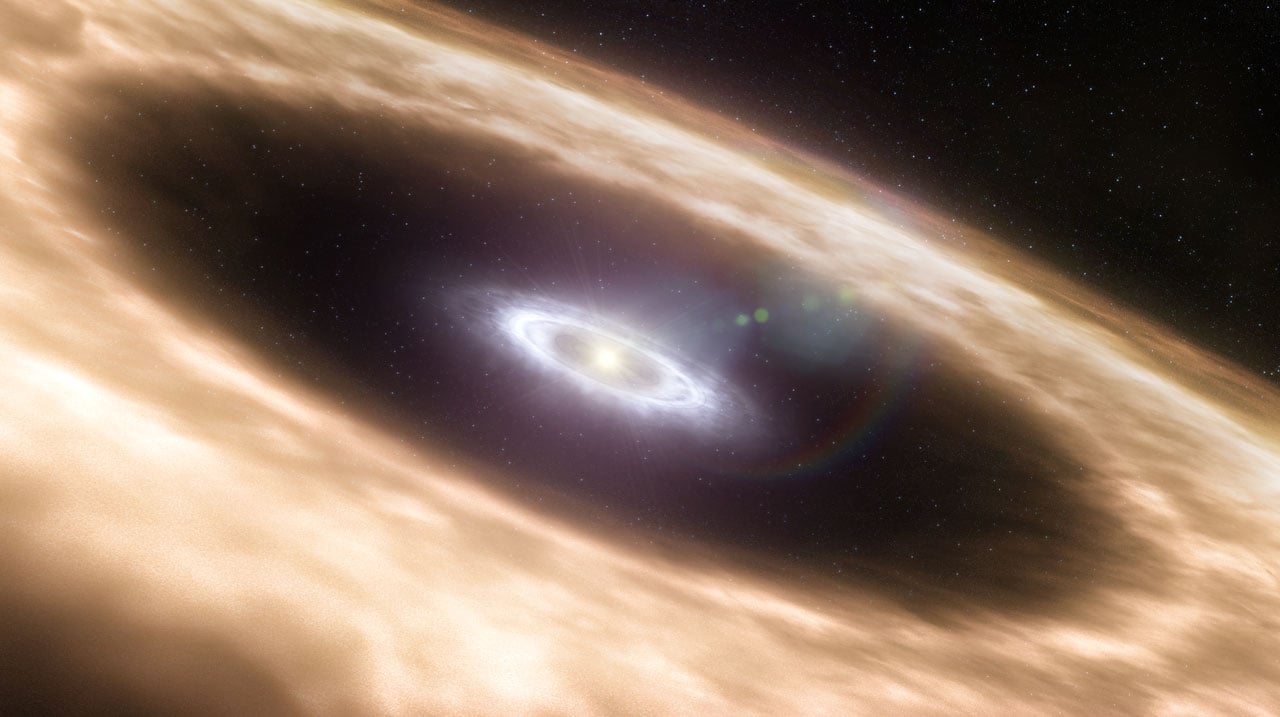
What happens in a protoplanetary disk to create planetesimals around a star? We know the general story. The material begins to clump together and eventually grows from dust grains to rocky bodies capable of sticking together to make planets. But, how does that dust begin the aggregation journey? That's what a research team from the Switzerland wanted to know. So, they did experiments aboard parabolic micro-gravity flights to find an answer.
For the team, the trick to understanding the process was to move from a "rocks hit each other to make bigger rocks" process to looking at one where gas and dust behave more like a fluid. This cannot easily be studied in other planetary systems, except with telescopes. In the Solar System, we have only comets and asteroids as "leftovers" from a time when dust became planetesimals, which became planets.
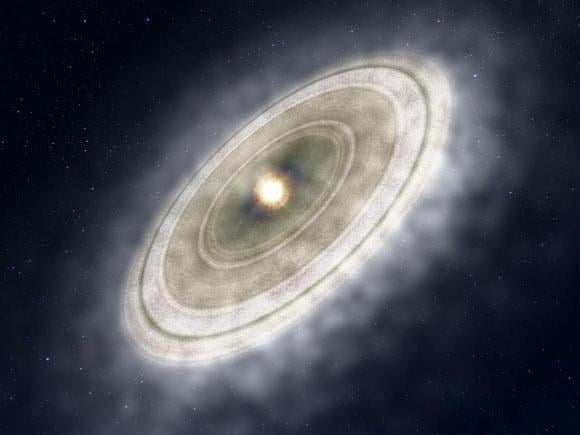 An artist's impression of a star's dusty debris disk, thought to be produced when asteroids or other planetesimals collide and fragment. Microgravity experiments simulate motions inside this cloud of gas and dust as its materials evolve to become planetesimals, planets, asteroids, and comets. Courtesy NAOJ.
Still, there are no "hands on" experiments, so planetary scientists have to create simulations that work. In this case, it allows scientists to explore the hydrodynamical instabilities that naturally occur in a fluid as it moves through a space. The team, led by Dr. Holly L. Capelo from the University of Bern, is called the "shear-flow" instability. It forms when two fluids with different properties interact. It's difficult to simulate on Earth, since in reality, if they occur, it happens in extremely tenuous gas in the near vacuum of space. In addition, there's not just one velocity and density throughout the disk.
Microgravity Experiments to the Rescue
To see if these instabilities can form in protoplanetary disks (or, if other conditions keep them from forming), Capelo's team built an instrument called TEMPusVoLa in 2020. It contains high-speed cameras to track the behavior of dust particles in an extremely thin gas under vacuum conditions, and the team built it specifically to fly in micro-gravity parabolic flights. "On Earth, gravity influences the behavior of the dust and gas," said team member Lucio Mayer from the University of Zurich "Only conditions that simulate the absence of gravity allow us to probe an extremely dilute flow regime, similar to the gas and dust disks orbiting around young stars."
On a parabolic flight, aircraft similar to the well-known "Vomit Comet" fly on routes where they climb and dive at angles of about 45 degrees. During each dive, the plane (and its occupants and experiments) experiences weightlessness for about 20 to 30 seconds. That is exactly the microgravity regime where dust and gas interact in a protoplanetary disk. Then, after the dive comes the climb, which exposes everything to a gravitational pull stronger than Earth's. The team went through several flights to simulate the conditions under which gas and dust could experience shear-flow instabilities. The experiments provided valuable data and pointed the way to further testing.
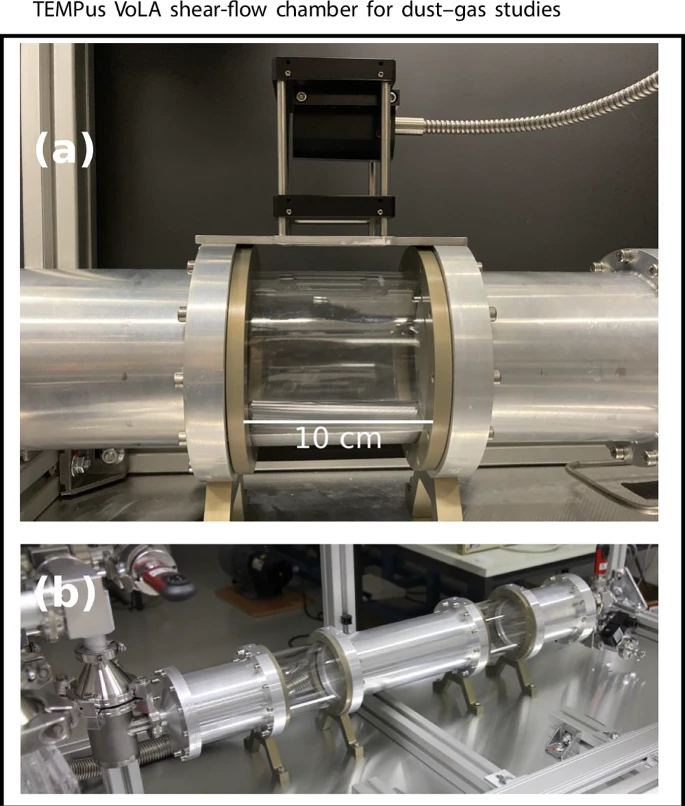 The shear-flow chamber in the TEMPusVoLA experimental instrument flown on several parabolic flights. This experiment allowed scientists to test materials in a microgravity environment. Courtesy: Capelo, et al. Communications Physics.
"To sum up, we recreated the conditions that arise in the planet-forming regions of protoplanetary discs, and we managed to demonstrate that this theoretically proposed shear-flow instability is not just a mathematical construct, but can actually occur in reality," said Capelo. The parabolic flights only offered very short phases of weightlessness, which gives linmited insight into the process, according to Capelo. "Once the instability starts, we noticed characteristic patterns developing in the flow of the material," she said. "Yet, the limited micro-gravity time prevents us from observing how these patterns evolve into fully developed turbulence."
The current studies show that shear-flow instabilities can form in conditions similar to those in protoplanetary disks. The next steps for the team involve coming up with an improved experiment that can fly on the International Space Station. That would give them a lot more data over longer periods of time to observe the formation of the turbulent flows and their natural evolution. "Only experiments can bridge this knowledge gap and reveal the crucial details of the dust and gas movement on spatial and time scales so small that they cannot be observed directly in the cosmos." The new experiment not only provides a direct confirmation that a long-theorized phenomenon can occur under protoplanetary disk-like conditions, it will also help to improve theoretical models and refine simulations. "This, in turn, will lead to a better understanding of the overall picture of planetary systems formation, and ultimately how our own Solar System, and Earth itself, formed billions of years from a simple cloud of dust and gas", says Capelo.
Planetary Science and Parabolic Flights
The tests that Capelo's team performed join a growing body of work being done in parabolic flight conditions. They are the best (and just about only) way to test conditions thought to exist early in the formation of planets. Astronauts train on "vomit comet" flights in preparation, and there are also increasing numbers of experiments in physics, material science, life support, medical sciences, and other planetary science studies that are done in microgravity conditions.
A good example of other planetary formation experiments is one that focused on the emplacement of crater ejecta on a solid body, but done in reduced gravity flight. Additional experiments have looked at the "sorting" of materials in a protoplanetary disk by simulating it in microgravity conditions. Future studies could include studies of landslides on Mars, volcanic flows on Io (or other worlds), and surface processes in icy environments such as the moons of the gas and ice giants. These, along with the Swiss team's experiments allow an almost "hands on" observational experimentation model for planetary scientists seeking to understand the processes of planetary formation and evolution.
"Only experiments can bridge this knowledge gap and reveal the crucial details of the dust and gas movement on spatial and time scales so small that they cannot be observed directly in the cosmos." The new experiment not only provides a direct confirmation that a long-theorized phenomenon can occur under protoplanetary disk-like conditions, it will also help to improve theoretical models and refine simulations. "This, in turn, will lead to a better understanding of the overall picture of planetary systems formation, and ultimately how our own Solar System, and Earth itself, formed billions of years from a simple cloud of dust and gas," said Capelo.
For More Information
From Dust to Planets: a Turbulent Story
Experimental Evidence for Granular Shear-flow Instability in the Epstein Regime