Universe Today
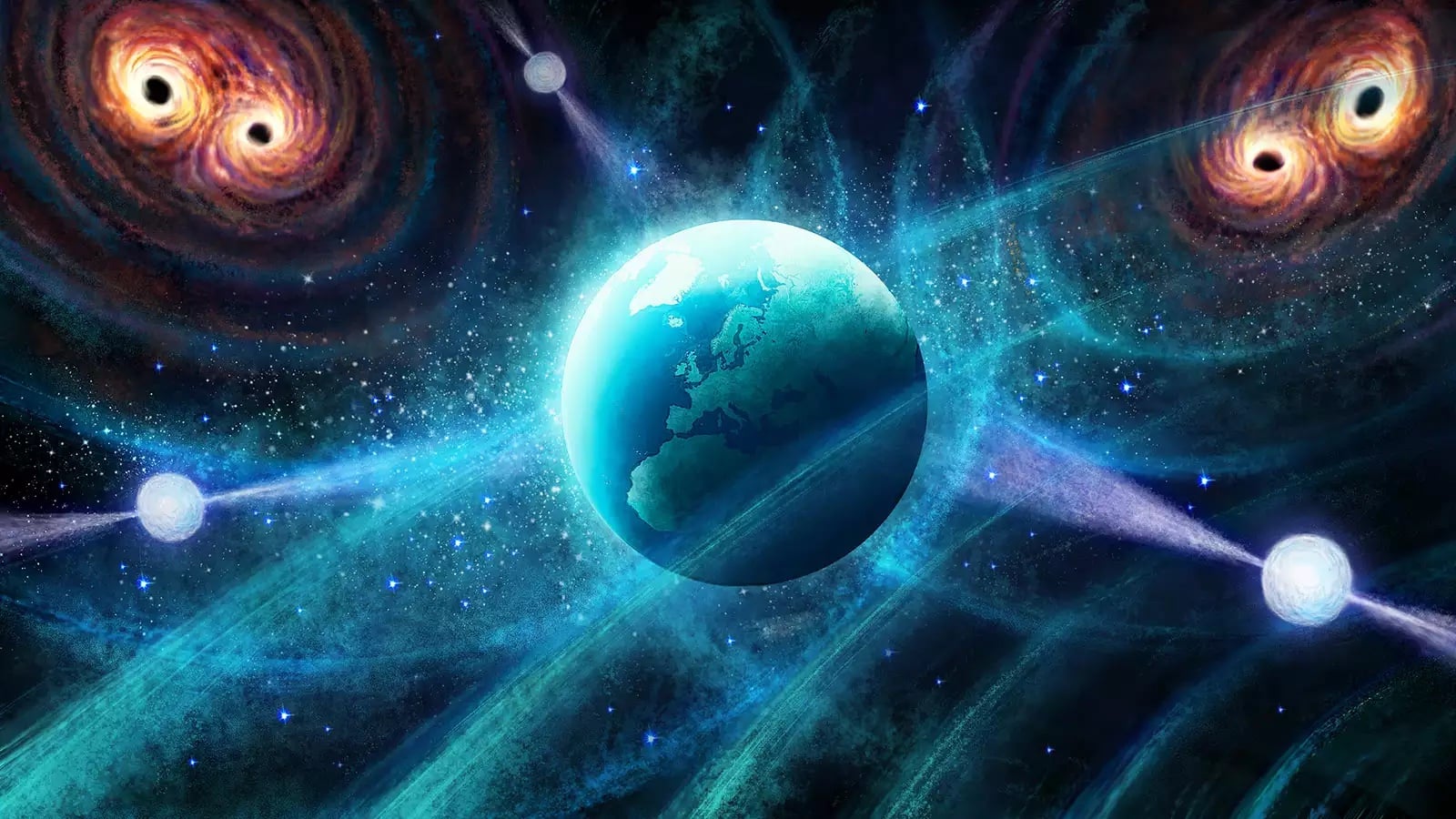
Pulsars are incredibly precise cosmic clocks. So precise that we can use them to measure subtle changes in their position thanks to the Doppler effect. Pulsar timings were used to prove the existence of gravitational waves long before we could observe them directly. This has led to the idea of a pulsar timing array (PTA). Observe lots of pulsars over time, then look at their timing shifts statistically to study gravitational waves on a cosmic scale.
A good PTA example is the NANOGrav project, which looked at 67 pulsars over the course of 15 years. They hoped to discover evidence of early cosmic inflation, which is the accepted model for explaining several cosmological mysteries. In theory, the rapid inflation of the universe just micro-moments after the Big Bang should have filled the cosmos with a distinct background of gravitational waves, just like the Big Bang itself created a thermal remnant of the cosmic microwave background. NANOGrav did observe cosmic gravitational waves, but they seemed to be dominated by waves created by supermassive black holes. It seems the gravitational cosmic background may be too noisy to detect gravitational waves from inflation.
A new study focuses on these gravitational waves and what they might tell us about supermassive objects in the early universe. One of the things we've discovered in recent years is that supermassive black holes existed much earlier than we thought. We aren't quite sure how supermassive black holes could have formed so quickly, but there are several ideas. This study looks at two of them.
The first is that supermassive black holes were seeded by what are known as Direct Collapse Black Holes (DCBHs). Rather than forming from the remnant of a large star, DCBHs would have formed directly from the collapse of massive clouds of hydrogen and helium. This means they could have formed around the same time the first stars started to appear. In the dense regions of the early universe, they would quickly grow to supermassive size.
The second is a more speculative model known as Supermassive Dark Stars (SMDSs). In this model, dark matter and regular matter collapse into enormous dense clouds. If dark matter can interact with itself and produce heat and light, then these dense clouds would be illuminated by the decay of dark matter rather than nuclear fusion. They could have had a mass of more than a million Suns and would shine like a blue giant star before collapsing into a supermassive black hole.
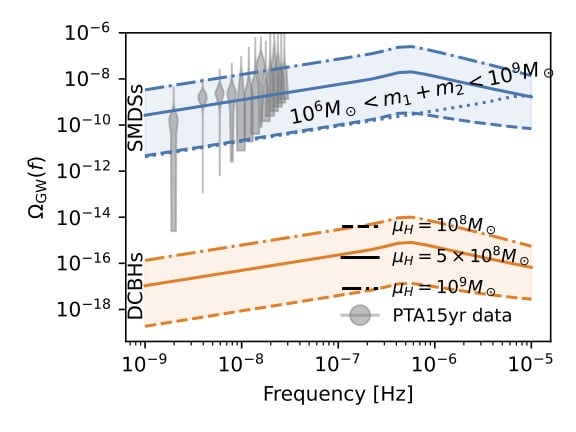 SMDS waves (blue) would be much stronger than DCBH waves (orange). Credit: Ghodla and Ilie, Physical Review D (2026)
The authors look at the types and intensities of gravitational waves that might be produced by both Direct Collapse Black Holes and Supermassive Dark Stars. One of the things they found was that the gravitational wave observations we have place an upper bound on the number of DCBHs. If there were more than one DCBH per 10 cubic megaparsecs, then the gravitational wave signal would be stronger than we observe. But it's estimated that DCBHs were quite rare, perhaps only one every million cubic megaparsecs. Well below the observed limit.
But Supermassive Dark Stars are an entirely different situation. If they existed, then the fact that dark matter is by far the dominant matter of the universe, then SMDSs would be rather common. The gravitational waves they produced would be the main source of what we observe today. This doesn't prove that Supermassive Dark Stars existed, only that they might have existed.
Pulsar timing arrays are already helping us explore the cosmic background of gravitational waves. If they can't help us prove early cosmic inflation, then perhaps they will reveal some of the strange features of dark matter.
Reference: Ghodla, Sohan, and Cosmin Ilie. "Reconstructing PTA measurements via early seeding of supermassive black holes." Physical Review D 114.4 (2026): L041303.