Universe Today
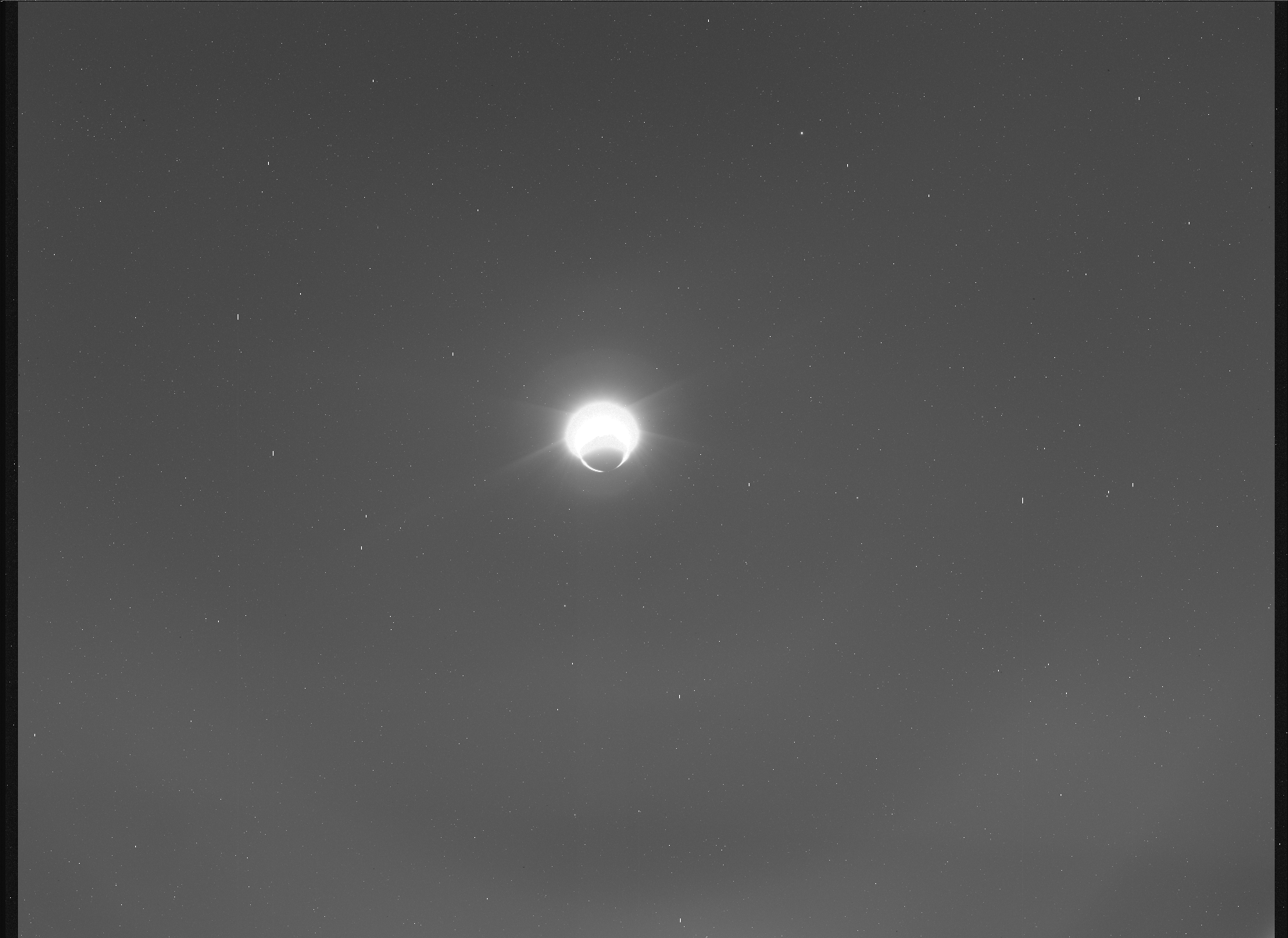
A close flyby past the Red Planet on Friday will send NASA’s Psyche mission on its way towards its final destination.
Mars is looming large as seen from the perspective of NASA’s inbound Psyche mission.
Launched on October 13th 2023 on the first interplanetary exploration flight for a SpaceX Falcon Heavy rocket, the mission is headed towards the enigmatic ‘metal asteroid’ 16 Psyche. The worldlet seems to be a remnant, metal-rich core of a world that never was. Exploration of 16 Psyche is top priority, as it could unlock secrets of planetary formation and the early history of the solar system.
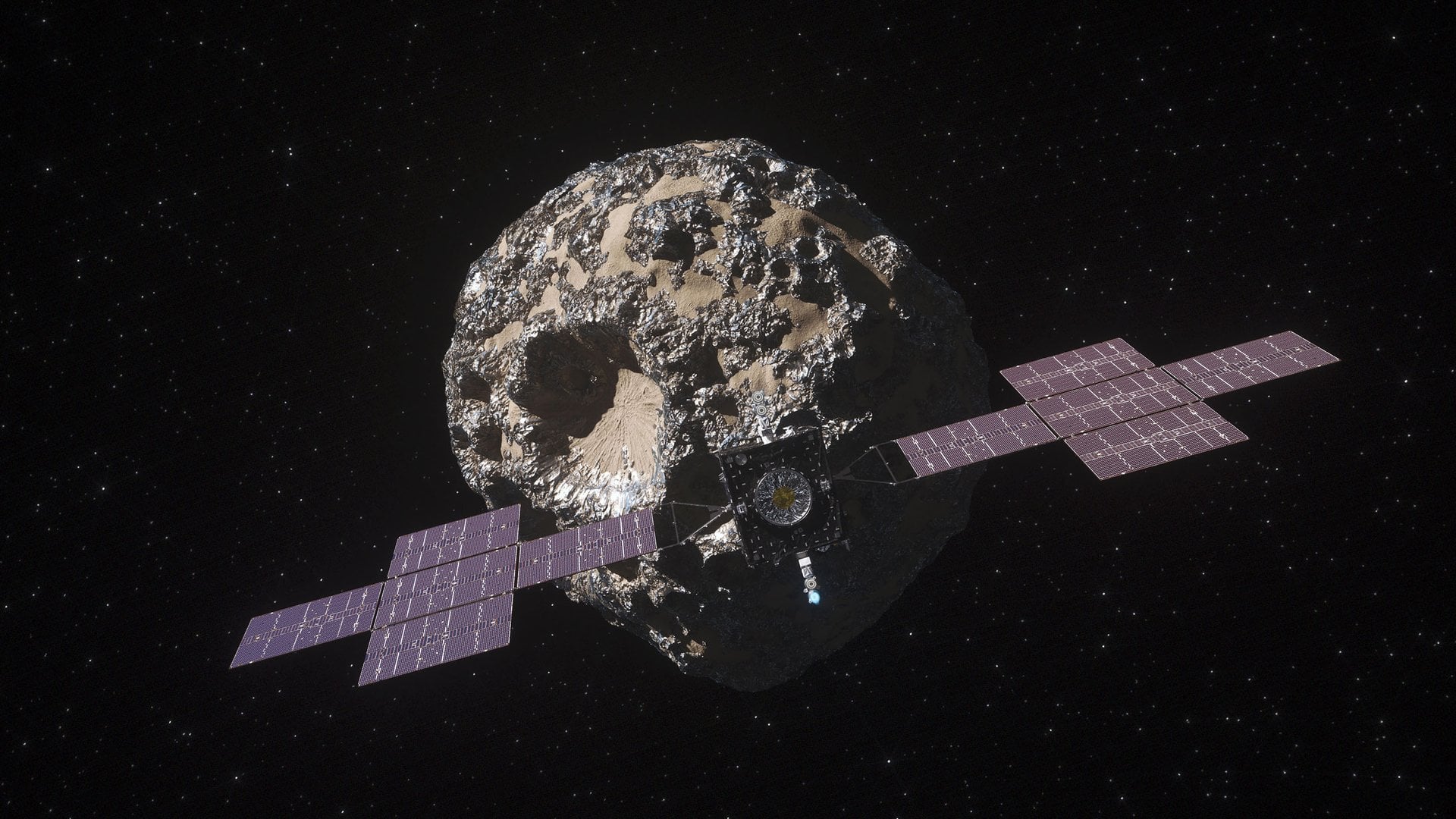 An artist's conception of the mission's arrival at 16 Psyche. Credit: NASA/JPL.
Psyche utilizes an innovative, inert xenon-gas fueled solar-electric propulsion system. This week’s Mars flyby will give it a free kick outbound to its target.
"We are now exactly on target for the flyby," says Sarah Bairstow (NASA-JPL) in a recent mission post. "This is our first opportunity in flight to calibrate Psyche's imager with something bigger than a few pixels, and we'll also make observations with the mission's other science instruments."
Prelude to Mars
The mission’s closest approach to Mars occurs on Friday, May 15th, when the spacecraft passes only 4,500 kilometers (2,800 miles) from the Red Planet. That’s just 1.3 Mars radii distant, inside the orbits of Phobos and Deimos.
The mission is approaching Mars from near anti-sunward, meaning that we’re looking at the nighttime side of Mars, pre-closest approach. Expect that to change, as the Red Planet fattens into a crescent (a view that we never see from the Earth) and is fully illuminated, post flyby.
 A colorized version of a Mars image captured by Psyche on May 3rd. Credit: NASA/JPL-Caltech/ASU.
The Psyche team plans on using the flyby opportunity to calibrate its onboard instruments, ahead of the primary Psyche encounter. NASA announced that the mission’s multi-spectral imager will be busy throughout the encounter, capturing images of Mars before and after closest approach.
The flyby may offer rare chance to make some Mars science discoveries as well. Engineers plan to test instruments during the flyby, as a dress rehearsal for arrival at 16 Psyche.
You can already see the raw flyby images trickling in to the mission page here. NASA's Eyes on the Solar System also has a great animation page dedicated to the flyby.
The unique alignment and phase angle of the approach might give Psyche a chance at seeing the dusty ring torus suspected of surrounding Mars. This would be the result of micro-meteoroid impacts on the Martian moons. This could also prove to be a substantial contributor to the dust seen along the plane of the inner solar system, causing what's known as the zodiacal light. Tantalizing clues supporting this idea actually came from NASA's Juno Jupiter mission.
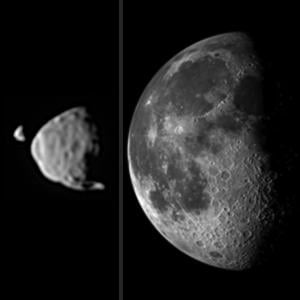 The apparent sizes of Phobos and Deimos as seen from Mars, versus the Moon as seen from Earth. Phobos and Deimos are only expected to appear 1-10 pixels across in Psyche's view. Credit: NASA Visualization Studio.
"On approach, we have been taking a number of very long exposure images to characterize scattered light in the cameras," Jim Bell (NASA Psyche Mission Imaging Investigation Lead) told Universe Today. "These images could also provide data that Mars scientists could use to search for evidence of the hypothesized faint dust rings associated with the Martian moons Phobos and Deimos. They have theorized to exist, but have not yet been detected. Our approach geometry–viewing Mars at high phase angle (thin crescent) provides maximum sensitivity to fine dusty particles like that. Who knows? But we’ll take a look..."
The Psyche mission carried out a planned course correction on February 23rd, ahead of the flyby. The mission has had its share of challenges to overcome, including a brief loss in pressure in its xenon fuel system, and navigating NASA cutbacks at JPL mid-mission.
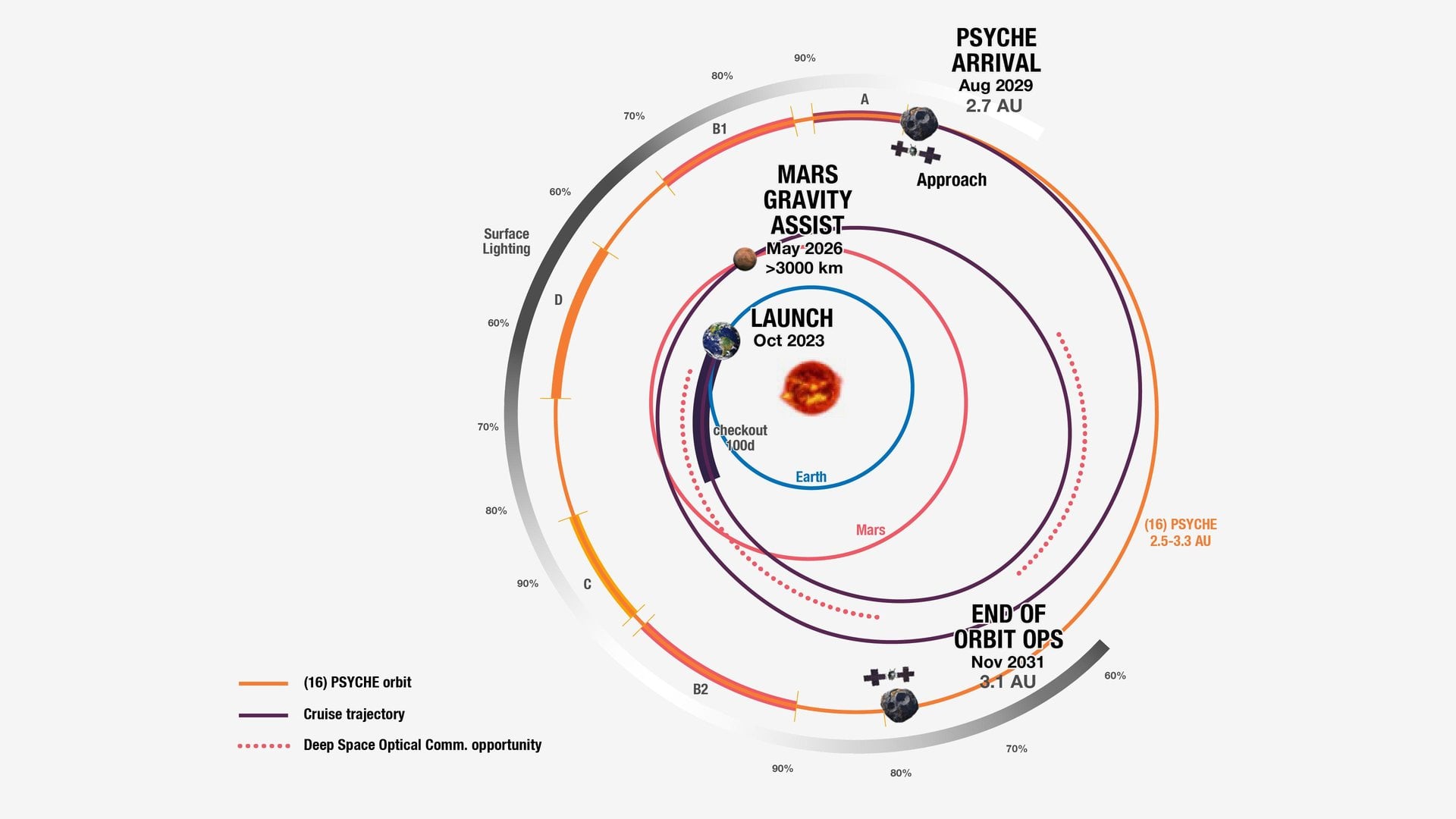 The orbital trajectory of Psyche through the inner solar system. Credit: NASA/JPL.
The mission also tested the first laser communication relay fielded beyond the Earth-Moon system. Known as the Deep Space Optical Communications (DSOC) instrument, the experiment concluded during the first two years into the mission's cruise phase, demonstrating relay capability of over 2 megabits per second from beyond Mars orbit. The experiment even relayed the first cat-video from space (!) in December 2023.
There are plans to study the slight magnetic field of Mars during the flyby using the spacecraft’s magnetometer, and conduct a ‘moon search’ as practice for hunting for moonlets surrounding 16 Psyche. The mission will arrive at asteroid 16 Psyche in August 2029.
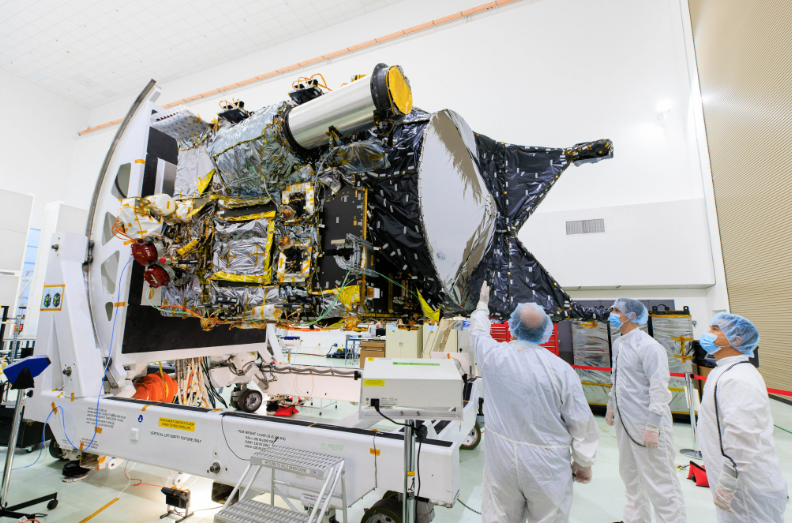 The Psyche spacecraft in the cleanroom on Earth, prior to launch. Credit: NASA/JPL.
"After Mars is the so-called 'Cruise 2' part of the mission where the spacecraft will again be using its Xenon thrusters to finalize the course to 16 Psyche," Says Bell. "Then, in summer 2029 (finally!), we will start the 'approach' phase as the asteroid goes from a tiny dot in the images to many hundreds of pixels across. We’ll be working hard to get to know the place on approach as best we can before we start orbital operations in August 2029!"
Mars is currently a tough catch, slowly emerging from the Sun’s glare in the dawn sky in the first half of 2026. That’ll soon change, as the Red Planet once again heads towards opposition on February 19th, 2027. This also means the optimal launch window for Mars is coming right up in the last half of 2026. This time around, the joint JAXA/NASA Mars Moons eXplorer (MMX) and ESCAPADE (currently loitering at the Sun-Earth L2 point) may make the trip.
It’ll be exciting to see 16 Psyche up close, but for now, we can enjoy the mission’s unique views of Mars.