Universe Today
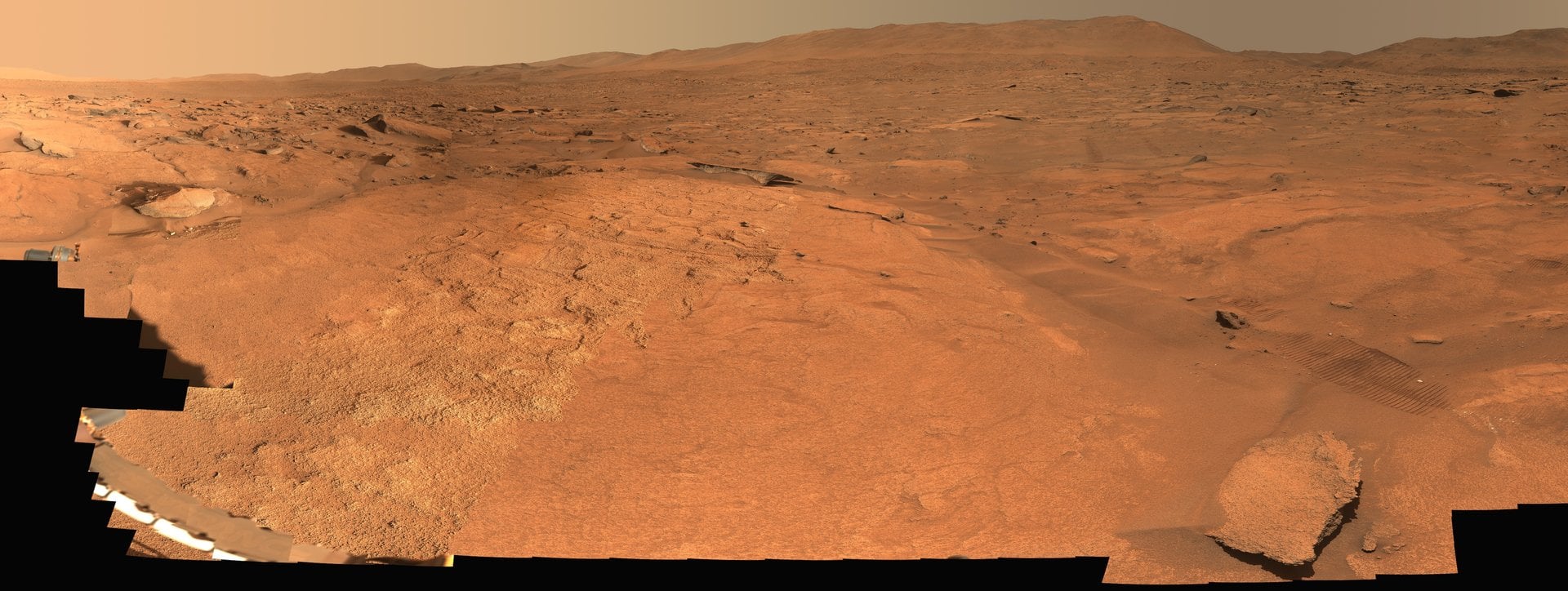
In Mars' Jezero Crater, a geologic area known as the “Margin Unit” stretches along the shoreline of a lake that filled the region billions of years ago. When the Perseverance rover reached there in September 2023, mission scientists expected to find sedimentary rocks that formed from sand deposits, which are good at preserving past microbial life. Instead, they were surprised to find olivine-rich igneous rock, which typically forms from underground magma or by volcanic activity on the surface.
These rock deposits are also excellent record-keepers, preserving details about their precise moment of formation through their mineral crystals. The minerals Perseverance detected with its SuperCam, which determines the mineralogy of geologic features based on reflected light, preserved a very complex record of water activity in the region when Mars was young. Specifically, they revealed how the rocks interacted with water on three separate occasions, each altering their chemistry and appearance.
The results were reported in the journal Communications Earth & Environment. As they indicated, Perseverance analyzed more than 185 bedrock targets across the Margin Unit using its SuperCam instrument. At high elevations of about 2350 m (~7700 ft), the rock had the texture and chemistry of slow-cooled, olivine-rich rock without significant water exposure. However, about 265 m (870 ft) lower, where the hypothesized ancient lake existed, there were signs indicating a complex history of rock-water interaction.
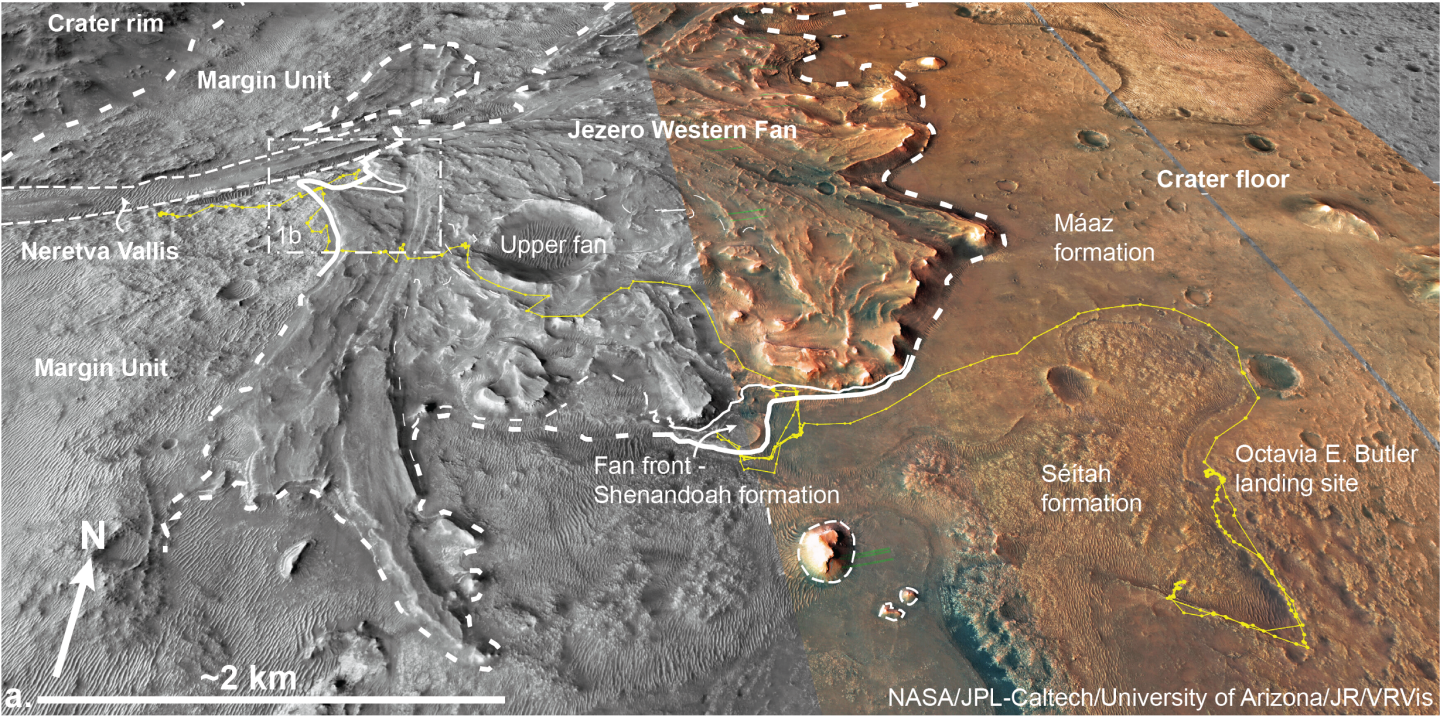 Diagram of the Jezero Crater, showing where the Perseverance rover has traversed to search for ancient biosignatures. Credit: NASA/JPL-Caltech/University of Arizona/JR/VRVis
This was especially near features like Neretva Vallis and the Western fan, the dried-up river channel that once carried water into Jezero Crater and the western part of the massive sedimentary deposits contained within (respectively). In these lakebed areas, the rocks showed signs of physical reworking, with olivine grains fractured and silica between them. As Candice Bedford, a research scientist at Purdue University and the study’s lead author, explained in a NASA press release:
Before we arrived at the Margin Unit, the main hypothesis — derived from orbital observations — was that the carbonate seen from orbit formed from interaction with the lake that existed in Jezero Crater. But now we know that this location became a sort of crossroads for aqueous systems. The Margin Unit findings are important because Jezero Crater sits inside one of the largest exposures of carbonate on Mars, so what we learn here reaches well beyond this crater.
When water interacts with olivine-rich minerals on Earth, the reaction can release hydrogen that some microbes feed on. The reaction leaves behind carbonate and silica, two minerals that are known to preserve evidence of microbes. As a result, carbonate and silica minerals are important in the search for biosignatures. From this, the team identified three main alteration periods, detailing their sequence, but not their age.
In the first, neutral to CO2-rich groundwater circulated through the bedrock, reacting with olivine to produce ridges of carbonate that run through fractures at low elevations. As the softer rock around them eroded, these carbonate rocks were left exposed. On the second occasion, the Unit was exposed to either the paleolake or changes in groundwater, which also left its mark.
“Some of the Margin Unit rocks also contain silica,” said co-author Eleni Ravanis, a planetary scientist at the University of Hawaii at Manoa. “Turning olivine into carbonate can leave silica behind, and we see more of that silica in rocks that sat below the water line.”
 Jezero Crater on Mars. Scientists think that the sediments in the crater may be one km deep. Image Credit: NASA/JPL-Caltech/ASU
In the final stage, warmer water flowed through younger fractures, creating fluorite-bearing, calcium-sulfate mineral veins measuring about 25 cm (10 inches) thick in the eastern part of the Unit. This finding was significant since fluorite typically forms when hot water circulates through volcanic rocks, suggesting the region experienced hydrothermal activity. This sequence of events, driven by groundwater activity and exposure to the lake, reinforces theories that the Jezero Crater may have once supported life. Said Bedford:
If there is one thing I have learned after 10 years working with Mars rovers, it is that Mars constantly throws surprises at you. It is very rare that things are as we expect them to be from orbital data. I hope this work helps reshape how scientists view the history of water in Jezero Crater and across Mars. Ultimately, I hope it helps planetary scientists reconstruct the changing climate and habitability of early Mars.
Further Reading: NASA