 Universe Today
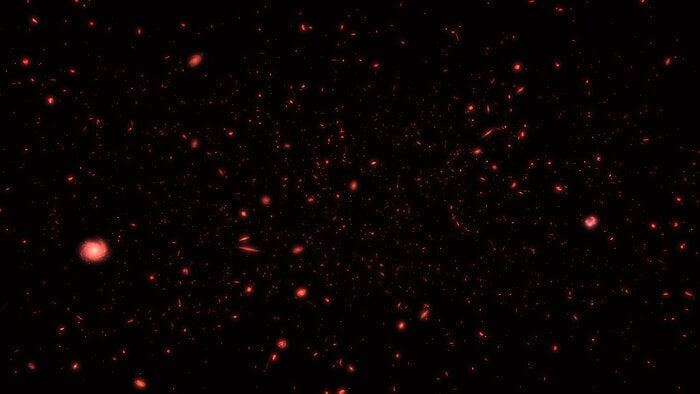
A few hundred million years after the Big Bang, the first stars ignited - literally the “let there be light” moment for the universe. Now known to astronomers as Population III, or Pop III, stars, these giants were very different from the stars we know today. They were formed out of pristine hydrogen and helium, with almost no “metal” (i.e. other elements) holding them back. They were also huge, growing to tens to hundreds of times larger than the Sun. And they died young, in many cases collapsing into the universe’s earliest black holes. Some of those black holes even partnered up, eventually colliding into one another and creating gravitational waves that, if we have instruments sensitive enough, we could potentially detect. A new study led by astrophysicist N.V. Krishnendu of the University of Birmingham and their colleagues shows just how much we can learn about them with the new suite of gravitational detectors about to come online.
Current gravitational wave observatories, such as LIGO in the US, Virgo in Italy, and KAGRA in Japan, have proven themselves very capable. They’ve detected around 400 events, with the first one only being about eleven years ago. However, they’re limited by their distance - which also means time when talking about space. Due to their limitations to high frequencies, they can only see back about 8 billion years. Still impressive, but not enough to capture any data on Pop III stars.
Enter the newcomers. Two projects are set to take over the new round of gravitational wave astrometry. Cosmic Explorer (CE), based in the US, is a planned L-shape similar to LIGO, with the “arms” stretching up to 40 km across. The Einstein Telescope (ET), on the other hand, is a planned underground facility on Sardinia, built in a 10-km triangle.
Fraser talks about gravitational waves.While these new observatories are planned to be very capable, trying to sort out what a black hole from around the beginning of the universe would look like is hard. A gravitational wave traveling from around 14 billion years ago would be stretched by a factor of 19 by the time it reached Earth due to the expansion of the universe itself. This not only causes black holes to appear more massive, but also lowers their frequency of the signal itself. For example, a pair of two 30-solar mass black holes merging back then would look to our detectors like a gigantic black hole binary weighing in at 1,100 solar masses.
This isn’t the first paper to point that out, nor is it the first to attempt to figure out how well these new detectors would do at catching these ancient mergers. Previous efforts had often relied on a mathematical model called Fisher matrices to take a guess at whether the new telescopes could figure out the properties of a very early black hole merger. The new paper, on the other hand, modeled a realistic set of Pop III stars and used Bayesian supercomputer simulations to test how well a combination of the ET and CE could figure out the properties of mergers occurring more than 13.54 billion years in the past.
It all comes down to frequency. The researchers modeled two detectors - one that could measure vibrations at 10 Hz and a more ambitious one that could get down to 5 Hz. While a five Hz difference might sound small, for gravitational waves it's massive. A detector capable of 10 Hz could only detect the final seconds of an “inspiral” - the death spiral where the two black holes end up essentially touching and vibrating together, known as the “ringdown”. A 5 Hz detector, on the other hand, could catch part of the inward spiral early enough to trace several full orbital cycles, before they rammed into each other - a massive difference in terms of understanding the properties of these mergers, and allowing astronomers to make sure they don’t confuse these distorted primordial beacons for more mundane, nearby black holes.
Fraser talks more about the current crop of GW detectors.Another up-side to these simulations are that the detectors appear to be able to measure the physical mass of these ancient black holes to within around 12% of their actual physical weight. That feature will be extremely helpful, as physicists are currently locked in a debate about why supermassive black holes existed so early in cosmic history in the first place. Cataloguing their exact weights will help scientists understand how exactly they grew so big, or whether their measurements were biased in some way.
A third feature of the simulation is the new set of detectors should be able to pinpoint the location of these merging binaries to within around 60 square degrees - at least in 60% of cases. Combining that localization with information from giant radio telescopes like the Square Kilometer Array (SKA) will allow scientists to tie together black holes and other cosmological features, such as neutral hydrogen flowing across the universe.
Admittedly, all of this potential science relies on two as-yet-unbuilt detectors in very different parts of the world. Each represents a set of engineering challenges that have yet to be overcome. But if they do, we as a species will have our first clear window into the dying breaths to the stars that gave us first light.
Learn More:
N.V. Krishnendu, P. Schmidt, & G. Pratten - Prospects for characterizing Population III remnants with next-generation gravitational-wave observatories
UT - Next Generation Gravitational Wave Observatories Could Detect 100-600 Solar Mass Black Hole Mergers
UT - Here's Why We Should Put a Gravitational Wave Observatory on the Moon
UT - Physicists Figure out how to Make Gravitational Wave Detectors "Hear" 6x More Universe

