Universe Today
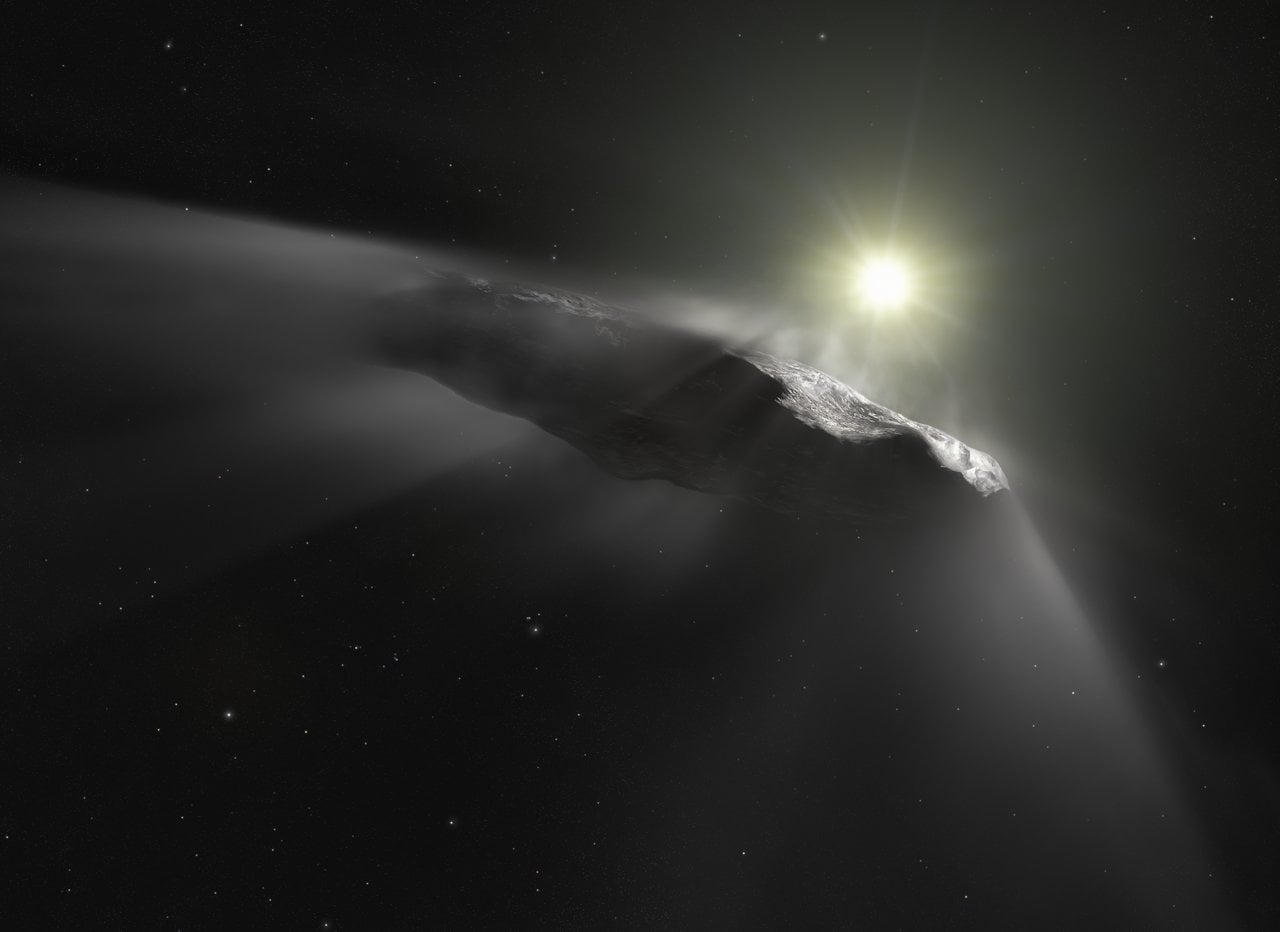
This is Part 1 of a new series on interstellar comets.
Imagine you live in a small town. Maybe it’s easy for you to imagine because you actually do. You’ve spent your whole life there. You know all the people, and all the people know you. Years go by. Decades. The same faces at the same corner store, the same routes to the same places, the same sky overhead. It’s comfortable. Predictable. You could walk the whole thing blindfolded and never trip.
And then one day a car drives through. It’s got a strange license plate. It’s not even from the next state over — it’s from across the country. Across the world. It’s from a completely different country. It doesn’t stop, doesn’t slow down. It blasts by so quickly that by the time anybody notices, it’s already on the outskirts of town (although, to be fair, except for the corner store the whole town can be considered “outskirts”).
That’s what happened to us in 2017. Our first out-of-towner came for a brief visit: the first known interstellar object detected within the solar system. Our good friend, ‘Oumuamua. And ‘Oumuamua was pretty weird. It was long and cigar-shaped — or possibly pancake-shaped, because here’s the thing: we don’t actually have a photograph of it. It was moving so fast and was so small and dim that by the time we realized what we were looking at, it was already on its way out of the solar system. All we had were brightness measurements over time, and from the way the light flickered and changed, astronomers worked out that it had to be something extremely elongated. Whether that means cigar or pancake depends on which model you trust more, and honestly, neither option is normal.
Just like a stranger blowing through town, ‘Oumuamua made us wonder: is this what all interstellar objects are like? Or was it just uniquely lonely? And if it was unique, then what were the odds that the very first time we detected an interstellar object it turned out to be a weirdo? All valid questions with no satisfying answers. We only had that one example, and last time I checked that’s not nearly enough data to draw conclusions from.
Then in 2019 we spotted another visitor, a comet named Borisov. Despite the fact that it was moving way, way too quickly to be from around here, it was otherwise an unremarkable chunk of rock and ice. If ’Oumuamua was the exotic stranger, Borisov was the out-of-towner who looked and acted pretty much like everyone else. Different zip code, same vibe.
Two visitors. One largely unlike anything else we’ve seen in the solar system. Another generally unremarkable.
And then last year, we had a new guest. The third out-of-towner to come blasting through: 3I/ATLAS. It was first spotted on July 1, 2025, caught by the Asteroid Terrestrial-impact Last Alert System (that’s the ATLAS survey) in Río Hurtado, Chile. After the discovery, astronomers dug through archival data from the Zwicky Transient Facility and found it lurking in images from a few days earlier — the astronomical equivalent of checking the security camera footage and realizing the stranger drove past once before anyone noticed.
It made its closest approach to the Sun on October 29, 2025, passing just inside the orbit of Mars. And it’s only a few hundred meters wide. Smaller than a football field.
And…ATLAS is weird again.
Like a stranger blasting through town in an exotic car, it was just plain weird. You could say that ATLAS was unlike any other comet in the entire solar system.
And you’d be right.
So what gives?
To be continued...