Universe Today
To date, astronomers have confirmed the existence of 6,324 exoplanets in 4,738 star systems, with tens of thousands awaiting confirmation. Sub-Neptunes, a class of planets that lie between Earth and Neptune in mass, are among the most common types in the exoplanet census, accounting for 2,182 confirmed discoveries. And yet, astronomers know very little about this mysterious class of planets, including what they are composed of.
In particular, scientists are interested in their interior composition. They suspect that they could have rocky interiors surrounded by hydrogen-rich atmospheres, or they could be volatile-rich with huge amounts of water and carbon-bearing molecules. Using data from the James Webb Space Telescope (JWST), a team of astronomers from Arizona State University (ASU) discovered an interesting relationship between these planets' atmospheres and the conditions deep in their interiors.
The study was led by Sagnick Mukherjee, a 51 Pegasi b Postdoctoral Fellow in ASU’s School of Earth and Space Exploration (SESE). He was joined by Matthew C. Nixon, also a 51 Pegasi b Fellow with SESE, NSF Graduate Research Fellow James Mang from the University of Texas at Austin, and researchers from NASA's Ames Research Center and the SETI Institute. Their findings were recently published in the Astrophysical Journal Letters.
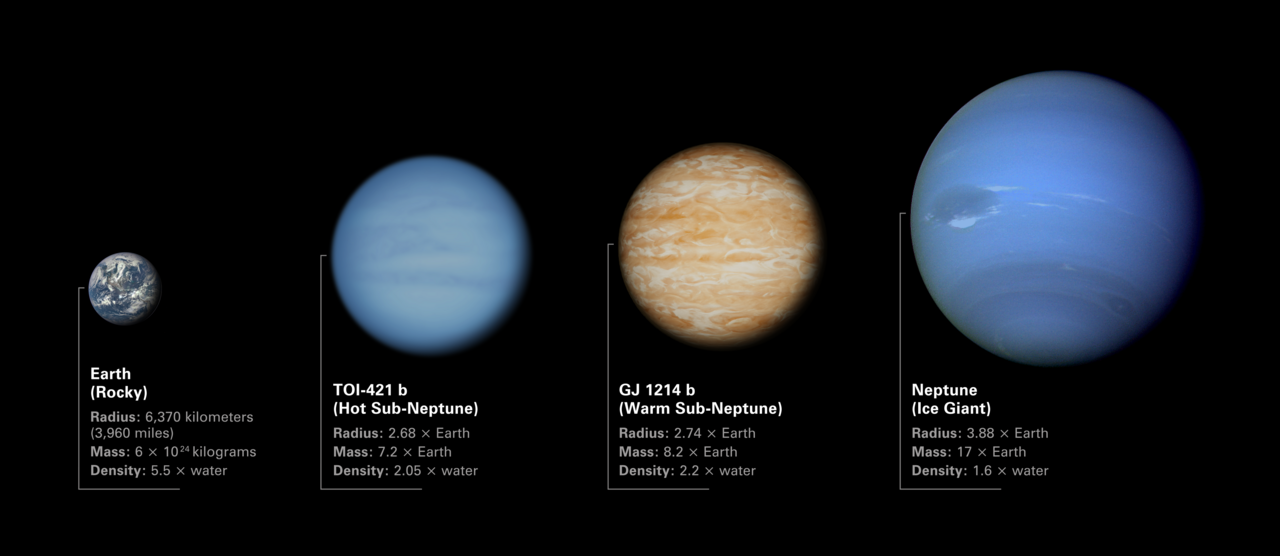 Illustration comparing the sizes of sub-Neptune exoplanets TOI-421 b and GJ 1214 b to Earth and Neptune. Credit: NASA/ESA/CSA/Dani Player (STScI))
While the JWST has the power and sensitivity to study the atmospheres of sub-Neptunes, it can only see the planets' upper atmospheres. The challenge for astronomers is to connect the upper atmosphere to the interior, a task complicated by the presence of clouds. Basically, if clouds form high in the planet's atmosphere, they can obscure the chemical makeup of what lies beneath. Using detailed computer models, Mukherjee and his colleagues determined that these clouds are actively shaping the physical conditions in the interior.
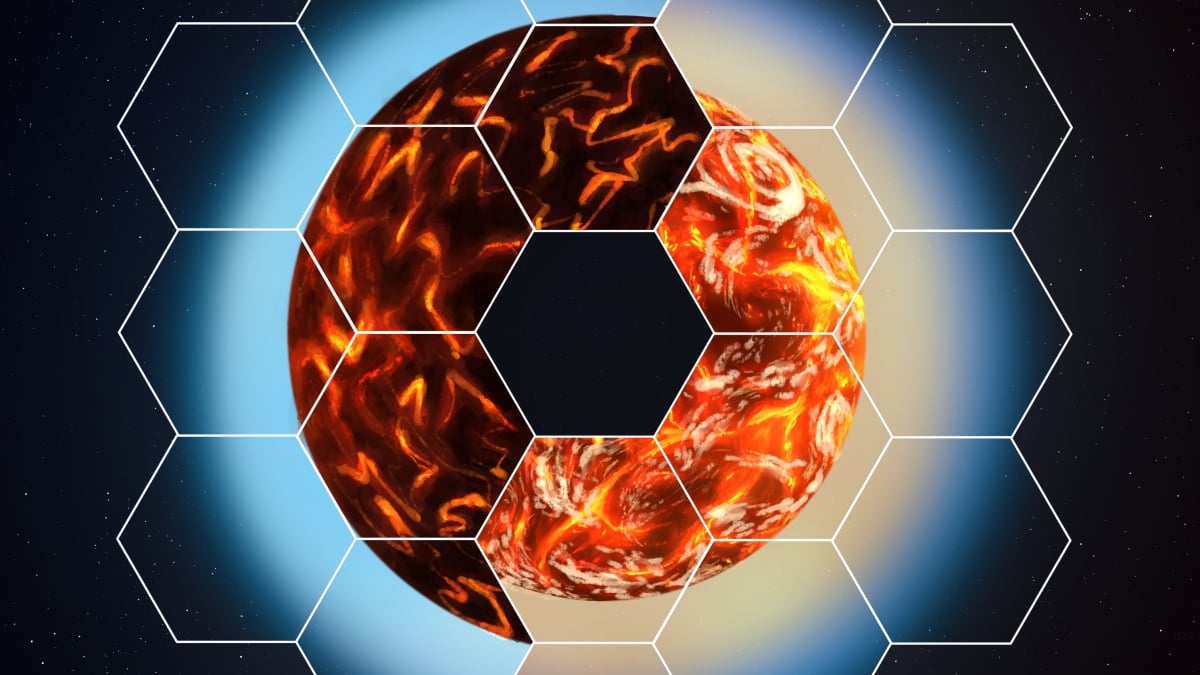
Essentially, they found that clouds composed of vaporized rocks and salts can form deep in the atmospheres of sub-Neptunes, which become a thermal blanket that traps heat in the interior. Based on their modeling, the team found that clouds can raise temperatures in the atmosphere's lower layers by more than 1,000 °C (1,832 °F) while cooling the upper layers. This temperature shift extends all the way to the boundary between the atmosphere and the underlying interior.
In particular, the team's models showed that for two sub-Neptunes, GJ 1214 b and TOI-1231 b, the added heat was sufficient to melt the rocky interior, potentially creating a magma ocean. "Among the sub-Neptunes currently being studied with JWST, we were amazed to find that cloud-driven heating can raise the temperature at the planet's atmosphere-interior boundary by roughly over 1,400 to 2,600 degrees Celsius," said Mukherjee.
As with volcanic activity on Earth, magma oceans in these planets' interiors would likely exchange gases between the rocky interiors and their outer atmospheres. The heating would trigger the release of gases (like oxygen), silicon hydride, and silicon monoxide into the atmosphere. Meanwhile, volatiles like methane, water vapor, and ammonia would be absorbed into the magma ocean. This would essentially mean the planets' atmospheres are polluted by events deep in the interior, the extent of which depends directly on how cloudy the atmospheres are.
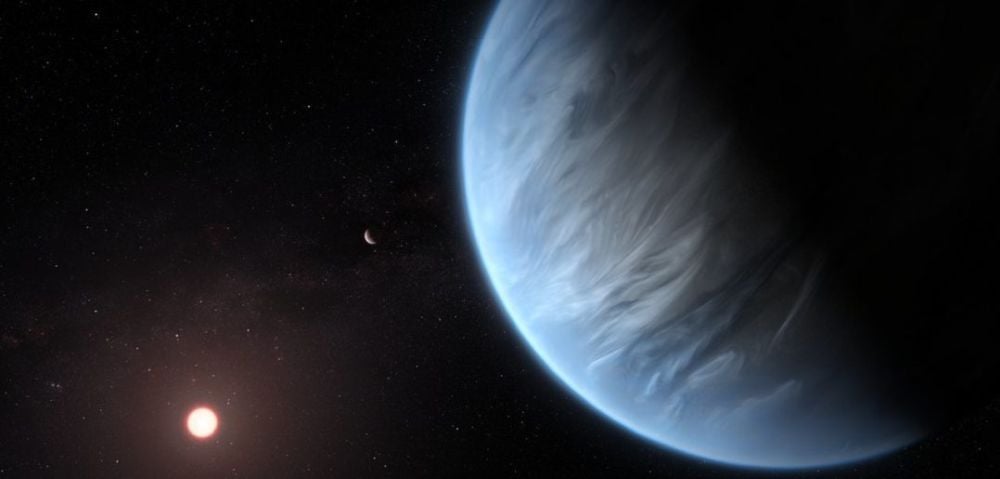 This artist's illustration shows K2-18b, which might be the most well-known sub-Neptune. Credit: ESA/Hubble/M. Kornmesser
This creates a serious conundrum for scientists interpreting JWST data. Basically, the clouds created by magma oceans could be distorting the signals that Webb receives, meaning that the chemical elements it detects in a sub-Neptune's atmosphere do not reflect the planet's overall composition. When it comes to the study of exoplanets, astronomers have traditionally viewed clouds as an obstacle, muting spectral signatures that reveal what the planet is made of.
What's more, clouds in a sub-Neptune's atmosphere drive heating and cooling patterns that reshape their interiors and influence how they contract and cool over time, affecting their current sizes and internal heat. This is especially significant given that sub-Neptunes are emerging as potential candidates for habitability (under the right conditions). To address this possibility, scientists need a clear picture of their surfaces and internal structures.
This research highlights how understanding the role of clouds in shaping the properties of the planets' interiors. "Interpreting JWST observations of sub-Neptunes is particularly challenging due to the complex relationship between the atmosphere and interior," said co-author Luis Welbanks, an assistant professor with the SESE. "This work takes us one step closer to answering the question of what these mysterious worlds are made of.
Further Reading: ASU, The Astrophysical Journal Letters